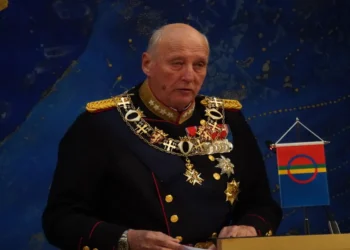
OSLO, Norway – Norway is mourning the death of King Harald V, who died Friday at the age of 89 at Oslo University Hospital, bringing to an end a reign that began in 1991. His only son, Haakon, automatically succeeded him and became King Haakon VIII.
Harald’s death marks a major transition for Norway’s constitutional monarchy. He had been Europe’s oldest reigning monarch and remained on the throne despite years of health problems, with Haakon increasingly carrying out official duties on his behalf.
A 35-year reign comes to an end
Harald became king in January 1991 following the death of his father, King Olav V. Over more than three decades, he became closely associated with a modern and increasingly inclusive Norwegian monarchy.

He was born on February 21, 1937, and spent part of his childhood outside Norway after the royal family went into exile during the German occupation of World War II. He later returned to Norway and pursued military training and higher education before becoming crown prince.
Harald was also an accomplished sailor and represented Norway at three Olympic Games. His sporting background remained an important part of his public identity throughout his life.
His marriage helped modernize the monarchy
One of Harald’s most consequential personal decisions came before he became king.
He married Sonja Haraldsen, a commoner, in 1968 after their relationship initially faced opposition because she did not come from a royal or aristocratic family.
Their marriage became an important symbol of the changing Norwegian monarchy and contributed to Harald’s image as a monarch willing to move beyond traditional royal conventions. Queen Sonja remained at his side throughout his reign.
■ Related News




The couple had two children, Princess Märtha Louise and Haakon.
Haakon automatically becomes king
Following Harald’s death, the Norwegian throne passed automatically to his son.
Haakon Magnus, 53, is now King Haakon VIII. He had served as crown prince since his father became king and had frequently assumed official responsibilities when Harald was unable to perform them because of illness.
Haakon has adopted the royal motto “All for Norway.”
He is expected to swear his oath before Norway’s parliament, the Storting, as part of the constitutional process. Norway does not hold a traditional coronation ceremony for its monarchs.
His wife, Mette-Marit, becomes queen consort.
Their daughter, Crown Princess Ingrid Alexandra, becomes the heir apparent to the throne.
Norway begins a period of mourning
News of Harald’s death brought mourners to the Royal Palace in Oslo, where citizens gathered with flowers, Norwegian flags and messages of condolence.
The king’s coffin was brought to the palace after his death, allowing members of the public to pay their respects. Churches and city halls across the country also opened spaces for people to light candles and sign remembrance books.
For many Norwegians, Harald was viewed less as a distant constitutional figure and more as a familiar national presence who had accompanied the country through decades of social and political change.
A monarch known for inclusion
Harald was particularly admired for speeches emphasizing tolerance, equality and the idea that Norwegian identity could encompass people from many different backgrounds.
His public response to national tragedies also strengthened his reputation as a compassionate figure.
During his reign, he generally avoided direct political intervention while using his ceremonial position to emphasize national unity.
That balance helped preserve broad public support for the monarchy even as other European royal families faced increasing scrutiny.
A new chapter for Norway’s monarchy
Haakon takes the throne at a moment when the Norwegian royal family faces significant public scrutiny.
Controversies surrounding members of the family have generated debate about the future of the monarchy, while Haakon’s wife and their wider family have faced intense media attention.
The new king therefore inherits both the institution his father spent decades strengthening and the challenges confronting it.
His immediate task will be to establish his own identity as monarch while maintaining the continuity associated with Harald’s reign.
Harald’s legacy
Harald leaves behind a monarchy that changed considerably during his 35 years as king.
He helped maintain the institution’s relevance while emphasizing accessibility, equality and national unity. His personal popularity became an important part of the monarchy’s relationship with the Norwegian public.
His death now closes one era and begins another.
King Haakon VIII inherits the throne automatically, but the transition represents more than a change of title. It is the first major generational change in Norway’s monarchy in more than three decades.
For a country accustomed to seeing Harald as its king for most of a generation, Norway is now entering a new royal chapter.
Key Facts
- King Harald V: 1937–2026
- Age at death: 89
- Reign: 1991–2026
- Successor: King Haakon VIII
- Haakon’s age: 53
- Queen: Sonja
- New Queen Consort: Mette-Marit
- Heir apparent: Crown Princess Ingrid Alexandra
- Royal motto of Haakon VIII: “All for Norway”
- Current status: NEW KING — NATIONAL MOURNING
Reporting Credit: Royal House of Norway – announcement of King Harald V’s death; Norwegian Parliament – constitutional succession and oath process; Norwegian government – national mourning and official response.