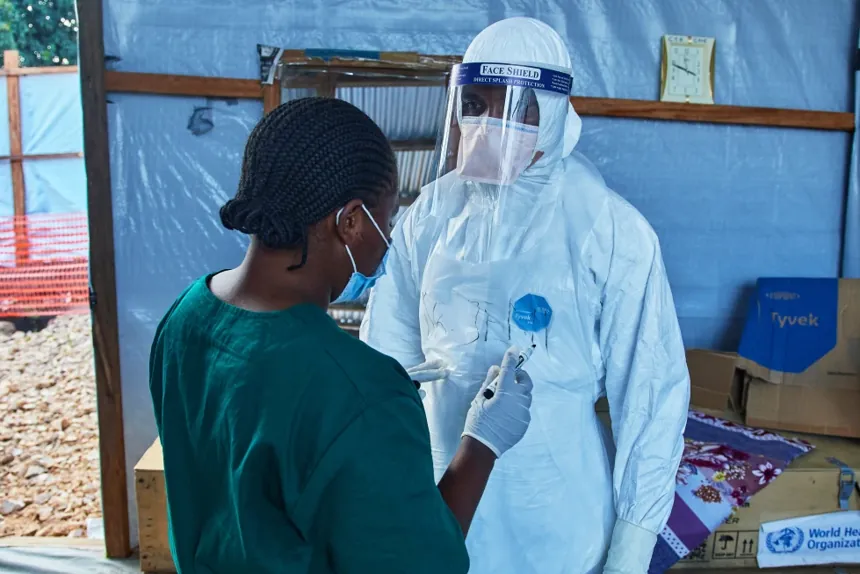
KINSHASA, Congo – The death toll from the Democratic Republic of Congo’s latest Ebola outbreak has risen to 600, while health officials investigate new suspected cases in provinces previously untouched by the virus.
The Congolese government said Thursday that suspected infections have emerged in Tshopo and Haut-Uele provinces. The development raises fresh concerns that the outbreak is spreading beyond its original epicenter in Ituri province.
The Ministry of Health said the country has recorded 1,759 confirmed Ebola cases since the outbreak began.

New suspected cases emerge
A government report released late Wednesday said authorities identified two suspected Ebola cases in Kisangani, the capital of Tshopo province.
Officials did not disclose how many suspected cases were detected in neighboring Haut-Uele.
Health authorities said one suspected patient in Tshopo had recently traveled from the Nia-Nia health zone in Ituri, where the outbreak first began.
However, the second suspected case has no apparent link to any known outbreak. Investigators are now working to determine how that person became infected.
Outbreak continues to accelerate
The Africa Centres for Disease Control and Prevention said Thursday that the current epidemic has become Africa’s fastest-growing Ebola outbreak.



Congolese authorities officially declared the outbreak on May 15. However, the World Health Organization said the virus had already been spreading for weeks before officials confirmed the outbreak.
The current epidemic involves the rare Bundibugyo strain of Ebola. At present, no approved vaccine or licensed treatment exists for that strain.
Clinical trials offer hope
Last week, researchers launched clinical treatment trials aimed at finding effective therapies against the Bundibugyo virus.
Health experts said the study could improve treatment options if future outbreaks involve the same strain.
Response faces growing obstacles
Health officials continue to face major challenges as they work to contain the outbreak.
Funding shortages have slowed the response. In addition, attacks on health facilities and ongoing armed conflict in eastern Congo have disrupted surveillance and emergency operations.
As a result, health workers have struggled to trace contacts, monitor new infections and deliver medical care in affected communities.
Authorities continue to monitor suspected cases while expanding efforts to contain the virus and prevent it from spreading into additional provinces.
This report is based on reporting by The Associated Press.
Article Topics: Ebola | Democratic Republic of the Congo | Congo Health Ministry | Bundibugyo Virus | World Health Organization | Africa CDC | Infectious Diseases | Public Health