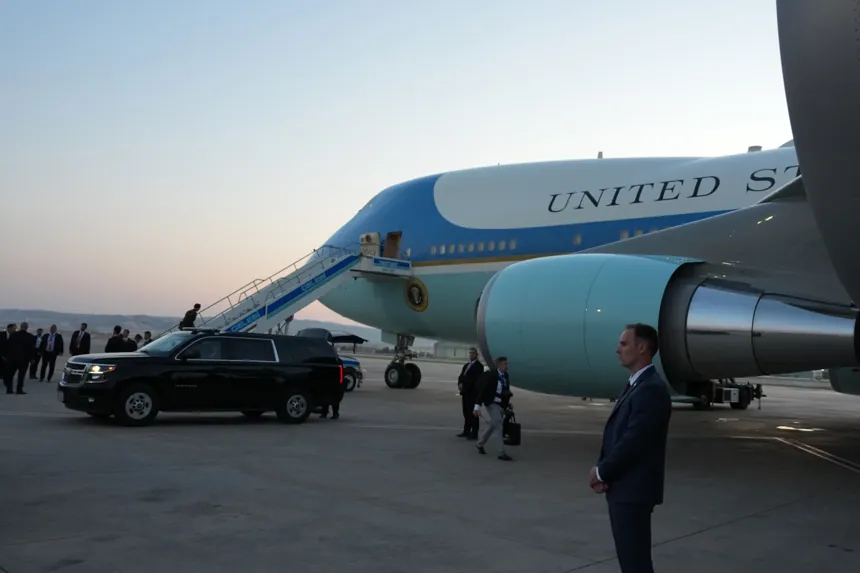
WASHINGTON – President Donald Trump unexpectedly switched from the recently retrofitted Qatari-gifted Air Force One to one of the long-serving presidential aircraft during his return from the NATO summit in Turkey, a move that drew attention as tensions between the United States and Iran intensified.
Trump flew from Turkey aboard the older Boeing VC-25A before later boarding the newer aircraft at Royal Air Force (RAF) Mildenhall in the United Kingdom for the final leg to Joint Base Andrews near Washington.
The change came shortly after the United States launched new military strikes against Iran in response to attacks on commercial shipping in the region, raising questions about whether security concerns influenced the president’s travel arrangements.

Trump, however, dismissed suggestions that the aircraft swap reflected heightened threats.
“For old time’s sake,” Trump said when explaining why he initially chose the legacy Air Force One.
He also said the stop at RAF Mildenhall allowed U.S. service members stationed there to view the new presidential aircraft and insisted the diversion added virtually no extra distance to the return journey.
Security Questions Emerge Over New Presidential Aircraft
The decision renewed scrutiny over the capabilities of the Boeing 747-800 donated by Qatar and converted for presidential use.
Photographs released since the aircraft entered service indicate it lacks some of the missile-warning and defensive countermeasure systems installed on the older VC-25A fleet that has transported U.S. presidents for more than three decades.
Asked whether the missing defensive systems influenced the decision to change aircraft, the U.S. Air Force referred questions to the White House.

White House Communications Director Steven Cheung said the aircraft incorporates extensive security protections.
“The new Air Force One is a state-of-the-art aircraft that has been fitted with high-level security protocols that ensure the safety of the President and his staff,” Cheung said in a statement.
He added that the administration employs “every tool at our disposal — including distraction and misdirection” to address security threats against the president.
Iran Tensions Coincide With Flight Changes
During the flight, Trump rejected suggestions that intelligence concerning Iran prompted the travel changes.
Asked whether he had received credible threats against Air Force One, the president replied that he remains a constant target.
“I have a threat all the time. I’m No. 1 on their list,” Trump told reporters.
Trump also suggested that instructions requiring reporters aboard the aircraft to keep window blinds closed may have been related to Iran, although he said he had not personally been asked to do so.
The flight changes occurred as Washington and Tehran exchanged new military strikes following U.S. operations targeting Iranian capabilities linked to attacks on merchant shipping.
Flight Tracking Reveals Additional Security Measures
Trump initially departed Turkey aboard one of the older presidential aircraft while public flight-tracking services temporarily lost visibility of the aircraft after takeoff because its transponder was disabled.
Such procedures are commonly used during presidential travel through high-risk areas, although they are unusual for flights departing a NATO ally hosting a scheduled summit.
By comparison, publicly available flight data showed that aircraft carrying other leaders, including those of Germany and the United Kingdom, continued broadcasting their positions.
Flight-tracking services also showed the Qatari Boeing 747-800 departed Turkey separately before landing at RAF Mildenhall, where Trump later transferred to the aircraft.
Bridge Aircraft Serves as Interim Presidential Jet
The Boeing 747-800 serves as an interim or “bridge” Air Force One while two permanently modified presidential aircraft continue undergoing conversion.
The U.S. Air Force has previously acknowledged that several advanced engineering modifications planned for the permanent fleet were intentionally omitted from the bridge aircraft to accelerate its delivery.
Officials have maintained that the aircraft entered service without compromising presidential safety, secure communications or operational security.
Defense aviation analyst Jeremiah Gertler of the Teal Group previously told The Associated Press that the apparent absence of some defensive countermeasures and a reduced number of communications antennas suggests the aircraft is better suited for domestic missions than operations in higher-threat environments.
Trump first traveled aboard the converted Qatari aircraft during a visit to North Dakota last week.
The existing VC-25A aircraft, introduced near the end of the Cold War, were specifically designed for presidential operations and include protection against nuclear blast effects, anti-missile defense systems, secure communications, an onboard medical facility and aerial refueling capability, although the latter has never been used while carrying a president.
Meanwhile, Boeing’s long-delayed replacement presidential aircraft remain under development and are currently expected to enter service in 2028.
This report is based on reporting by The Associated Press.
Article Topics: Donald Trump | Air Force One | Qatar Aircraft | U.S.-Iran Tensions | NATO Summit | Presidential Security | U.S. Air Force | RAF Mildenhall