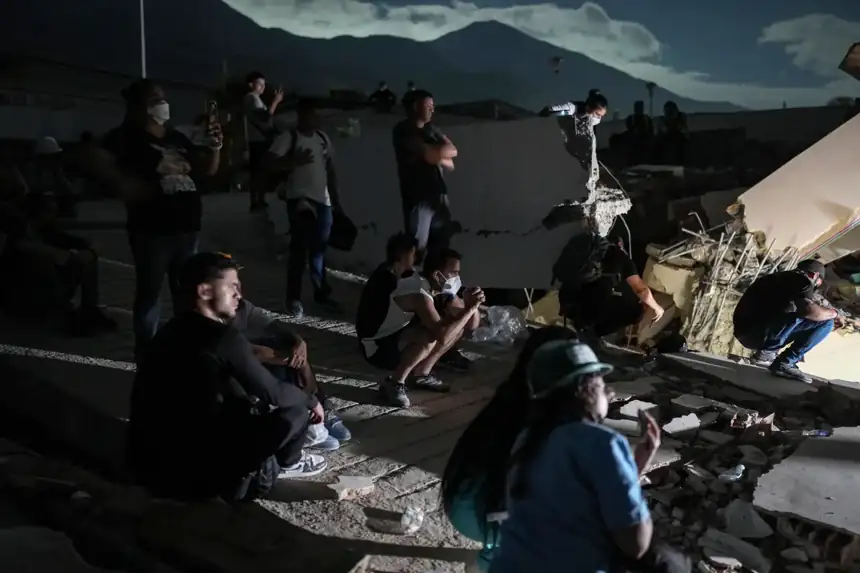
LA GUAIRA, Venezuela – Five days after devastating back-to-back earthquakes struck northern Venezuela, rescue teams and volunteers continue searching through collapsed buildings as hopes of finding more survivors diminish. At the same time, officials and humanitarian organizations are increasingly focusing on the long-term crisis facing thousands of displaced residents and communities left without essential services.
According to The Associated Press, the Venezuelan government reported that the death toll had surpassed 1,700 as emergency crews worked across the hardest-hit areas, particularly in the northern coastal state of La Guaira. Relief organizations note that the first 72 hours following a major earthquake are typically the most critical for locating survivors, although people trapped beneath debris may survive longer if they have access to food and water.
Rescue Operations Continue Amid Growing Humanitarian Needs
As search efforts entered their fifth day, concerns intensified over whether Venezuela’s financially strained government would be able to coordinate the extensive recovery and humanitarian assistance required in the coming months and years.

Authorities said a magnitude 4.6 aftershock struck Monday near the disaster zone, following more than 600 seismic events that officials said had occurred since the twin earthquakes struck the previous Wednesday.
The latest tremor was centered about 27 kilometers (17 miles) north of Caraballeda on Venezuela’s Caribbean coast, according to the United States Geological Survey. Colombia’s geological agency estimated the earthquake at magnitude 5.1.
Although officials reported no significant new damage, the aftershock prompted residents in Caracas to evacuate buildings as a precaution.
“I don’t know when we’ll have a moment of true peace,” Caracas resident Concepción Hernández said after leaving her apartment building.
Government Defends Emergency Response
Facing criticism over the pace of rescue and relief efforts, Venezuelan officials highlighted progress made since the disaster.
Jorge Rodríguez said electricity had been restored to approximately 90% of La Guaira and that engineers were continuing inspections of damaged structures that could still collapse.
He also said authorities had established 15 temporary shelters to accommodate displaced residents.
Acting President Delcy Rodríguez shared footage on social media showing emergency workers rescuing a survivor after a 43-hour search beneath collapsed buildings.
“Each life saved is a victory for hope,” she wrote.
Despite those successful rescues, many families remained gathered outside damaged buildings, waiting for news of missing relatives.
Ana Rada, whose brother remained missing, said her family continued to hold onto hope despite exhaustion and limited access to food.
International Aid Expands
Dozens of countries have offered humanitarian assistance following the disaster.
A senior U.S. State Department official said approximately 300 American first responders are participating in rescue operations, while two dozen C-17 military transport aircraft are delivering humanitarian supplies to Venezuela each day.
According to the official, U.S. assistance has now exceeded $300 million.
American military personnel are also helping repair damage at the port in La Guaira to improve maritime delivery of relief supplies. Additional teams are assisting air traffic operations after part of the control tower at Simón Bolívar International Airport was damaged in the earthquakes.
The official spoke anonymously because they were not authorized to discuss the operations publicly.
Despite the expanded relief effort, it appeared unlikely that the administration of Donald Trump would extend temporary humanitarian protections to Venezuelan nationals already living in the United States, a measure previously granted after major earthquakes in Haiti and El Salvador.
Volunteer Rescuers Fill Critical Gaps
Among those assisting rescue operations is Jean Sosa, a 31-year-old miner who said he was deported from the United States earlier this year after missing an immigration court hearing.
Sosa said he spent four years living and working in New York before being detained by immigration authorities and eventually returned to Venezuela.
Using mining tools, including a pickaxe and shovel, he joined volunteer rescue efforts in La Guaira, where he said he had helped rescue 20 survivors.
According to Sosa, volunteer rescuers initially operated with minimal equipment before larger emergency teams arrived.
“We’re working without gloves, without equipment, borrowing supplies, improvising bandages and whatever else we can,” he told The Associated Press.
He also expressed frustration over what he believed was a delayed official response, saying additional equipment during the earliest hours might have saved more lives.
Scale of Destruction Still Emerging
Authorities said more than 15,800 people had been directly affected by the disaster, while 855 buildings had either collapsed or suffered significant damage.
However, humanitarian organizations and technical experts believe the actual extent of destruction may be considerably greater.
A preliminary assessment by NASA, using radar imagery collected by the European Space Agency‘s Sentinel-1 satellites, estimated that approximately 58,870 buildings were damaged or destroyed.
The United Nations has warned that as many as 6.8 million people—nearly one-quarter of Venezuela’s population—could experience displacement or disruptions to essential services such as electricity and water.
Meanwhile, the Venezuelan Red Cross said it expects relief operations supporting at least 300,000 people to continue for two years.
Communications outages have also complicated efforts to locate missing individuals. More than 50,000 names have been entered into independent online databases created by non-governmental groups to help families search for loved ones, although officials have not confirmed how many of those individuals remain missing.
Firefighter Kleider Carrillo said the destruction exceeded anything he had encountered during his professional training.
“When you study for this profession, you’re trained for situations like this,” he said. “But what’s in textbooks is one thing. Reality is another.”
Tags: Venezuela, La Guaira, Earthquake, Humanitarian Crisis, Search and Rescue, United Nations, NASA, Venezuelan Red Cross, Delcy Rodríguez, Jorge Rodríguez, Natural Disaster, U.S. Aid