MELBOURNE, Australia – Australia and Vanuatu have signed a long-awaited security and economic agreement aimed at strengthening bilateral ties while preventing any foreign country from establishing a military base on the Pacific island nation, a move that comes as strategic competition intensifies across the South Pacific.
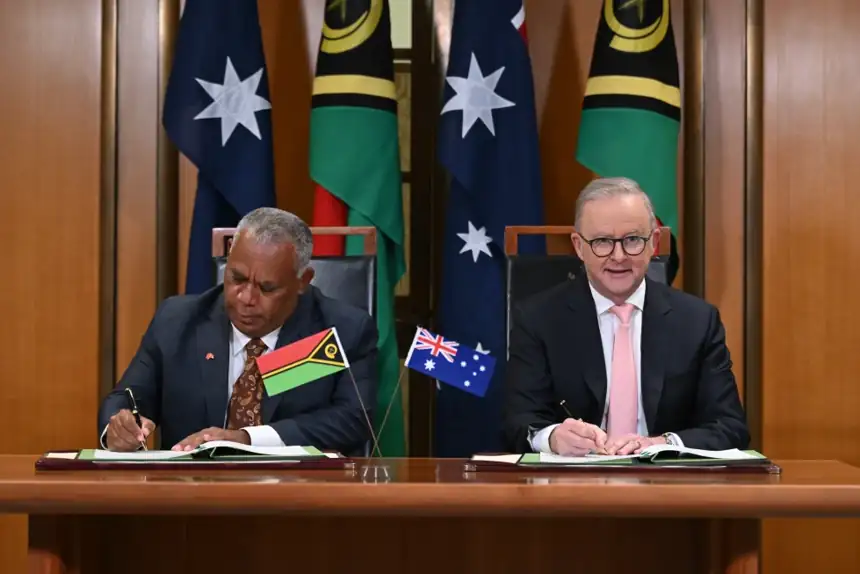
The agreement, known as the Nakamal Agreement, was signed Monday in Canberra by Australian Prime Minister Anthony Albanese and Vanuatu Prime Minister Jotham Napat. The pact follows months of negotiations after Vanuatu rejected an earlier draft last year over concerns it could limit the country’s ability to attract infrastructure investment.
“Our agreement reflects and confirms Australia’s role as Vanuatu’s largest and most comprehensive economic, security and development partner, a responsibility that we take seriously,” Albanese said following the signing.

Napat described the agreement as a reaffirmation of the two countries’ longstanding relationship.
“It reaffirms our shared commitment to continuing and strengthening the comprehensive partnership between our two countries, founded on mutual respect, trust and our common vision for a peaceful, stable and prosperous Pacific,” he said.
Agreement Restricts Foreign Military Presence
According to a joint government statement, Vanuatu has agreed not to permit any foreign military base or military infrastructure on its territory. The country also committed to protecting critical infrastructure from militarization, foreign interference, and unauthorized access.
The agreement requires Vanuatu to consult Australia before allowing third-party involvement in critical infrastructure projects. However, Canberra will not have veto authority over such decisions, a provision that had been included in an earlier proposal but was removed following negotiations.
The security pact forms part of Australia’s broader efforts to deepen partnerships with Pacific Island nations as regional powers compete for diplomatic and strategic influence.

China Raises Concerns Over the Deal
China responded cautiously to the agreement, expressing hope that regional partnerships would promote stability rather than intensify geopolitical rivalry.
Guo Jiakun, a spokesperson for China’s Ministry of Foreign Affairs, said Beijing hopes cooperation between Pacific Island countries and their partners “will contribute to the development and stability of the island region, not target any third party or be used as a tool for geopolitical rivalry.”
Although the agreement prioritizes policing cooperation between Vanuatu and fellow members of the Pacific Islands Forum, it does not prohibit cooperation with Chinese law enforcement agencies.
China currently maintains no permanent police presence in Vanuatu, though Chinese police personnel regularly visit the island nation of about 350,000 people.
Disaster Response and Development Cooperation
The pact also outlines emergency coordination measures, with Vanuatu agreeing to seek assistance first from Australia, New Zealand and France in the event of major natural disasters.
An earlier draft of the agreement proposed Australia would provide 500 million Australian dollars (approximately US$344 million) in funding over a decade. Albanese said financial details of the finalized agreement would be released by December.
Separate China Agreement Still Under Negotiation
Napat confirmed that Vanuatu continues to negotiate a separate bilateral agreement with China, known as the Namele Agreement, describing it as a comprehensive development cooperation arrangement rather than a security pact.
He said the agreement would be made public after receiving approval from Beijing.
“Currently, it’s not yet signed. We will share the agreement. There is nothing to hide,” Napat said, adding that his government remains committed to transparency and had informed Australia it would also share the Nakamal Agreement with Chinese officials.
When asked Monday whether China would likewise release details of the pending agreement, the Chinese Foreign Ministry did not provide a direct answer.
China has become a significant development partner for Vanuatu over the past decade, financing public buildings, ports, wharves and other major infrastructure projects through loans and aid.
Negotiations Follow Earlier Setback
The signing marks the successful conclusion of negotiations that stalled in September last year, when Vanuatu informed Australia only hours before Albanese was due to travel to the country that it would not approve the original draft.
Officials subsequently revised the agreement to address Vanuatu’s concerns over national sovereignty and economic flexibility, paving the way for Monday’s signing.
The finalized pact underscores Australia’s continued effort to strengthen regional partnerships while Vanuatu seeks to balance relationships with multiple international partners amid growing strategic interest in the Pacific.
Tags: Australia, Vanuatu, China, Pacific Islands, Nakamal Agreement, Namele Agreement, Anthony Albanese, Jotham Napat, Indo-Pacific Security, Foreign Policy, Regional Diplomacy, Military Bases