A hardline presidential candidate who has openly aligned himself with the political style of U.S. President Donald Trump has emerged as a leading force in Colombia’s election, reflecting growing public frustration over insecurity and setting the stage for a high-stakes runoff that could reshape the country’s political direction.
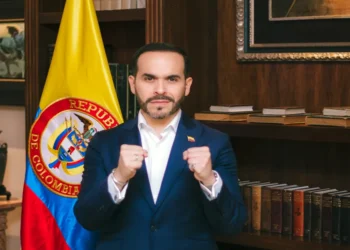
Abelardo de la Espriella, a lawyer and political outsider known for his tough anti-crime rhetoric, finished first in the initial round of Colombia’s presidential election and will face left-wing Senator Iván Cepeda in a June 21 runoff, according to official election results cited by the Associated Press and Reuters. The result marks a major challenge to the governing coalition linked to President Gustavo Petro and highlights security as the central issue in the campaign.
De la Espriella secured nearly 44% of the vote, while Cepeda received just under 41%, according to preliminary results. The unexpectedly strong performance by the conservative candidate outpaced several opinion polls and immediately shifted attention toward how voters may respond to competing visions for Colombia’s security and peace policies.

Security Becomes Defining Election Issue
The campaign has been dominated by concerns over organized crime, armed groups and rising violence in several parts of Colombia.
De la Espriella has built his campaign around promises to dismantle criminal networks through aggressive enforcement measures, including the construction of large prison complexes and the rejection of negotiations with armed organizations. In an interview with the Associated Press, he said criminals would either surrender or leave the country.
His proposals have frequently drawn comparisons to the security policies implemented by Salvadoran President Nayib Bukele, whose anti-gang crackdown has attracted support among voters across Latin America while also drawing criticism from human rights groups. Reuters reported that de la Espriella has sought to position himself as a law-and-order alternative to Petro’s security strategy.
Challenge to Petro’s “Total Peace” Strategy
The runoff is widely viewed as a referendum on President Petro’s approach toward armed conflict and criminal violence.
Petro’s administration promoted a policy known as “Total Peace,” which sought negotiations with armed groups and criminal organizations in an effort to reduce violence. Critics, including de la Espriella, argue the strategy has failed to improve security and has allowed criminal groups to expand their influence.




Cepeda, a longtime ally of Petro, has defended dialogue-based approaches while advocating social reforms and peace-building measures. His campaign now faces the challenge of attracting moderate and centrist voters before the second round.
Political Polarization Intensifies
The election result has further deepened political divisions in Colombia.
Following the vote, Petro and Cepeda questioned aspects of the election process and raised concerns about the results, though neither publicly presented evidence supporting claims of irregularities, according to reporting by the Associated Press and The Guardian. Election authorities have not reported systemic problems affecting the outcome.
De la Espriella responded by calling for vigilance ahead of the runoff and said democratic institutions should be respected. Reporting by El País indicated that he also urged international observation of the second-round vote.
Regional Political Shift Gains Momentum
Analysts cited by multiple news organizations said the Colombian election reflects broader political trends across Latin America, where concerns over crime, economic uncertainty and public security have increasingly benefited candidates advocating tougher enforcement policies.
The Associated Press described de la Espriella as a pro-Trump figure whose rise mirrors wider regional shifts away from progressive political movements. Reuters reported that several conservative leaders and political groups quickly endorsed his candidacy after the first-round results.
Financial markets also reacted positively to his lead, according to Reuters, with investors viewing his pro-business positions as potentially favorable for economic policy. However, analysts warned that Colombia’s fragmented political system could make major reforms difficult even if he wins the presidency.
Runoff Will Test Colombia’s Political Direction
The June 21 runoff is expected to focus heavily on security, economic management and the future of Colombia’s relations with international partners.
De la Espriella has portrayed the election as an opportunity to reverse the current government’s approach to crime and governance, while Cepeda argues that social investment and negotiated solutions remain necessary to address the country’s long-running conflict.
With public concern over violence remaining high and the margin between the two candidates relatively narrow, the final outcome remains uncertain. Authorities have not reported any major disruptions to the electoral process, and international observers continue to monitor developments ahead of the decisive second round.