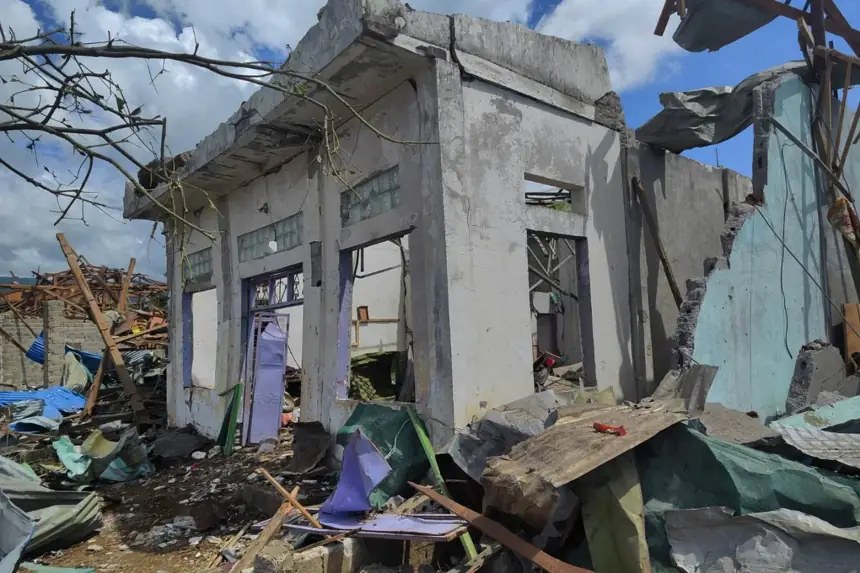
A powerful explosion at a building used to store mining explosives in northeastern Myanmar killed more than 45 people and injured dozens more on Sunday, according to rescue workers and reports cited by The Associated Press. The incident occurred in an area near the Chinese border controlled by an ethnic armed group, underscoring the continuing challenges facing communities in conflict-affected parts of the country.
The blast struck around midday in Kaungtup village, located in Namhkam township of Myanmar’s northern Shan State. The area lies roughly three kilometers from the border with China and is under the control of the Ta’ang National Liberation Army (TNLA), an ethnic armed organization that has long sought greater autonomy and has engaged in periodic clashes with Myanmar’s military.
Rescue workers reported a heavy death toll as recovery operations continued into the evening. One rescuer told The Associated Press that 46 bodies, including six children, had been recovered and transported for cremation. The same source said 74 injured people had been taken to a local hospital for treatment.

Another rescuer in the township reported that approximately 40 people were killed and that more than 100 nearby homes suffered damage from the explosion. Independent media outlets in Myanmar reported death toll estimates ranging between 50 and 55 people, although authorities had not publicly confirmed those figures.
Investigation Underway
The TNLA said in a statement released through its Telegram channel that the building contained gelignite, an explosive material commonly used in mining and quarrying operations. The group stated that the explosives had been stored by its economic department and that an investigation into the cause of the blast was underway.
Chinese state broadcaster CCTV also reported multiple fatalities and injuries, citing preliminary findings that indicated large quantities of mining explosives were being stored at the site. The broadcaster said local authorities were providing emergency assistance, medical care, and temporary support for affected residents.
While gelignite is widely used in industrial blasting operations, it can become unstable if improperly stored or handled over extended periods.
Strategic Area Near Chinese Border
The explosion occurred in a region that has experienced years of armed conflict involving ethnic organizations and Myanmar’s military government. The TNLA is part of the Three Brotherhood Alliance, a coalition of ethnic armed groups that expanded its territorial control during a major offensive launched against military forces in late 2023.
■ Related News


The alliance’s operations reshaped control across parts of northeastern Myanmar, including the Namhkam area where the explosion occurred. Although the TNLA later agreed to a China-mediated ceasefire with Myanmar’s military, tensions have remained high and security conditions continue to be fragile.
Broader Context of Instability
Myanmar has faced prolonged political and security turmoil since the military seized power from the elected government of Aung San Suu Kyi in February 2021. The takeover triggered widespread opposition, and armed resistance movements emerged across large parts of the country after peaceful protests were met with force.
The resulting conflict has fragmented authority in many regions, leaving large areas under the control of ethnic armed organizations and resistance groups. Sunday’s explosion adds to the challenges confronting communities already affected by years of conflict and instability.
Authorities have not yet announced a final casualty figure, and rescue operations were still ongoing as investigators worked to determine what caused the deadly blast.