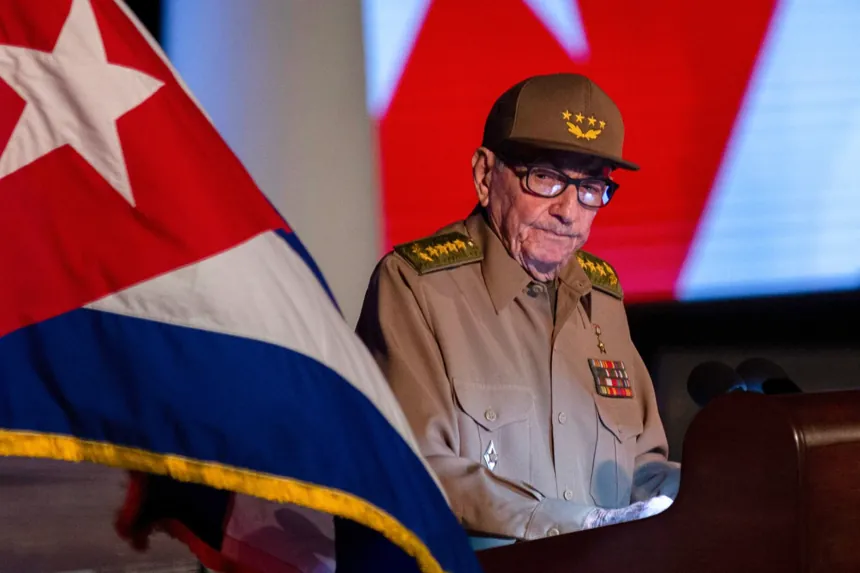
The United States has escalated pressure on Cuba by indicting former Cuban leader Raúl Castro over the 1996 shootdown of two civilian aircraft operated by the exile group Brothers to the Rescue, a move condemned by Havana as politically motivated.
Federal prosecutors in Miami announced charges against Castro and several former Cuban military officials linked to the destruction of two U.S.-registered planes that killed four people nearly three decades ago. According to Associated Press reporting, the charges include conspiracy to kill U.S. nationals, murder, and destruction of aircraft.
The indictment represents one of the most aggressive legal actions taken by Washington against a senior Cuban leader in decades and comes as the administration of Donald Trump intensifies economic and diplomatic pressure on Cuba’s communist government.

Havana Rejects Charges as Political Escalation
Cuban President Miguel Díaz-Canel strongly rejected the indictment, accusing the United States of manipulating historical events to justify hostility toward Cuba.
According to international reports, Díaz-Canel described the charges as “a political action without any legal basis” and argued that Cuba acted in self-defense after repeated violations of its airspace by anti-government exile groups. Cuban authorities maintain the aircraft were operating near or inside Cuban territorial airspace at the time of the incident.
U.S. investigators and international observers have long disputed Cuba’s version of events, concluding that the planes were shot down over international waters. The incident triggered global condemnation in 1996 and contributed to tighter U.S. sanctions on Havana through the Helms-Burton Act.
Brothers to the Rescue Case Returns to Spotlight
The indictment revives one of the most controversial episodes in modern U.S.-Cuba relations. Brothers to the Rescue, a Miami-based exile organization founded by Cuban expatriates, originally conducted humanitarian missions aimed at locating Cuban migrants attempting to cross the Florida Straits.
U.S. prosecutors allege Castro, who served as Cuba’s defense minister at the time, authorized Cuban military pilots to intercept and destroy the aircraft. Acting Attorney General Todd Blanche said the families of the victims had waited nearly 30 years for justice.
■ Related News

Analysts noted that the charges are unlikely to result in Castro’s extradition, particularly given his age and continued protection within Cuba. However, the indictment carries symbolic and geopolitical significance as Washington signals a more confrontational approach toward Havana.
Wider Regional Pressure Campaign Expands
The indictment comes amid broader tensions between Washington and Havana over sanctions, migration, and Cuba’s alliances with governments including Venezuela, Russia, and China.
According to recent reports, the Trump administration has increased economic restrictions on Cuba, including measures affecting fuel imports that have worsened blackouts and shortages across the island. U.S. officials have framed the strategy as part of a wider effort to weaken authoritarian governments in the Western Hemisphere.
Observers have also compared the case to recent U.S. actions against former Venezuelan leader Nicolás Maduro, whose removal earlier this year intensified speculation about Washington’s broader regional strategy.
Despite the indictment’s limited practical legal reach, analysts said it is likely to deepen already strained U.S.-Cuba relations while energizing anti-Castro political groups in South Florida.