More than 80 children are missing after a series of militant attacks targeting schools in Nigeria, according to local authorities and human rights groups, reviving international concern over mass abductions in Africa’s most populous country.
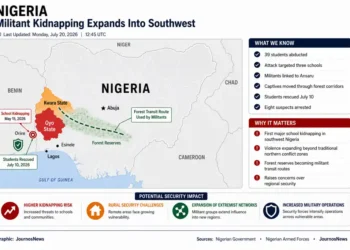
The latest assaults struck schools in northeastern Borno state and southwestern Oyo state within days of each other, highlighting the widening reach of armed groups and the continuing vulnerability of students despite years of government promises to improve security. Analysts warned that the attacks could deepen an already severe humanitarian and education crisis across parts of Nigeria.
Authorities said suspected militants abducted at least 42 children during an attack on schools in the Askira Uba and Chibok areas of Borno state, near the Sambisa Forest region long associated with the extremist group Boko Haram and its splinter faction, Islamic State West Africa Province (ISWAP). Amnesty International said the raid occurred in the village of Mussa, where armed attackers stormed schools and nearby homes.

School Abductions Spread Beyond Traditional Conflict Zones
In a separate incident, armed attackers raided two secondary schools in Oyo state in southwestern Nigeria, where school kidnappings have historically been rare. Rights groups estimated that between 40 and 48 children were abducted during the assaults, while police confirmed arrests had been made in connection with the attack.
The expansion of school attacks into southern regions has raised concerns among security experts that criminal and militant networks are adapting tactics previously concentrated in Nigeria’s conflict-ridden northwestern and northeastern regions.
Nigerian authorities said investigations are continuing to determine the exact number of missing children because some students fled during the chaos and remain unaccounted for. Witnesses told local media that several attackers arrived on motorcycles and used children as human shields during the raids.
Humanitarian Concerns Deepen
Human rights organizations warned that repeated attacks on schools are forcing families to remove children from education systems already weakened by conflict and poverty.
Amnesty International said many parents now fear sending children to school, while some families are arranging early marriages for girls in an attempt to protect them from future kidnappings. International aid groups have repeatedly described school abductions as one of Nigeria’s most damaging long-term humanitarian crises.
■ Related News


Nigeria has faced a decade-long pattern of mass school kidnappings carried out by extremist groups and armed gangs seeking ransom payments, political leverage or publicity. The issue gained global attention after Boko Haram abducted 276 schoolgirls from Chibok in Borno state in 2014, an incident that sparked the international #BringBackOurGirls campaign.
According to international reports, more than 1,500 students have been kidnapped across Nigeria in recent years as armed groups increasingly target schools in poorly secured rural areas.
Pressure Mounts on Nigerian Government
The latest attacks come as Nigeria faces escalating security threats from Islamist insurgencies, criminal gangs and communal violence across multiple regions.
President Bola Tinubu’s administration has pledged to strengthen military operations against armed groups, including Boko Haram and ISWAP militants operating around the Lake Chad Basin. However, critics argue that repeated kidnappings and attacks on civilians demonstrate continuing failures in intelligence gathering and rural security coordination.
Security analysts noted that militants often target schools because attacks generate international attention while exposing weaknesses in state authority. The incidents also threaten Nigeria’s efforts to improve literacy and economic development in regions already affected by years of conflict.
Officials said rescue operations are ongoing, though many local residents expressed skepticism over whether all missing children will be recovered safely.