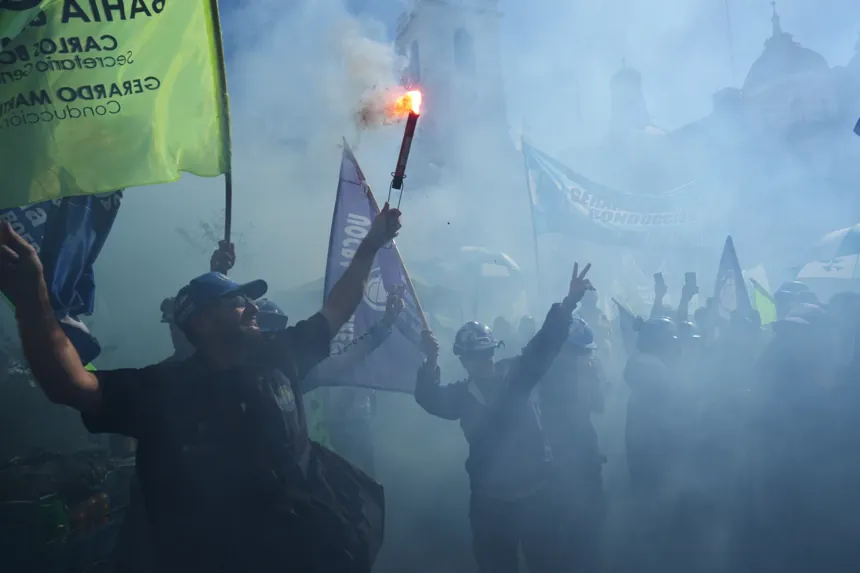
Thousands of Argentine workers took to the streets in Buenos Aires ahead of International Workers’ Day to protest President Javier Milei’s sweeping labor reforms, underscoring mounting domestic unrest with broader regional economic implications.
The demonstrations, led by the country’s largest union federation, the General Confederation of Labor (CGT), focused on opposition to new labor laws that significantly alter long-standing worker protections. The protests reflect escalating tensions as Argentina implements one of the most ambitious market-oriented reform agendas in Latin America in recent years.
Governance Pressures Rise as Labor Reforms Take Effect
Argentina’s labor overhaul, passed earlier this year, introduces measures aimed at increasing flexibility for employers, including easing hiring and firing rules, extending probation periods, and allowing longer working hours. Government officials argue the changes are necessary to reduce costs, attract foreign investment, and revive economic growth.

However, unions and opposition groups say the reforms undermine workers’ rights and weaken collective bargaining power. Reporting from The Associated Press indicates that protesters gathered to “defend decent employment,” reflecting widespread concern over declining job security and labor standards.
Analysts note that the reforms form a central pillar of Milei’s broader economic strategy, which seeks to liberalize Argentina’s heavily regulated economy following years of stagnation and high inflation.
Economic Strain Amplifies Public Discontent
The May Day protests come amid a deteriorating economic environment, with job losses and contraction in key industries fueling dissatisfaction. According to AP reporting, nearly 200,000 formal jobs have been lost since the reforms were introduced, with sectors such as manufacturing and textiles particularly affected.
Workers and union leaders argue that the reforms have intensified economic hardship rather than alleviating it, especially for lower-income households already facing rising living costs. The government has dismissed such criticism, maintaining that structural changes are necessary to stabilize the economy over the long term.
The demonstrations also reflect broader concerns about inequality and social protection, issues that resonate across Latin America as countries balance fiscal reform with public welfare.



Regional Implications for Economic Policy Direction
Argentina’s labor overhaul is being closely watched across the region as a test case for market-driven reform in a politically volatile environment. Governments facing similar economic pressures may draw lessons from the country’s experience, particularly regarding the social and political costs of rapid liberalization.
According to analysts interviewed by Financial Times, sustained unrest could complicate Argentina’s reform trajectory, potentially affecting investor confidence and slowing implementation of additional policy changes.
The protests also highlight the enduring influence of organized labor in Argentina, where unions remain a powerful force capable of mobilizing large-scale opposition.
Strategic Outlook for Reform and Stability
Despite the protests, the Milei administration has signaled it will continue pushing forward with its reform agenda, framing the changes as essential to restoring economic competitiveness.
The unfolding situation presents a critical test for Argentina’s governance stability, as authorities attempt to balance economic restructuring with social cohesion. Continued demonstrations may increase political pressure on the government to adjust or moderate its policies.
Looking ahead, the scale and persistence of labor unrest will likely shape both domestic policy decisions and international perceptions of Argentina’s economic transformation, with implications for investment flows and regional policy debates.