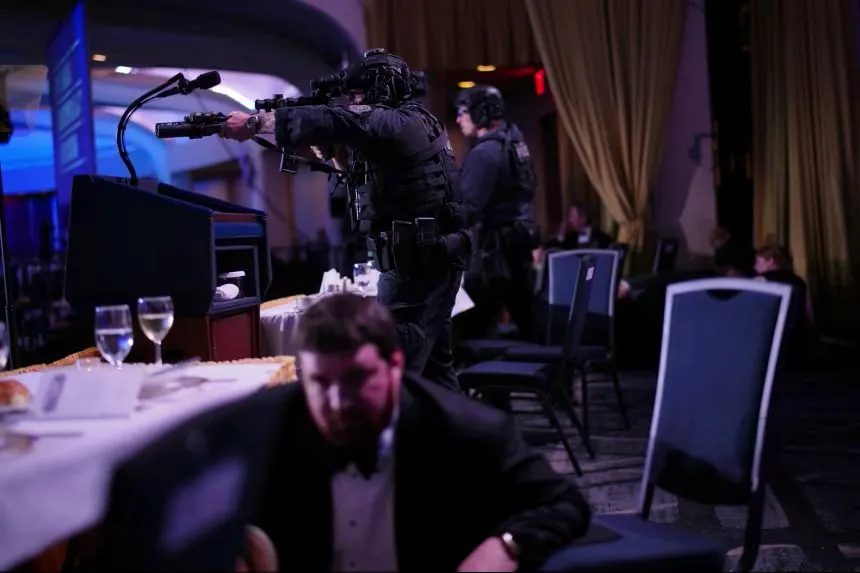
The phrase “White House dinner shooting” evokes a scenario that is both highly unusual and deeply consequential. While incidents involving violence near high-level political events in the United States remain rare, they raise fundamental questions about how security systems function, where vulnerabilities exist, and why absolute protection is difficult to guarantee.
Such events matter not only because of the individuals involved—often senior political leaders, diplomats, or public figures—but also because they test the resilience of institutions designed to safeguard democratic governance. Understanding how these incidents occur requires examining the broader architecture of security, threat detection, and operational limitations surrounding high-profile gatherings.
Introduction
Security at events involving the White House is among the most sophisticated in the world. Managed primarily by the United States Secret Service, these operations involve multiple layers of protection, including intelligence gathering, physical barriers, controlled access points, and rapid-response teams.

Despite these measures, no system is entirely impermeable. As reporting from Reuters and the Associated Press has consistently noted in coverage of security incidents, the challenge is not only preventing attacks but also managing unpredictable human behavior, evolving threats, and the logistical complexity of large gatherings.
A shooting linked to a White House dinner setting—whether within proximity or involving attendees—would therefore be understood not as a simple failure, but as a stress test of a highly complex security ecosystem.
Historical Context of Security Around Presidential Events
The United States has a long history of refining security protocols following high-profile threats or attacks. The assassinations of presidents such as John F. Kennedy and attempted attacks on figures like Ronald Reagan fundamentally reshaped how protective services operate.
According to historical analysis cited by the BBC and AP News, these events led to:
- Expansion of protective perimeters
- Increased intelligence coordination between agencies
- Greater use of surveillance technologies
- More rigorous screening of event attendees
Modern White House events, including formal dinners, now involve extensive pre-screening of guests, background checks, and physical security sweeps conducted hours or even days in advance.



Yet, history shows that attackers often exploit moments outside tightly controlled environments—transitional spaces such as entrances, nearby streets, or adjacent venues.
How White House Event Security Works
Security for a White House dinner is not limited to the building itself. It typically extends outward in concentric layers:
Inner perimeter:
Highly restricted access zone, secured by armed personnel, credential verification, and surveillance systems.
Middle perimeter:
Includes checkpoints, controlled vehicle access, and monitoring of surrounding buildings.
Outer perimeter:
Public areas where law enforcement monitors for suspicious activity, often involving coordination with local police such as the Metropolitan Police Department of the District of Columbia.
Reuters reporting on presidential security has highlighted that these layers are designed to delay, detect, and neutralize threats before they reach protected individuals.
However, a shooting incident linked to a dinner setting could occur in any of these zones—each presenting different operational challenges.
Structural Vulnerabilities in High-Profile Gatherings
Even with advanced systems, certain structural vulnerabilities persist:
1. Open Urban Environments
The White House is located in a dense urban area, surrounded by public roads, parks, and buildings. This creates unavoidable exposure points.
2. Predictability of Events
Formal dinners are often scheduled and publicly known in advance, increasing the risk of premeditated threats.
3. Human Factors
Large gatherings involve staff, guests, media personnel, and service workers. Each additional individual introduces complexity in screening and monitoring.
4. Proximity Without Access
An attacker does not necessarily need to breach the inner perimeter. Incidents occurring nearby can still create disruption, panic, or symbolic impact.
The Financial Times has noted in broader security analysis that modern threats increasingly exploit “soft edges” rather than heavily fortified centers.
The Role of Intelligence and Threat Detection
Preventing incidents relies heavily on intelligence gathering. Agencies monitor:
- Online threats and extremist rhetoric
- Suspicious travel or behavior patterns
- Known individuals with prior risk indicators
According to reporting from Bloomberg and Reuters, many potential threats are disrupted before they materialize due to intelligence coordination between federal, state, and local agencies.
However, intelligence systems face limitations:
- Not all attackers are previously known to authorities
- Some threats emerge rapidly without detectable warning signs
- False positives require careful handling to avoid unnecessary disruption
A shooting incident tied to a White House event may therefore reflect a gap not necessarily in physical security, but in predictive intelligence.
Immediate Response Protocols
If a shooting occurs near a high-level event, response protocols are activated within seconds. These typically include:
Protective relocation:
Securing and moving high-value individuals to safe zones.
Lockdown procedures:
Restricting movement within and around the venue.
Medical response:
Rapid deployment of emergency services.
Threat neutralization:
Law enforcement engages the source of the threat.
The Federal Bureau of Investigation may also become involved in investigating the incident, particularly if there are indications of broader security implications.
AP News reporting on past incidents has emphasized the speed and coordination of these responses, which are designed to contain threats even when prevention fails.
Media, Public Perception, and Political Impact
Incidents involving violence near the White House carry significant symbolic weight. Even if casualties are limited, the perception of vulnerability can have broader implications.
Media coverage tends to focus on:
- Security effectiveness
- Motives of the attacker
- Political ramifications
According to analysis frequently cited by the BBC, such events can influence public confidence in government institutions and raise questions about national security preparedness.
However, experts often caution against drawing immediate conclusions. Investigations into these incidents can take weeks or months, and early information is often incomplete or evolving.
Why Absolute Security Is Impossible
Security experts widely agree on a fundamental principle: no system can guarantee zero risk.
This is due to several factors:
- The unpredictability of human behavior
- The evolving nature of threats
- The need to balance openness with protection in democratic societies
The White House, as both a working government building and a symbolic public institution, cannot function as a completely sealed environment.
As the World Bank and other institutions have noted in broader governance analysis, democratic systems inherently involve exposure—public access, transparency, and engagement—all of which introduce elements of risk.
Broader Implications for Global Security Practices
Incidents near high-profile political events in the United States often influence security practices worldwide.
Governments may respond by:
- Reviewing event security protocols
- Increasing intelligence-sharing efforts
- Enhancing coordination between agencies
The United Nations has emphasized in various security discussions that protecting public institutions requires continuous adaptation, not static solutions.
A White House-related shooting incident would likely contribute to this ongoing evolution, prompting reassessment not only in the U.S. but also among allied nations.
Conclusion
A “White House dinner shooting” scenario illustrates the complex interplay between security systems, human behavior, and structural limitations. While protective measures around the White House are among the most advanced globally, they operate within an environment that cannot be entirely controlled.
What is known from past incidents and established reporting is that layered security significantly reduces risk and enables rapid response. What remains unresolved is how to anticipate and prevent increasingly unpredictable threats without compromising the openness that defines democratic institutions.
The issue continues to matter because it reflects a broader challenge faced by governments worldwide: maintaining security in public-facing systems where visibility, accessibility, and symbolic importance make complete insulation impossible.