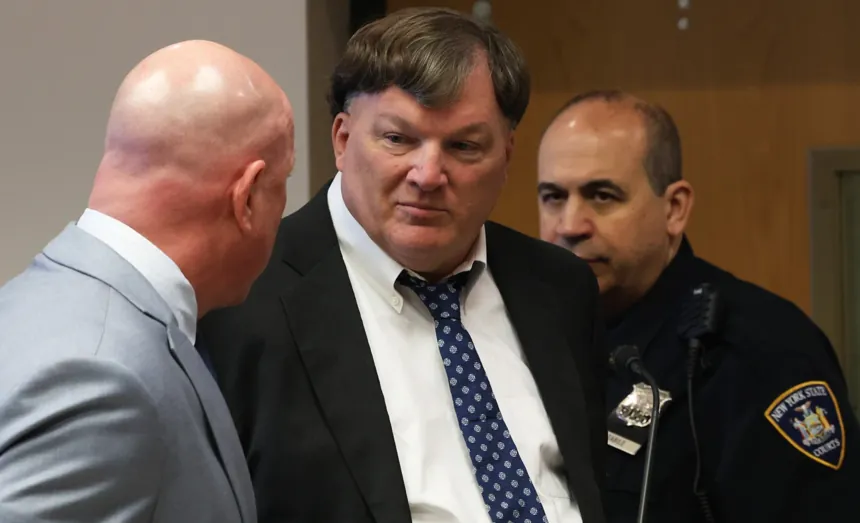
RIVERHEAD, New York — According to court proceedings in Suffolk County on Wednesday, Rex Heuermann, the Long Island architect accused in the Gilgo Beach serial killings investigation, pleaded guilty to seven murder charges and formally admitted responsibility for an eighth killing, bringing a major legal resolution to one of New York’s most closely followed homicide cases.
Heuermann, 62, entered guilty pleas to three counts of first-degree murder and four counts of intentional murder in a packed Riverhead courtroom, according to prosecutors and court statements. Authorities said he is scheduled to be sentenced in June and faces life imprisonment without the possibility of parole.
The guilty plea marks the formal court conclusion of a case that had remained unresolved for more than a decade and drew sustained public attention because of the discovery of multiple victims’ remains along Ocean Parkway near Gilgo Beach.

Charges and Legal Status
Prosecutors said the convictions cover the killings of seven women whose remains were recovered in connection with the Gilgo Beach investigation. During the plea allocution, Heuermann also admitted killing Karen Vergata in 1996, although prosecutors said that death had not been included as a charged count in the plea.
Court officials said Heuermann acknowledged strangling all eight women. Prosecutors further stated in court that some victims were dismembered before their remains were discarded in separate locations across Long Island.
The victims were killed over a span of approximately 17 years, according to the prosecution’s case timeline.
Courtroom Proceedings
Suffolk County District Attorney Ray Tierney led the questioning during the plea hearing, where Heuermann responded to the court’s factual inquiries in a direct and unemotional manner, according to reporters present.
Following the hearing, Tierney credited the Gilgo Beach Homicide Investigation Task Force and the victims’ families for the outcome, saying the case’s resolution was the result of years of investigative persistence and renewed forensic review.
■ Related News



Family members of several victims attended both the hearing and the post-court press conference. Some relatives described the plea as an important step toward legal closure after years of uncertainty.
Attorney Gloria Allred, who represents some victims’ families, said several of the women were mothers seeking income to support their children, emphasizing the long-term emotional toll on surviving relatives.
Defense and Family Statements
Defense attorney Michael Brown said the decision to plead guilty was made by Heuermann and was intended in part to spare the victims’ families and his own relatives from the burden of a lengthy trial.
Heuermann’s former wife, Asa Ellerup, attended the hearing with their daughter. Through family counsel Robert Macedonio, they said they had no prior knowledge of the killings and requested privacy.
Brown said further remarks from Heuermann may come during sentencing.
As part of the plea agreement, prosecutors said Heuermann also agreed to cooperate with the FBI’s behavioral analysis unit for academic and scientific review purposes.
Investigation Details
The Gilgo Beach killings investigation began after multiple sets of human remains were discovered along Long Island’s South Shore starting in late 2010, prompting authorities to examine whether a serial offender was responsible.
Investigators said a major breakthrough came in 2022 after a newly formed task force reexamined evidence. Detectives used a vehicle registration database to connect a pickup truck seen near the disappearance of one victim in 2010 to Heuermann.
According to investigators, additional evidence included burner phone billing records, cellphone tower data, DNA analysis, and internet search history tied to the suspect.
Authorities said one of the most significant forensic links came from DNA recovered from discarded pizza crusts collected during surveillance in Manhattan, where Heuermann worked. Prosecutors said the DNA matched evidence previously recovered from material used to bind one victim.
He was arrested in July 2023.
Court filings and investigative statements later described digital files found on his computer as operational checklists that allegedly detailed methods for controlling crime scenes, cleaning evidence, and reducing detection risk.
Background and Public Safety Context
The Gilgo Beach killings case became one of the most prominent unsolved serial homicide investigations in the United States, drawing international media attention, documentary coverage, and dramatizations, including the Netflix film Lost Girls.
The plea now closes the trial phase before it began, while leaving the case as a significant example of how renewed cold-case review, digital records, and DNA evidence can reshape long-stalled homicide investigations.