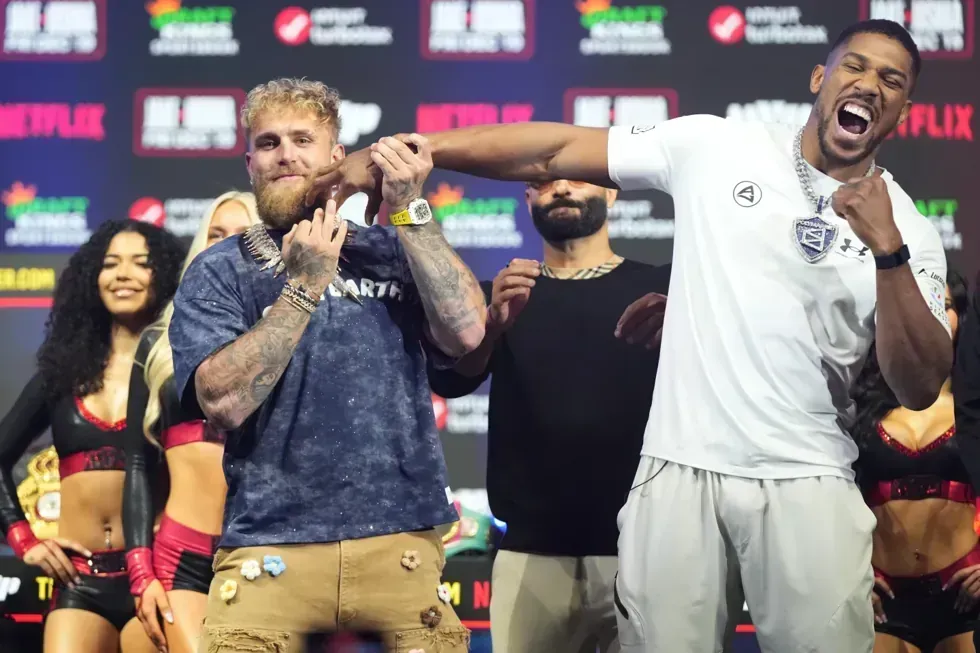
MIAMI — Jake Paul is set to face former two-time heavyweight champion Anthony Joshua on Friday at the Kaseya Center, in a bout widely regarded as a significant test of Paul’s professional boxing career and a critical moment in Joshua’s attempt to reassert his standing in the division.
The eight-round heavyweight contest, streamed globally on Netflix without a pay-per-view model, brings together two fighters from vastly different backgrounds and levels of experience. According to reporting from the Associated Press, Joshua enters as the clear favorite based on his résumé, size, and championship pedigree, while Paul seeks what he described as “the biggest upset in the history of sport.”
Heavyweight Division Stakes and Experience Gap
Joshua (28-4, 25 KOs), a former Olympic gold medalist at the 2012 London Games, has long been a central figure in the heavyweight division. However, he has not competed since September 2024, when he was stopped in five rounds by Daniel Dubois.

In contrast, Paul (12-1, 7 KOs) has built his career through a series of unconventional matchups, including bouts against retired or crossover athletes such as Anderson Silva and Nate Díaz, as well as a unanimous decision win over former middleweight champion Julio Cesar Chavez Jr.
The physical and experiential disparity is also notable. Joshua, standing 6-foot-6, holds a six-inch reach advantage and weighed 243 pounds at Thursday’s weigh-in, compared to Paul’s 216 pounds. The bout marks one of Paul’s first tests against a fully active, elite-level heavyweight competitor.
Promotion, Audience Reach, and Boxing’s Commercial Landscape
Paul has played a central role in reshaping how boxing events are marketed and consumed, leveraging his social media following and promotional company to attract global audiences.
His 2024 exhibition-style fight against Mike Tyson reportedly drew 72,300 spectators at AT&T Stadium in Texas and generated more than 100 million global views, according to figures cited in earlier reports.
Friday’s fight continues that model, with Netflix distributing the event to a global audience, signaling a shift away from traditional pay-per-view boxing economics. The card also features nine bouts, further reinforcing its positioning as a major broadcast event.
■ Related News




Clash of Narratives: Legacy vs. Disruption
Joshua has framed the fight as a defense of traditional boxing standards, acknowledging criticism surrounding his decision to face Paul.
According to the fighters’ pre-fight remarks reported by the Associated Press, Joshua emphasized his responsibility to “carry boxing” and confront what some in the sport view as a challenge to its legitimacy.
Paul, meanwhile, has positioned himself as a transformative figure in the sport, arguing that his influence and promotional reach have expanded boxing’s global audience. He also acknowledged the competitive disadvantage heading into the bout, citing disparities in experience, height, and strength.
Post-Fight Implications and Division Outlook
The result of Friday’s bout carries implications beyond a single matchup. A victory for Joshua would reinforce the established hierarchy in the heavyweight division and potentially reopen pathways toward title contention following his recent loss.
For Paul, a win over a former unified heavyweight champion would mark a significant step in his transition from influencer-driven events to legitimate high-level competition. It would also further complicate ongoing discussions within boxing governance regarding crossover fights and rankings.
Looking Ahead to Career Trajectories
Both fighters enter the bout at pivotal points in their careers. Joshua seeks to rebound from recent setbacks and reestablish momentum within the division, while Paul attempts to validate his claims as a serious competitor against elite opposition.
The outcome at the Kaseya Center is expected to influence future matchmaking decisions, promotional strategies, and the broader conversation around the evolving business model of professional boxing.