ATLANTA — Several of the most significant moments at this year’s FIFA World Cup have been shaped as much by video review and new officiating technology as by the action on the field. Updated rules, enhanced VAR protocols and connected ball technology have all played decisive roles throughout the knockout stage.
The latest example came during Argentina’s 3-1 extra-time quarterfinal victory over Switzerland. Switzerland forward Breel Embolo was sent off after a VAR review applied FIFA’s recently introduced “mistaken identity” protocol, renewing debate over how technology and revised laws are influencing matches at the tournament.
Embolo Dismissal Highlights Revised VAR Protocol
The key incident came shortly after Switzerland equalized in the second half.

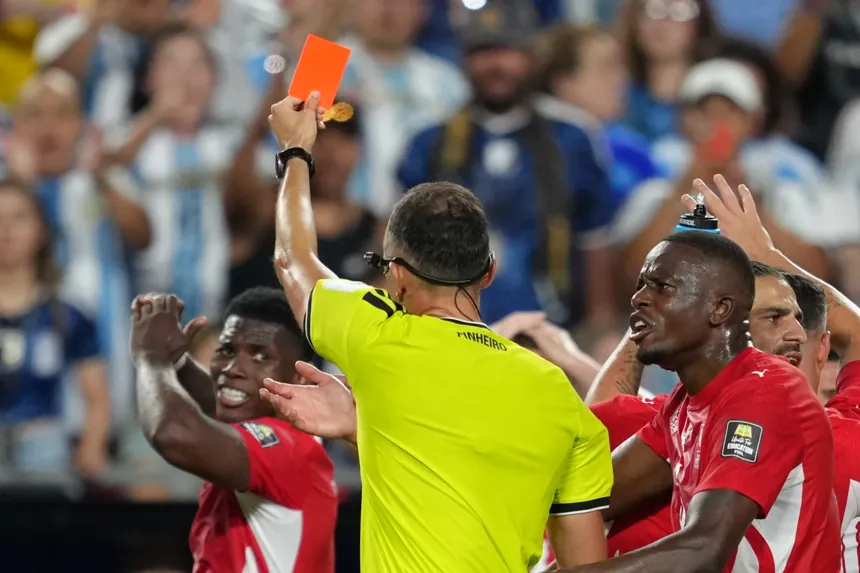
Referee João Pinheiro initially cautioned Argentina midfielder Leandro Paredes after a challenge involving Embolo. However, video review showed Embolo had simulated the foul before any contact occurred. Because Paredes had already received a yellow card, FIFA’s regulations allowed the video assistant referee to recommend an on-field review.
After reviewing the incident, Pinheiro ruled that Embolo had clearly simulated the foul. He issued Embolo a second yellow card and sent him off.
Under FIFA’s rules, VAR may intervene when the referee penalizes the wrong team for an offence that results in a yellow or red card being shown to the wrong player.
Switzerland coach Murat Yakin criticized the decision after the match, saying it changed the course of the game and contributed to his team’s elimination.
Germany Questions Stricter Foul Interpretations
Another major controversy emerged during Germany’s round-of-32 defeat to Paraguay.
■ Related News



Jonathan Tah thought he had scored a dramatic extra-time winner. However, VAR disallowed the goal after determining teammate Waldemar Anton had fouled goalkeeper Orlando Gill during the build-up.
Although replays showed only limited contact, FIFA referees committee chairman Pierluigi Collina said officials had been instructed to penalize players who block opponents without attempting to play the ball, particularly when goalkeepers are involved.
Germany eventually lost in a penalty shootout. According to The Associated Press, coach Julian Nagelsmann later resigned, with Jürgen Klopp expected to succeed him.
Connected Ball Technology Influences Croatia Exit
Connected ball technology also played a decisive role in Croatia’s elimination against Portugal.
Josko Gvardiol appeared to score a stoppage-time equalizer. However, VAR ruled the goal offside after sensors inside the match ball detected a slight touch from Croatia’s Igor Mantanovic during the attacking move.
According to FIFA, the ball’s embedded sensors collect data 500 times per second, allowing officials to detect even minimal contact that may not be visible on conventional video replay.
Croatia coach Zlatko Dalić criticized the growing reliance on technology, arguing that decisions like this reduce the enjoyment of the game.
Egypt and Norway Also Challenge VAR Decisions
Egypt also questioned VAR following its round-of-16 loss to Argentina.
Mostafa Zico had a second-half goal ruled out after officials reviewed an earlier foul on Argentina defender Lisandro Martínez. Argentina recovered from a two-goal deficit to win 3-2.
Egypt coach Hossam Hassan said his team had been treated unfairly. The Egyptian Football Association also questioned the consistency of the decisions that affected the match.
In response, Collina said FIFA’s Laws of the Game place no fixed limit on either the elapsed time or the distance between an earlier infringement and a subsequent goal during a VAR review.
Norway also disputed two decisions during its 2-1 quarterfinal defeat to England.
Players and coaches believed the ball had struck the overhead camera cable before Jude Bellingham’s equalizer, which would have required play to stop. However, FIFA said data from the connected ball sensor showed no contact with the cable.
Norway also had a goal disallowed after VAR ruled that Erling Haaland had fouled England’s Elliot Anderson before a corner kick. Under FIFA’s updated guidance, officials may review attacking fouls that occur before a corner when they directly influence the resulting play.
Technology Remains Central to Tournament Officiating
As the World Cup enters the semifinal stage, VAR protocols, connected ball technology and updated interpretations of the Laws of the Game continue to shape decisive moments alongside the performances of players on the field.
FIFA has defended both the technology and its refereeing framework. Meanwhile, several teams eliminated during the knockout rounds argue that the new systems have played a significant role in determining the outcome of their campaigns.
This report is based on reporting by The Associated Press.
Article Topics: FIFA World Cup | VAR | FIFA | Officiating | Connected Ball Technology | Sports Governance | Refereeing | Knockout Stage