The contest to succeed retiring U.S. Sen. Dick Durbin is rapidly evolving into a test of internal Democratic cohesion, as Illinois’ primary elections expose competing power centers, ideological divisions, and shifting donor influence.
According to a report by The Associated Press, former state Republican chairman Don Tracy secured the GOP nomination, setting the stage for a general election that will unfold against a backdrop of Democratic infighting rather than traditional partisan competition.
While Republicans have struggled to regain statewide footing in Illinois, the more consequential developments are emerging within the Democratic field—where competing factions are redefining the party’s direction.

Command Fractures Surface in Democratic Senate Battle
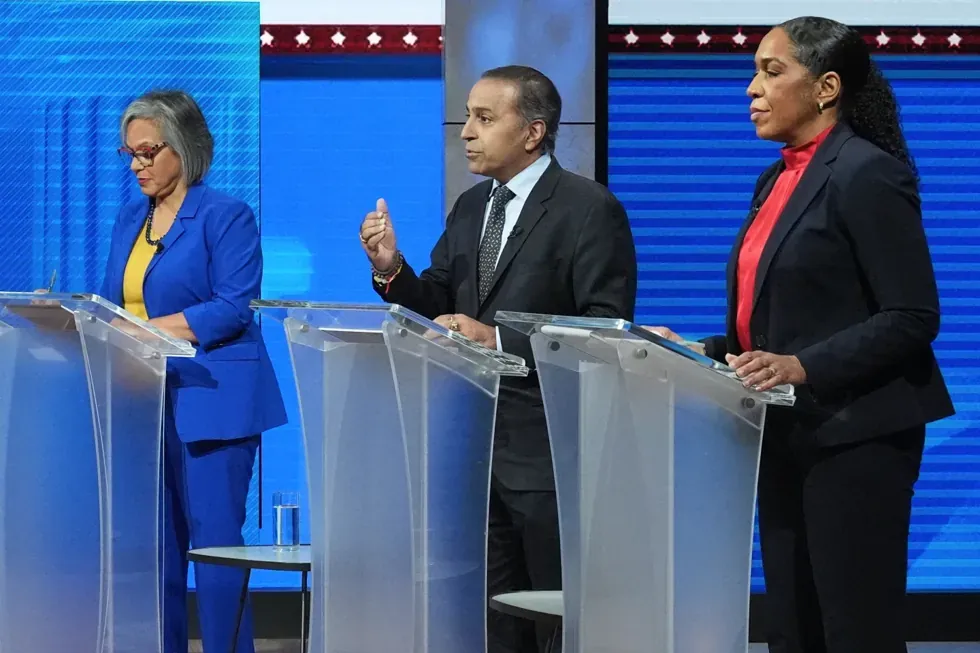
The Democratic primary to replace Durbin has drawn prominent figures, including U.S. Reps. Raja Krishnamoorthi and Robin Kelly, alongside Lt. Gov. Juliana Stratton. But rather than consolidating support, the race has highlighted divisions over policy priorities, donor alignment, and political strategy.
Stratton’s campaign, backed by Governor JB Pritzker, has taken direct aim at Krishnamoorthi’s funding sources and legislative record, signaling a deeper ideological split within the party. The governor’s financial intervention—channeling millions into supportive political action committees—has further sharpened tensions over executive influence in what is nominally a grassroots-driven primary.
Krishnamoorthi, who has dominated fundraising and early advertising, has positioned himself as a policy-focused candidate, while critics argue his donor network reflects competing interests within the party’s coalition.
This dynamic underscores a broader question: whether financial dominance or institutional backing will ultimately define Democratic leadership in a post-Durbin era.
Strategic Alliances Tested by Donor Influence and Policy Divides
Beyond candidate rivalries, the primary has exposed growing friction over the role of external funding groups. Political action committees linked to pro-Israel advocacy, cryptocurrency, and emerging technology sectors have injected significant resources into multiple races.



These financial flows have not only amplified campaign visibility but also introduced new fault lines among voters and candidates. Concerns over foreign policy alignment—particularly U.S. support for Israel—have surfaced at the voter level, reflecting a shift in grassroots priorities that candidates have been forced to address directly.
At the same time, debates over immigration enforcement and federal agencies have further polarized the field. Disputes over positions on Immigration and Customs Enforcement (ICE) have become symbolic of wider disagreements about how aggressively Democrats should pursue structural reforms.
Taken together, these issues suggest that policy alignment within the party is no longer assumed, but actively contested.
Generational Turnover Reshapes Congressional Landscape
The Senate race is unfolding alongside a wave of retirements across Illinois’ congressional delegation, particularly in the Chicago area. Multiple open House seats have attracted crowded Democratic primaries, reinforcing the sense of a broader leadership transition.
Candidates competing for these seats have similarly navigated a landscape shaped by heavy outside spending and shifting voter expectations. In several districts, endorsements tied to national advocacy groups have triggered backlash, complicating efforts to unify support.
The scale of turnover signals more than routine political change—it represents a restructuring of the state’s Democratic bench, with implications for policy direction and coalition-building at the national level.
Executive Influence Faces Quiet Resistance
Governor Pritzker’s role in the primaries has emerged as a secondary flashpoint. While his financial backing has elevated certain candidates, it has also drawn criticism from within his own party.
Opponents argue that direct involvement by a sitting governor risks undermining the independence of primary contests. Supporters, however, frame his actions as necessary to shape a competitive and strategically aligned Democratic slate.
This tension reflects a broader debate over centralized influence versus decentralized party dynamics—a theme increasingly visible in state-level politics with national implications.
Republican Positioning Remains Secondary but Strategic
Tracy’s victory in the Republican primary restores a degree of organizational clarity for the GOP, which has not held an Illinois Senate seat in over a decade. However, the party’s path to competitiveness remains narrow in a state where Democratic dominance has been consistent.
Still, Republican strategists may view Democratic fragmentation as an opening—particularly if internal divisions persist beyond the primary phase.
Outlook: Fragmentation Today, Realignment Tomorrow
As Illinois moves toward the general election, the immediate question is less about partisan balance and more about Democratic consolidation. The outcome of the Senate primary—and the resolution of intra-party disputes—will shape not only the state’s political trajectory but also its influence in national debates.
With fundraising networks, policy priorities, and leadership influence all in flux, Illinois is emerging as a case study in how dominant parties manage internal competition during periods of transition.
The resolution of these tensions will determine whether the current fragmentation evolves into renewed cohesion—or a longer-term realignment within one of the country’s most reliably Democratic states.