WASHINGTON (Journos News) – The political nerve center of the The White House is confronting an unexpected personal challenge after Chief of Staff Susie Wiles disclosed she has been diagnosed with early-stage breast cancer, a development that comes as the administration navigates a period of international tension and domestic political pressure.
Wiles, one of the most influential figures in President Donald Trump’s inner circle, announced the diagnosis Monday but signaled she intends to remain fully engaged in her role while undergoing treatment. According to reporting by The Associated Press, the 68-year-old chief of staff said she learned of the diagnosis last week and plans to continue working from the White House throughout her medical care.
The announcement immediately placed the spotlight on the resilience of the administration’s leadership structure at a moment when the presidency is facing multiple geopolitical and economic pressures.

Institutional Continuity Under Personal Strain
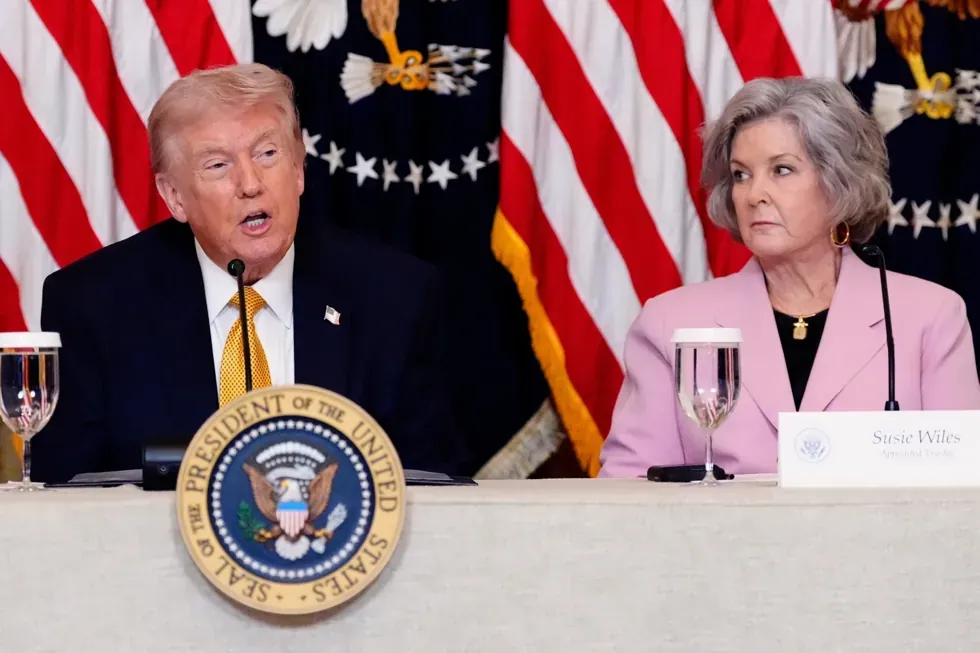
Within minutes of Trump publicly addressing the diagnosis on his Truth Social platform, Wiles appeared beside the president during a meeting of the John F. Kennedy Center for the Performing Arts board of trustees, signaling operational continuity inside the West Wing.
Trump described his chief of staff as “one of the strongest people I know,” adding that doctors expect an “excellent” prognosis.
“She will be spending virtually full time at the White House during treatment,” Trump wrote, underscoring his confidence in her continued leadership.
The immediate return to work highlighted Wiles’ central role in managing day-to-day presidential operations and coordinating policy strategy during a politically sensitive period that includes foreign policy tensions and the approaching midterm election cycle.
A Central Figure in Trump’s Political Infrastructure
Wiles’ influence within Trump’s orbit has grown steadily over the past decade. A longtime political strategist and former lobbyist based in Florida, she helped guide Trump’s 2016 campaign operations in the state and later rose to become one of his most trusted advisers.




Her appointment as chief of staff marked the first time a woman has held the position in the modern White House power structure, placing her at the center of decision-making across policy, communications and political strategy.
Despite her proximity to power, Wiles has largely avoided public visibility. That changed late last year when remarks she made in a profile by Vanity Fair generated attention inside Washington after she offered unusually candid criticism of several administration figures, including Vice President JD Vance and Attorney General Pam Bondi.
Trump publicly defended Wiles at the time, dismissing the article as a “hit piece” and reiterating his confidence in her leadership.
A Personal Diagnosis With National Visibility
The diagnosis also underscores the broader public health context of breast cancer in the United States. According to the American Cancer Society, more than 300,000 women in the country are expected to receive the diagnosis this year.
In a statement acknowledging her condition, Wiles pointed to the prevalence of the disease.
“Nearly one in eight women in the United States will face this diagnosis,” she said. “Every day these women continue to raise their families, go to work and serve their communities with strength and determination. I now join their ranks.”
Early-stage breast cancer is often treatable through surgery and follow-up therapies such as radiation, depending on the tumor’s characteristics and stage.
Leadership Stability in a High-Pressure Moment
The White House is confronting a complex geopolitical environment that includes rising energy prices and ongoing international tensions. At the same time, the administration faces domestic political scrutiny ahead of midterm elections that could reshape the balance of power in Washington.
Against that backdrop, Wiles’ decision to remain in her role sends a message of institutional continuity from inside the president’s senior advisory team.
For Trump, whose leadership style has historically relied on a tight inner circle, maintaining stability in the chief of staff position may prove particularly important as the administration navigates both political and policy challenges in the months ahead.