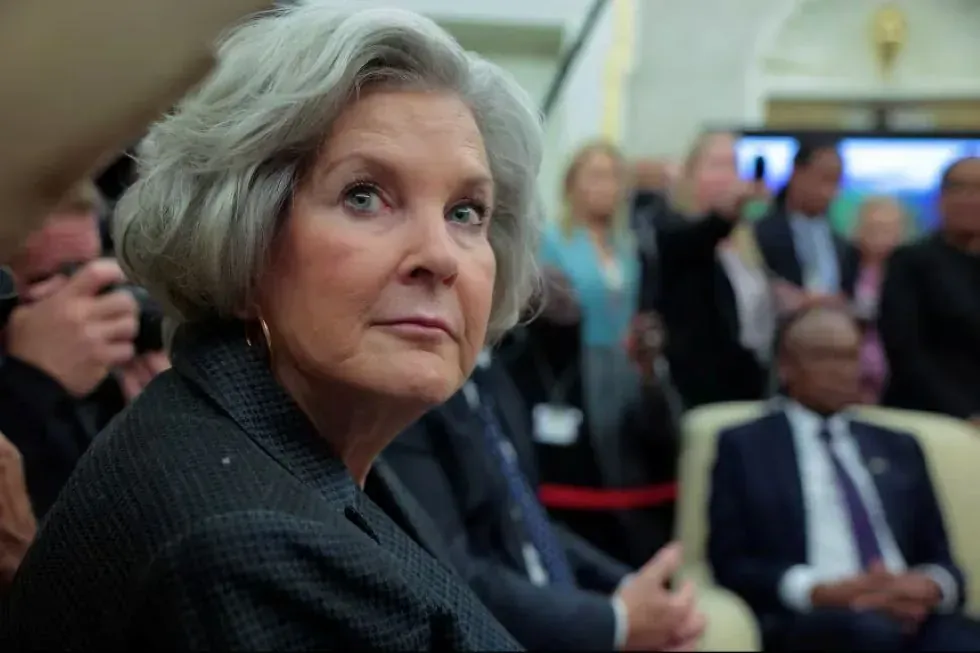
A series of unusually candid interviews from White House chief of staff Susie Wiles has triggered fresh scrutiny over internal cohesion inside the administration of Donald Trump.
Published by Vanity Fair and based on more than ten conversations with journalist Chris Whipple, the interviews revealed unusually direct assessments of the president’s leadership style, his governing instincts, and several high-profile members of his political circle.
As first reported by CNN, the remarks have reverberated through political and media circles in Washington, raising questions about internal alignment within the White House and how policy decisions are shaped behind closed doors.

The interviews, conducted over the past year, were published as part of Whipple’s book The Gatekeepers, widely regarded as a definitive examination of the White House chief-of-staff role.
Leadership Style at the Center of the Debate
Among the most widely discussed comments were Wiles’ observations about Trump’s governing personality.
Despite the president’s well-known avoidance of alcohol, Wiles suggested his approach to power reflects what she described as “an alcoholic’s personality,” explaining that highly driven personalities can become more intense under pressure.
She characterized Trump as someone who operates with a belief that there are few practical limits on presidential authority.
The president later addressed the remark in an interview with the New York Post, acknowledging that he has what he called a “possessive and addictive personality,” while praising Wiles’ performance as chief of staff and dismissing speculation about her position.

Retribution Debate Raises Questions About Governance
The interviews also shed light on one of the defining themes of Trump’s second term: the role of political retaliation in shaping government actions.
Wiles acknowledged that some critics could reasonably interpret legal actions against Trump’s opponents as vindictive. In discussing the unsuccessful prosecution of former James Comey, she conceded that observers might see elements of retribution in such moves.
“I don’t think he wakes up thinking about retribution,” Wiles said in the interviews, adding that the president is nonetheless willing to pursue opportunities for it when they arise.
The remarks have intensified debates in Washington about how the administration balances political objectives with institutional norms.
Policy Disagreements Surface Inside the Administration
Beyond personal dynamics, the interviews revealed several instances in which Wiles said the president rejected her advice on policy decisions.
Among them were disagreements over deportation practices, where she suggested the administration should more carefully avoid wrongful removals, and disputes about tariff announcements that triggered divisions among economic advisers.
She also said she urged Trump not to issue pardons to the most violent participants in the January 6 United States Capitol attack — advice that ultimately went unheeded.
These comments offer a rare glimpse into the policymaking process inside the West Wing, where the chief of staff typically operates as a gatekeeper between the president and competing factions.
Foreign Policy Signals Complicate Messaging
One of the more consequential revelations involved the administration’s posture toward Nicolás Maduro.
Wiles suggested that Trump’s strategy toward the Venezuelan government included aggressive maritime strikes aimed at forcing concessions from Caracas — remarks that appeared to diverge from official explanations offered publicly by the administration.
The comments could raise new questions in diplomatic circles about the coherence of U.S. messaging on Latin America policy.
Sharp Assessments of Allies Add to Tension
Wiles’ interviews also included blunt descriptions of several prominent figures within the administration and its broader political network.
She described Vice President JD Vance as having spent years engaged with conspiracy-theory narratives before aligning politically with Trump. Vance later responded publicly, acknowledging that he occasionally entertains conspiracy theories but defending Wiles as a loyal adviser.
The chief of staff also criticized Attorney General Pam Bondi for mishandling public expectations around documents connected to convicted sex offender Jeffrey Epstein.
And in comments about technology billionaire Elon Musk, she described him as eccentric while expressing alarm at his role in dismantling the United States Agency for International Development.
Administration Moves to Contain Fallout
Shortly after the article’s publication, Wiles pushed back against its framing in a statement posted on the social platform X.
She argued the piece had removed context from her remarks and described it as a “disingenuously framed hit piece” targeting both her and the administration.
White House press secretary Karoline Leavitt also issued a statement defending Wiles, saying the president had no more loyal adviser and that the administration remained united behind her leadership.
Whipple, however, defended the reporting in an interview with CNN’s Anderson Cooper, stating that all of the interviews were recorded and accurately reflected their context.
Internal Reactions Reveal Political Sensitivity
Inside Trump’s political orbit, the interviews have reportedly sparked intense private discussion.
According to CNN, advisers and allies circulated the remarks widely in internal group chats, with some expressing surprise at the unusually direct tone from one of the administration’s most disciplined political operators.
For many observers, the central question is not only why Wiles spoke so candidly but what the episode reveals about the internal dynamics shaping the president’s second-term agenda.
While the White House has sought to project unity, the interviews offer a rare window into how competing perspectives and personal loyalties continue to shape the administration’s governing style.