China’s leadership is closely monitoring the unfolding Iran war as the conflict raises strategic questions about energy security, global trade stability, and Beijing’s long-term geopolitical ambitions.
Although China has not yet faced immediate economic disruption, analysts say the war introduces new uncertainty for a country already navigating domestic economic pressures and an increasingly volatile international environment.
The Iran war comes as Chinese officials gather in Beijing to outline the next phase of economic policy for the world’s second-largest economy. Beijing has already lowered its annual growth target to its weakest level in decades, reflecting concerns about slowing consumption, a prolonged property sector crisis, and rising local government debt.

Against that backdrop, the instability in the Middle East — a region central to China’s energy imports and trade routes — is forcing policymakers to weigh how prolonged conflict could reshape global supply chains and Beijing’s international influence.
Energy Security Concerns Intensify
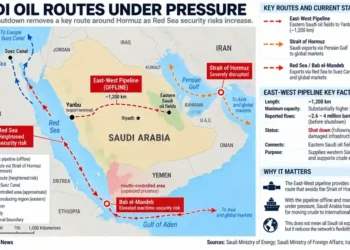
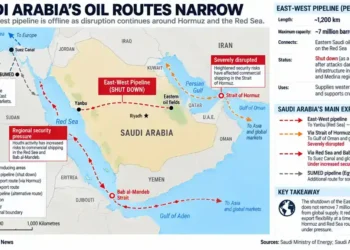
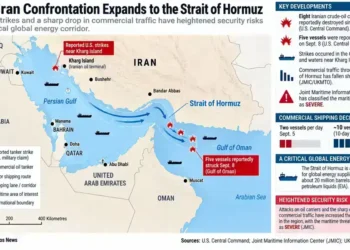
China remains the world’s largest importer of crude oil, and a significant share of those imports flows from the Middle East. Analysts warn that sustained disruption, particularly in strategic waterways such as the Strait of Hormuz, could present longer-term challenges for Beijing’s energy supply.
In the short term, China has accumulated oil reserves that could cushion immediate shocks. Additional supply from Russia could also help offset disruptions if Middle Eastern shipments decline.
Yet the scale of China’s dependence on the region makes any extended instability a strategic concern.
According to research from the Center on Global Energy Policy at Columbia University, China imported about 1.38 million barrels of crude per day from Iran in 2025, representing roughly 12 percent of its total crude imports. Much of that oil has reportedly entered China through indirect channels, sometimes relabeled through intermediary markets.

Analysts also estimate tens of millions of barrels of Iranian crude remain in floating storage in Asia or in bonded facilities at Chinese ports awaiting customs clearance.
Economic Stakes Extend Beyond the Middle East
The geopolitical ripple effects of the Iran war could extend far beyond China’s direct energy supplies.
Philip Shetler-Jones, a senior research fellow at the Royal United Services Institute, told the BBC that prolonged instability could disrupt investment flows across regions tied to China’s global economic strategy.
“A prolonged period of turmoil and insecurity in the Middle East will disrupt other regions of importance for China,” he said, noting that Gulf investment has become a critical source of capital for several African economies.
If that investment slows due to regional instability, Shetler-Jones warned, it could undermine economic stability in areas where China has expanded trade and infrastructure projects over the past decade.
Such disruptions could complicate Beijing’s broader economic agenda, particularly as China has increasingly relied on export growth and overseas investment to offset domestic economic weakness.
Strategic Limits of China’s Partnerships
The crisis has also highlighted the limits of China’s relationships with countries often described as part of its geopolitical orbit.
Iran and China signed a 25-year strategic cooperation agreement in 2021 that envisioned up to $400 billion in Chinese investment in Iranian infrastructure, energy, and industrial sectors. However, analysts say only a portion of that promised investment has materialized.
The relationship has largely revolved around energy trade rather than deep political alignment.
Professor Kerry Brown, director of the Lau China Institute at King’s College London, said the partnership is fundamentally transactional.
“There’s no real ideological or cultural reason why China would get on with Iran,” Brown said in comments broadcast by the BBC. “That’s a fragile basis for a relationship.”
China has historically avoided formal military alliances and has shown little appetite for direct involvement in overseas conflicts. As a result, Beijing has remained largely on the diplomatic sidelines during the escalating confrontation.
Diplomatic Balancing Act Emerges
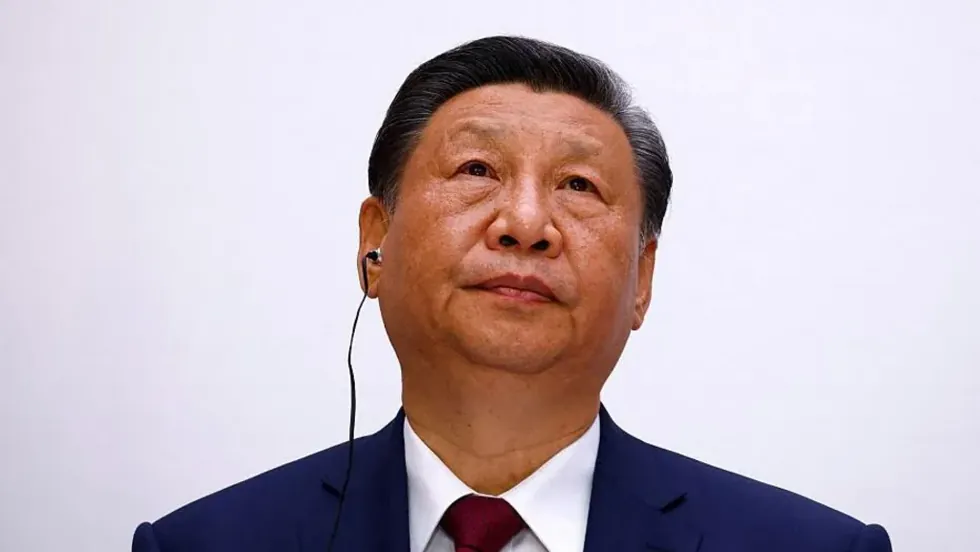
Beijing has responded cautiously to the conflict, calling for a ceasefire and urging restraint without taking a leading role in the crisis.
Chinese Foreign Minister Wang Yi criticized attacks targeting Iran, describing strikes against a sovereign state as unacceptable and warning against efforts to impose regime change.
At the same time, Chinese diplomats have begun consultations with international partners. Wang has held discussions with counterparts in Oman and France, and Chinese officials have indicated that a special envoy may be dispatched to the Middle East to support diplomatic efforts.
Observers say China is seeking to balance two objectives: portraying itself as a stabilizing international actor while avoiding entanglement in a conflict dominated by U.S. military power.
Global Power Dynamics Come Into Focus
The war has also underscored the gap between China’s economic reach and its military capacity to shape events far from its borders.
According to analysts at the Royal United Services Institute, the crisis illustrates how the United States retains unmatched ability to influence outcomes across multiple global theatres.
While Beijing has expanded its diplomatic and economic footprint worldwide, it remains reluctant to project military power in distant conflicts.
Some Chinese strategists view the crisis as an opportunity to contrast Beijing’s approach with Washington’s foreign policy. Analysts at the SOAS China Institute say Chinese officials are likely to frame the conflict as evidence of instability in the Western-led international order.
Yet unpredictability in U.S. foreign policy also creates uncertainty for Beijing.
Professor Brown said Chinese leaders may be uneasy about navigating an international system shaped by an increasingly volatile relationship with Washington.
“I don’t think China wants a world dominated by the United States,” he said, “but they also don’t want one where the U.S. behaves unpredictably.”
Policy Consequences Take Shape
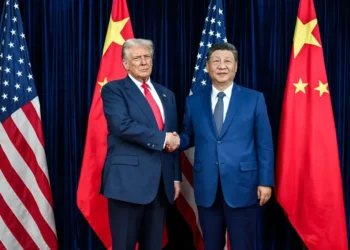
The evolving crisis is unfolding just weeks before an anticipated high-level meeting between Chinese leaders and U.S. President Donald Trump, according to Reuters. Officials from both sides are reportedly preparing discussions ahead of a planned visit later this month.
Analysts say the meeting could provide Beijing with critical insight into how Washington intends to manage future geopolitical flashpoints — including tensions surrounding Taiwan.
For China, the Iran war is becoming more than a regional conflict. It is a test of how global instability could shape the balance between economic ambition, energy security, and Beijing’s long-term strategy in an increasingly contested international order.