DUBAI, United Arab Emirates — The United States and Iran exchanged another wave of military strikes across the Middle East on Friday, targeting infrastructure, military facilities and strategic assets as fighting around the Strait of Hormuz intensified, raising fresh concerns over regional stability and global energy supplies.
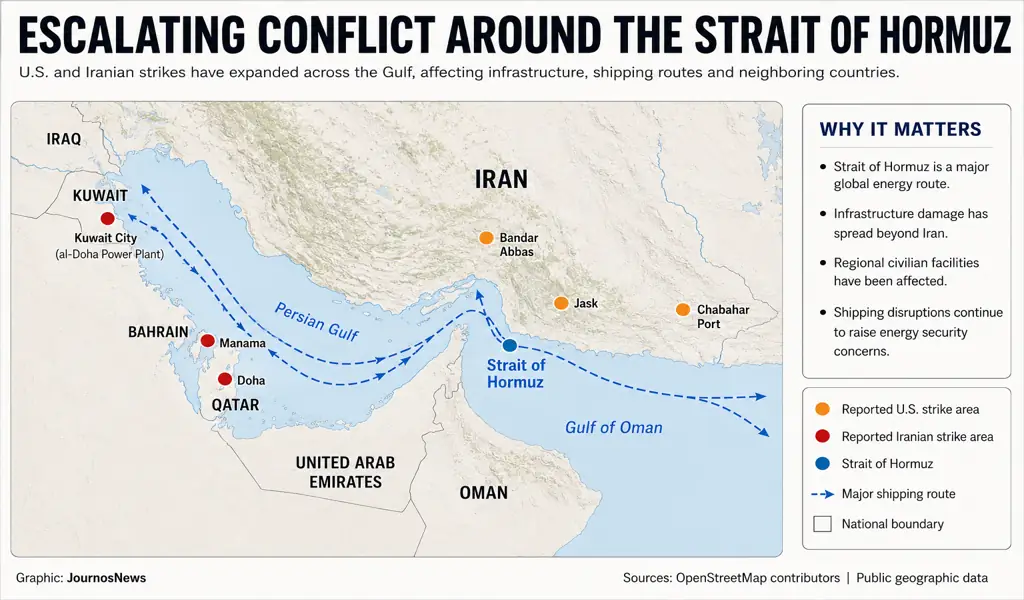
American forces struck bridges, energy infrastructure and a surveillance tower at a key Iranian port. Iran responded with missile and drone attacks targeting several U.S.-allied countries, including Qatar and Kuwait, where a power generation and water desalination plant sustained heavy damage.
The latest escalation underscores the conflict’s growing focus on the Strait of Hormuz, one of the world’s most strategically important maritime corridors. An interim ceasefire has collapsed, diplomatic efforts remain stalled and, after more than four months of fighting, there is no clear path toward renewed negotiations.

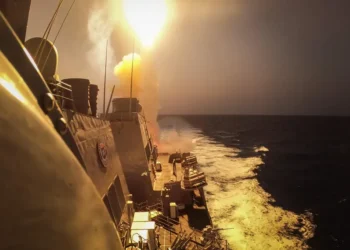
Late Friday, U.S. Central Command said American forces had completed a seventh consecutive night of operations aimed at degrading Iran’s military capabilities.
US Expands Strikes on Transport and Energy Infrastructure
Iranian state television reported that U.S. airstrikes struck several bridges in Hormozgan province overnight, including transportation links in Bandar Khamir along Iran’s southern coastline near the Strait of Hormuz.
The attacks appeared designed to disrupt road and rail connections linking Bandar Abbas, Iran’s largest commercial port, with central Iran and the capital, Tehran.
Iran’s Energy Ministry also acknowledged for the first time that U.S. strikes had damaged parts of the country’s energy infrastructure. The ministry urged residents in southern provinces experiencing extreme heat to conserve electricity but did not identify the affected facilities.
Iranian authorities said recent U.S. attacks killed at least 46 people and wounded more than 400, including eight people who died when a bridge was struck Friday. Those casualty figures could not be independently verified.
■ Related News




The U.S. military also reported that 13 additional American service members—10 Army soldiers and three Navy sailors—had been injured since Monday. U.S. officials say the conflict has now killed 14 American service members and wounded 427 others.
Port Strike Fuels Competing Narratives
U.S. Central Command said Friday’s operation targeted dozens of Iranian military sites and military infrastructure.
Among the targets was a surveillance tower at Chabahar port on the Gulf of Oman. Iran’s state-run IRNA news agency reported the structure collapsed during the strikes, a claim later acknowledged by the U.S. military.
Iran described the tower as part of its commercial maritime monitoring system. Central Command, however, said it belonged to the Revolutionary Guard’s surveillance network used to track and target commercial vessels transiting the Strait of Hormuz.
Iranian state media later reported explosions in several parts of the country, including Ahvaz in the southwest and the cities of Lar, Yazd and Sirik. Local officials confirmed strikes near Ahvaz but released few additional details.
Early Saturday, Iran’s military claimed two oil tankers exploded and caught fire while attempting to transit what it described as a mined route through the Strait of Hormuz. Iranian authorities did not provide evidence supporting the claim.
U.S. Central Command rejected the account, calling it false. Independent verification was not immediately available.
Iran Widens Retaliation Across the Gulf
Iran retaliated with missile and drone attacks targeting several U.S.-allied countries across the Gulf.
Qatar, which has continued mediating between Washington and Tehran, twice instructed residents to seek shelter as incoming missiles approached. Air defense systems intercepted the projectiles, although Qatar’s Interior Ministry said falling debris injured one child.
Iran also launched attacks against Bahrain and Kuwait.
Kuwaiti authorities said a missile strike damaged a power generation and water desalination facility, igniting a fire that emergency crews later extinguished. Officials said engineers were assessing the damage while emergency plans were activated to maintain essential services.
Kuwait depends on desalination plants for about 90% of its drinking water, underscoring the strategic importance of the damaged facility.
A spokesperson for Kuwait’s Defense Ministry also said Iranian drone attacks struck military facilities and camps, injuring an unspecified number of personnel.
Jordan’s military reported intercepting three Iranian missiles early Friday.
Explosions were also reported in Irbil and Sulaymaniyah in Iraq’s semiautonomous Kurdish region. An apparent strike targeting the Iranian Kurdish opposition group Komala killed at least nine people and injured several others, according to an Iraqi official who spoke on condition of anonymity because of security concerns. Iran did not immediately claim responsibility, although it has previously targeted the group.
Shipping Disruptions Deepen Market Uncertainty
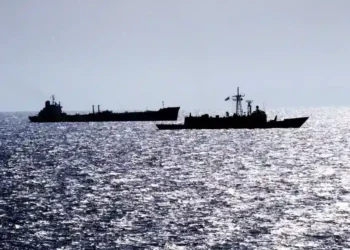
As fighting increasingly centers on the Strait of Hormuz, concern continues to grow over the security of one of the world’s busiest energy corridors.
Iran has maintained that it should exercise authority over shipping through the waterway and has proposed charging vessels to transit the strait. Most countries, however, regard the passage as an international shipping route that guarantees freedom of navigation.
President Donald Trump has repeatedly threatened to target Iranian bridges and energy infrastructure in an effort to pressure Tehran to loosen its control over access to the strait.
Commercial shipping through the waterway has been severely disrupted since the United States and Israel launched military operations against Iran on Feb. 28. The uncertainty has pushed oil prices sharply higher while increasing pressure on global energy markets.
Brent crude traded above $86 per barrel on Friday, approaching a one-month high as vessel traffic through the strait fell to a three-week low, according to MarineTraffic.
The United Kingdom Maritime Trade Operations center also reported that a tanker traveling along the route nearest Oman sustained minor damage during an attack Friday. No crew members were injured. Iran did not comment on the incident, although it has acknowledged targeting commercial vessels in recent days.
Meanwhile, the United States has reimposed a naval blockade on Iranian ports in an effort to restrict Tehran’s crude oil exports.
Diplomatic Outlook Remains Uncertain
In a nationally televised address Thursday, Trump said the military campaign was progressing as planned.
Before the conflict escalated, Washington and Tehran had been engaged in negotiations over Iran’s nuclear program. Those talks have since stalled as both sides continue expanding military operations.
With attacks intensifying across the Gulf, energy infrastructure increasingly under threat and diplomatic efforts at a standstill, regional and international officials face mounting pressure to prevent the conflict from developing into a broader and more prolonged Middle East war.
This report is based on reporting by The Associated Press.
Article Topics: US-Iran Conflict | Strait of Hormuz | Middle East Security | Oil Markets | Kuwait | Qatar | Iran