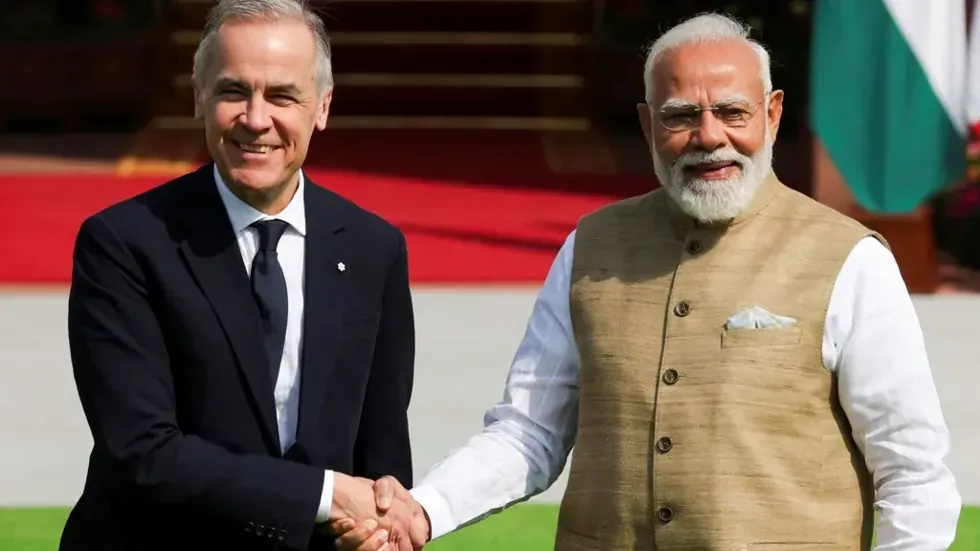
India and Canada have agreed to a 10-year civil nuclear energy partnership, marking the most significant step yet in restoring relations that nearly collapsed after a high-profile diplomatic crisis. The India–Canada nuclear energy deal was announced following talks between Prime Minister Narendra Modi and Canadian Prime Minister Mark Carney in New Delhi.
The agreement, which includes long-term uranium supply and collaboration on advanced reactor technologies, reflects a broader attempt by both governments to stabilize ties while recalibrating trade and energy strategies. Officials from both sides framed the accord as a strategic move to deepen economic cooperation at a time of shifting global alliances and heightened trade uncertainty.
Beyond energy, the leaders signaled progress toward finalizing a long-delayed comprehensive economic partnership agreement, aiming to expand bilateral trade to $50 billion and conclude negotiations by the end of 2026.

Nuclear Partnership Anchors Broader Strategic Shift
The civil nuclear agreement is central to the reset. Speaking after the meeting at Hyderabad House in Delhi, Modi said the two countries had reached a “landmark” understanding for long-term uranium supply and would cooperate on small modular reactors and advanced reactor technologies.
India, one of the world’s fastest-growing major economies, is seeking to expand its clean energy capacity while meeting rising electricity demand. Nuclear power forms part of its strategy to diversify energy sources and reduce dependence on fossil fuels. Canada, a leading uranium producer, is positioned to play a key role in fueling that expansion.
Carney said Canada would launch a strategic energy partnership with India, describing the engagement between the two governments over the past year as unprecedented compared with the previous two decades.
The nuclear accord is also politically symbolic. Cooperation in civil nuclear energy had been overshadowed by diplomatic tensions that escalated sharply in 2023.
Diplomatic Rupture Still Casts Shadow
Relations deteriorated after former Canadian prime minister Justin Trudeau publicly alleged a possible Indian link to the killing of Sikh separatist Hardeep Singh Nijjar in British Columbia. India strongly rejected the allegation.
■ Related News




The fallout was swift. Both countries expelled diplomats, visa services were suspended, and high-level contacts stalled. The episode strained ties between two Commonwealth nations with longstanding trade links and a large Indian diaspora in Canada.
Since taking office last year, Carney has pursued cautious re-engagement. His government has stated it believes India is not currently linked to violent crimes or threats on Canadian soil, although some Canadian lawmakers and members of the Sikh diaspora have continued to raise concerns.
During the Delhi visit, Canada’s Foreign Minister Anita Anand sought to temper remarks by a senior Canadian official suggesting that India had ceased all foreign interference activities. Anand told reporters she would not personally use those words, while defending renewed diplomatic engagement as necessary for progress.
The legal case involving four men charged in connection with Nijjar’s killing remains before Canadian courts.
Trade Deal Gains Urgency Amid Tariff Pressures
Economic calculations appear to be driving the reset as much as diplomacy. Both governments expressed a renewed push to finalize a comprehensive economic partnership agreement that has been discussed intermittently for more than 15 years.
Modi reiterated a target of reaching $50 billion in bilateral trade, while Carney said he aimed to conclude an “ambitious agreement” by the end of next year. Officials on both sides see diversification as critical, particularly as countries reassess exposure to trade disruptions and punitive tariffs in global markets.
India is seeking to broaden its trade relationships as it recalibrates energy imports and reduces reliance on single suppliers. Canada, meanwhile, is looking to deepen commercial ties in Asia and attract new investment flows.
Carney’s itinerary reflected that strategy. Before arriving in Delhi, he met business leaders and ministers in Mumbai to discuss investment opportunities. Following India, he is scheduled to travel to Australia and Japan as part of efforts to expand Canada’s economic footprint in the Indo-Pacific region.
Technology and Critical Minerals in Focus
The nuclear agreement is part of a wider set of understandings covering technology, critical minerals, space cooperation, defence, and education. Both leaders described their countries as natural partners in innovation and pledged to strengthen collaboration in artificial intelligence, supercomputing, and semiconductors.
Critical minerals — essential for renewable energy systems and advanced manufacturing — are likely to become another pillar of cooperation. Canada is rich in mineral resources needed for clean energy technologies, while India’s industrial expansion is increasing demand for secure supply chains.
The leaders also agreed to jointly host a renewable energy summit, signaling alignment in climate and energy transition priorities.
Strategic Recalibration Over Symbolism
The reset between Ottawa and New Delhi reflects pragmatic calculation on both sides. For Canada, re-engagement with India — the world’s most populous country and a rapidly growing economy — offers strategic depth in Asia at a time of geopolitical fragmentation. For India, improved ties with Canada enhance access to energy resources, technology collaboration, and expanded trade routes.
The diplomatic tensions of 2023 have not been erased, and unresolved legal and political sensitivities remain. But the India–Canada nuclear energy deal signals that both governments are prepared to prioritize long-term economic and strategic interests over prolonged confrontation.
As negotiations on trade and energy cooperation move forward, the durability of this reset will depend on whether diplomatic caution can coexist with expanded economic interdependence.