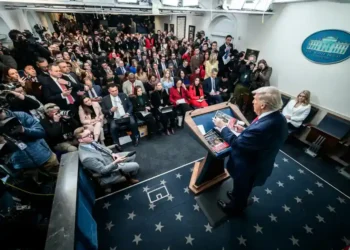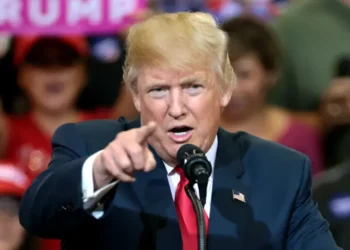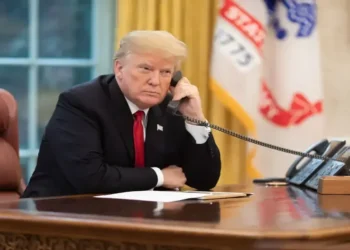
President Donald Trump delivered the longest State of the Union address in modern history on Tuesday, using the nationally televised platform to defend his economic record, criticize a recent Supreme Court ruling against his tariff policy, and issue fresh warnings to Iran.
The 1 hour and 47 minute speech unfolded before a sharply divided Congress, with visible Democratic absences and protests underscoring the deep partisan rift shaping Washington. Coming days after the Supreme Court struck down much of his global tariff program and amid rising tensions with Tehran, the address served both as a policy defense and a political rallying point.
Trump’s remarks blended celebratory language about domestic achievements with pointed attacks on critics, reflecting the high stakes facing his administration ahead of the midterm elections.

A Record-Setting Speech Focused on Economy and Iran
The Trump State of the Union address broke the previous record for length set by former President Bill Clinton, exceeding it by nearly 20 minutes. Much of the speech centered on domestic issues, including the economy and immigration.
Trump described the US economy as “roaring like never before” and asserted that the country now had “the strongest and most secure border in American history.” He argued that his administration had transformed the United States from a nation “in crisis” into what he called “the hottest country on Earth.”
On foreign policy, Trump devoted comparatively less time but delivered firm language toward Iran. He warned Tehran against pursuing nuclear weapons and claimed that at least 20,000 protesters had been killed during a recent crackdown. He also said Iran had developed missiles capable of threatening Europe and could soon reach the United States.
An Iranian foreign ministry spokesperson rejected the claims, calling them “blatant falsehoods.”
While Trump reiterated that diplomatic talks were ongoing, he did not specify what steps Washington would take if negotiations were to collapse. The ambiguity left lawmakers with few concrete signals about the administration’s next move.


Supreme Court Tensions Over Tariffs
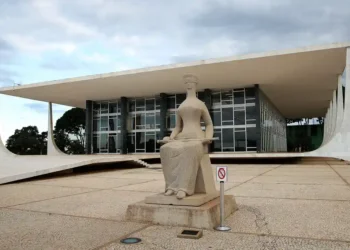
The address marked the first public appearance between Trump and members of the Supreme Court of the United States since the court struck down the bulk of his global tariffs last week, ruling that he had exceeded his authority.
Four of the nine justices attended: Chief Justice John Roberts and Justices Amy Coney Barrett, Elena Kagan and Brett Kavanaugh. As is customary, Trump shook hands with Roberts before beginning his remarks, though the exchange appeared restrained.
Later in the speech, Trump described the ruling as “disappointing” and “unfortunate,” while signaling that he would seek alternative legal pathways to implement a revised tariff regime, including a proposed 15% global rate. He stopped short of directly attacking individual justices but made clear his disagreement with the decision.
The episode highlights the continuing constitutional tension between the executive branch and the judiciary over trade authority — a core plank of Trump’s economic strategy.
Democratic Boycotts and Protests Inside the Chamber
The political divide was also visible in the chamber itself. Dozens of Democrats chose to skip the address, attending rallies in Washington instead. Rows of empty seats on one side of the aisle were visible throughout the evening.
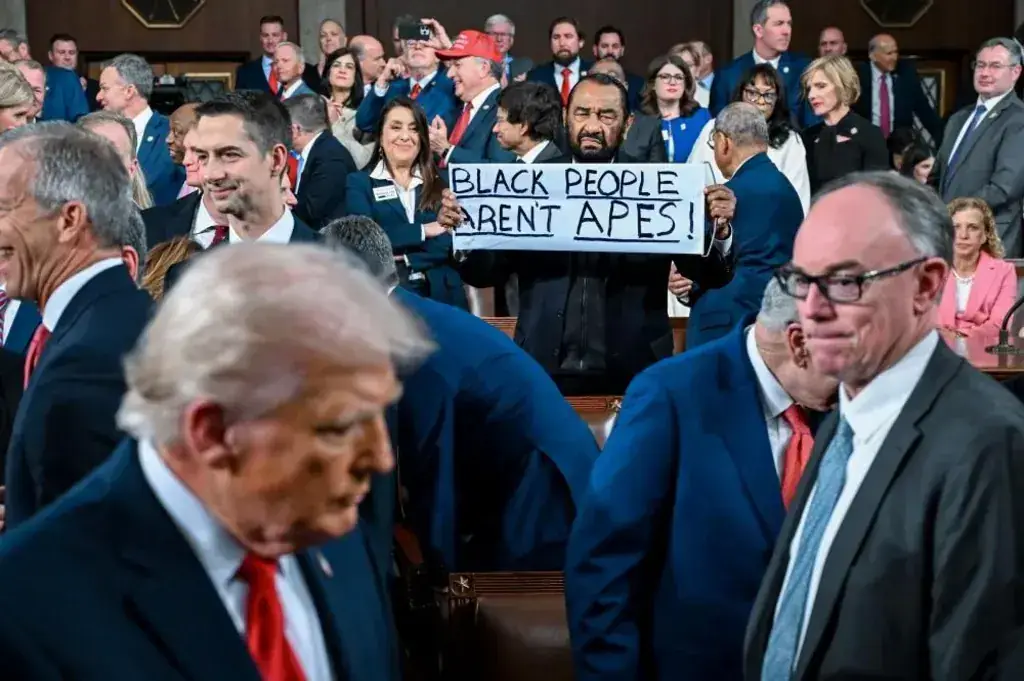
Among those present, protests emerged during the speech. Representative Al Green of Texas was escorted out after holding up a sign reading “black people aren’t apes!” The message appeared to reference a social media video previously posted and later deleted by Trump that depicted former President Barack Obama and former First Lady Michelle Obama in racist imagery. Green was also removed during last year’s address.
Representative Ilhan Omar of Minnesota and Representative Rashida Tlaib of Michigan were heard shouting objections as Trump discussed immigration and alleged fraud within Minnesota’s Somali-American communities.
In the official Democratic response, Virginia Governor Abigail Spanberger criticized the administration’s policies and framed the political debate around affordability, national security, and whether the president was acting in Americans’ interests. She answered those questions in the negative.
A Partisan ‘Stand Up’ Moment
In one of the evening’s most visually striking moments, Trump asked members of Congress to stand if they agreed that “the first duty of the American government is to protect American citizens, not illegal aliens.”
Republicans rose in unison, while most Democrats remained seated. The camera sweep across the chamber reinforced the partisan divide that has increasingly defined such addresses.
Trump criticized Democrats for failing to applaud his administration’s actions and said they “should be ashamed” for not standing. At another point, he referred to his political opponents as “crazy,” drawing cheers from Republican lawmakers.
The exchange underscored how the State of the Union, traditionally a forum for outlining national priorities, has evolved into a stage for overt political contrast.
Olympic Champions and Patriotic Pageantry
The speech also included ceremonial elements. Members of the US men’s hockey team, fresh from a gold medal victory over Canada at the Winter Olympics, were introduced to chants of “U-S-A.”
Trump praised the team’s achievement and announced that goaltender Connor Hellebuyck would receive the Presidential Medal of Freedom, the nation’s highest civilian honor. He added that the women’s hockey team, which also won gold, would be invited to the White House at a later date.
Later in the address, Trump presented Purple Heart decorations to National Guard member Andrew Wolfe, who was wounded while on patrol in Washington, and to the family of Sarah Beckstrom, who was killed in the same incident. He also awarded the Medal of Honor to Chief Warrant Officer Eric Slover, a helicopter pilot injured during a US military operation targeting Venezuelan President Nicolás Maduro.
The ceremony blended personal tributes with broader patriotic themes, including references to upcoming celebrations marking the 250th anniversary of the United States.
A High-Stakes Moment Before Midterms
Taken together, the address reflected a presidency navigating legal setbacks, foreign policy tensions, and domestic political pressure. With midterm elections approaching and affordability concerns lingering for many Americans, the speech appeared designed to consolidate Republican support while drawing sharp contrasts with Democrats.
While State of the Union addresses often aim to unify, this year’s event highlighted the enduring polarization shaping American politics — inside the chamber and beyond it.
Source: BBC – Trump’s State of the Union speech – at a glance