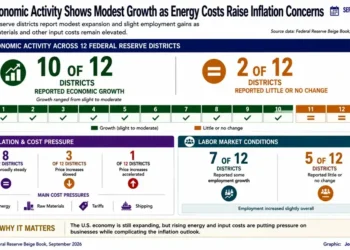
An unexpectedly strong third-quarter expansion strengthens confidence in domestic demand, but rising price pressures now shift attention to whether growth can remain durable into the next policy cycle.
The U.S. economy accelerated at a stronger-than-expected 4.3% annualized pace in the third quarter, delivering the fastest expansion in two years and reinforcing the view that domestic demand remains resilient despite persistent cost pressures. The Commerce Department’s delayed estimate came in well above economist forecasts near 3.0%–3.3%, with consumer spending once again providing the central engine of growth.
As first reported by The Associated Press, the expansion was driven by a 3.5% rise in consumer spending, alongside stronger exports and higher government outlays. That combination matters strategically because it suggests the growth pulse was broad-based rather than dependent on a single technical factor, giving policymakers a more credible signal that underlying momentum remained intact through the July-to-September period.

Consumer Demand Continues to Carry the Expansion
The third-quarter performance underscores the continued durability of U.S. households even after a prolonged period of elevated prices.
Consumer spending, which accounts for roughly 70% of economic activity, accelerated from the prior quarter and once again offset softer private investment. The strength of household demand is becoming the clearest measure of institutional resilience inside the economy: labor markets may be cooling gradually, but consumers have not yet materially retrenched.
This resilience is especially notable because many forecasts had anticipated tariffs, policy uncertainty, and the delayed effects of tighter financial conditions to weigh more heavily on activity.
Inflation Pressures Complicate the Growth Narrative
The stronger GDP figure does not remove the policy dilemma created by inflation.
Price pressures accelerated during the same quarter, with Personal Consumption Expenditures inflation rising to 2.8% and core PCE moving up to 2.9%, both still above the Federal Reserve’s preferred target zone. That means the growth surprise, while positive for recession fears, simultaneously reduces the urgency for monetary easing.
■ Related News



The core challenge for policymakers is that resilience in demand may itself be prolonging the inflation problem, particularly in services and wage-linked categories.
Policy Credibility Now Depends on Managing the Next Slowdown
A faster third quarter also raises the stakes for the quarters ahead.
More recent data shows growth cooled sharply to just 0.5% in the fourth quarter, highlighting how quickly momentum can fade after a strong summer performance. That slowdown makes the 4.3% surge look less like a new trend and more like the high-water mark of a year defined by uneven but resilient expansion.
For markets and policymakers, the key institutional test is whether the economy can transition from headline strength to steadier, less inflationary growth without slipping into a harder deceleration.
The Real Measure Is Whether Resilience Can Outlast Price Pressure
The forward-looking question is no longer whether the U.S. economy was strong in the third quarter—it clearly was.
The more consequential issue is whether that resilience can persist once inflation, borrowing costs, and weaker late-year momentum begin to filter more deeply into household and business behavior. If demand remains firm, the economy may retain a soft-landing trajectory. If not, the third quarter may ultimately be remembered as the peak before a more constrained 2026 growth environment.