The United States is preparing to deploy a rapid-response airborne force to the Middle East, a move that underscores growing military escalation risk as the conflict with Iran widens and diplomatic signals remain contested.
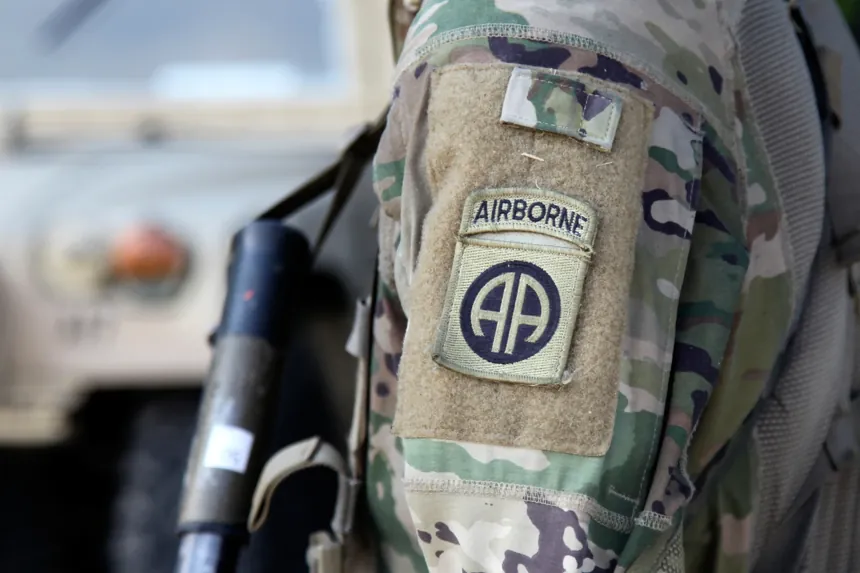
As first reported by the The Associated Press, at least 1,000 troops from the 82nd Airborne Division are expected to deploy in the coming days, adding a highly mobile combat capability to an already expanding U.S. force posture in the տարածաշրջ.
The deployment, which includes command elements led by Maj. Gen. Brandon Tegtmeier, reflects a shift toward operational readiness for fast-moving contingencies rather than static deterrence alone.

Command Readiness Accelerates as Crisis Timelines Compress
The 82nd Airborne Division is designed for immediate insertion into contested environments, with units trained to seize and secure strategic infrastructure such as airfields and supply corridors.
Its deployment signals that U.S. planners are preparing for scenarios requiring rapid territorial control or emergency stabilization—capabilities that extend beyond traditional force projection.
While the White House has not detailed the mission scope, spokeswoman Anna Kelly emphasized that Donald Trump retains full military options, reinforcing the administration’s flexible posture amid uncertain escalation dynamics.
Briefings scheduled for lawmakers on Capitol Hill indicate that the deployment is being treated as part of a broader strategic recalibration rather than an isolated move.
Force Posture Expands as Multi-Domain Assets Converge
The airborne deployment comes alongside a significant maritime buildup. U.S. officials have confirmed that multiple Marine Expeditionary Units—totaling roughly 5,000 Marines and supported by naval assets—are being redirected to the region.




Among them is the USS Tripoli, repositioned from exercises near Taiwan, reflecting the reprioritization of military assets toward the Middle East theater.
These amphibious forces are trained for a range of missions, including embassy reinforcement, civilian evacuation, and crisis response, complementing the offensive and rapid-entry capabilities of airborne units.
With approximately 50,000 U.S. troops already in the region, the layered deployment suggests an increasingly complex force structure designed to manage multiple escalation pathways simultaneously.
Diplomatic Signals Diverge as Military Preparations Advance
The troop buildup coincides with conflicting narratives around diplomatic engagement. The Trump administration has stated that negotiations with Iran are underway, involving senior figures such as envoy Steve Witkoff, Jared Kushner, Secretary of State Marco Rubio, and Vice President JD Vance.
However, Iranian officials have publicly denied direct talks. Statements from Foreign Minister Abbas Araghchi and parliamentary leadership suggest Tehran is maintaining a hardline stance, while military officials have issued statements committing to continued confrontation.
This divergence between public diplomacy and military signaling introduces ambiguity into the strategic environment, complicating risk assessment for both regional actors and global stakeholders.
Escalation Pathways Multiply as Strategic Flexibility Narrows
The convergence of rapid-response ground forces, amphibious units, and naval assets indicates that the U.S. is preparing for a wide spectrum of contingencies—from evacuation operations to potential direct engagement.
At the same time, Iran’s refusal to acknowledge negotiations and its continued assertive rhetoric reduce the likelihood of immediate de-escalation through diplomacy.
The resulting dynamic is one in which military preparedness advances faster than political resolution, increasing the probability of miscalculation.
Forward Outlook: Contingency Posture Becomes Central to Conflict Trajectory
The deployment of elite airborne forces marks a turning point in how the United States is positioning itself within the conflict—shifting from reactive deterrence to proactive contingency planning.
As force concentrations grow and diplomatic clarity remains elusive, the risk environment is becoming more structurally volatile, with rapid escalation scenarios increasingly plausible.
Absent synchronized political engagement, the expanding military footprint may define the trajectory of the conflict more than negotiations in the near term.