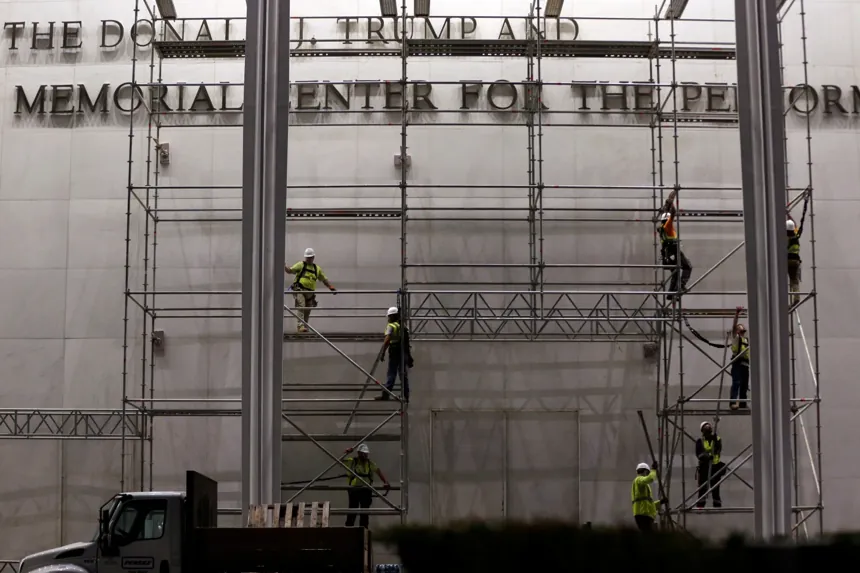
WASHINGTON – Workers began removing President Donald Trump’s name from the exterior of the John F. Kennedy Center for the Performing Arts early Saturday, just hours after a court-ordered deadline required references to the president to be taken down from the landmark cultural institution.
The action followed a series of legal setbacks for the Kennedy Center, which had sought additional time to comply with a federal court ruling. According to court filings submitted shortly after midnight, the center requested an extension until noon Saturday after thunderstorms in the Washington area delayed work on the building.
In the filing, the institution told the court that removal efforts were already underway and expected to be completed during the early morning hours.

By dawn, workers had begun dismantling letters bearing Trump’s name from the facade. Tarps were placed around scaffolding erected on the building, limiting public visibility of the work. Crews left the site around 3:30 a.m., though coverings remained in place, making it unclear whether all references had been fully removed.
Court Order Drives Compliance Effort
The removal stems from a ruling by U.S. District Judge Christopher Cooper, who determined that changes to the Kennedy Center’s official name could only be authorized by Congress. The decision required the institution to remove references to Trump that had been added after he assumed a leadership role at the venue earlier this year.
The Kennedy Center attempted to halt enforcement of the ruling through emergency appeals, but those efforts were unsuccessful. On Friday afternoon, a judge denied a request to pause the compliance deadline, and a subsequent appeal was rejected later the same day.
The legal dispute has become a prominent test of the limits of executive influence over federally chartered cultural institutions.
Public Reaction Outside the Venue
Dozens of people gathered Friday outside the Kennedy Center as workers prepared for the removal. Some attendees took photographs and applauded developments throughout the day, while others chanted in support of eliminating Trump’s name from the building.
■ Related News



Among those present was Rep. Joyce Beatty of Ohio, an ex-officio member of the Kennedy Center board who filed suit seeking the removal of Trump’s name from the institution.
The demonstrations underscored the political and symbolic significance the controversy has acquired since Trump returned to office.
Trump’s Expanded Influence at the Kennedy Center
Although Trump paid limited attention to the Kennedy Center during his first term, his administration moved quickly to reshape the institution after his return to the White House.
Within weeks of beginning a second term, Trump removed the center’s previous leadership and appointed a new board of trustees. The board subsequently selected him as chairman, and his name was soon added to the venue.
The legal challenge argued that those changes conflicted with congressional authority governing the institution’s name and structure.
Judge Cooper’s ruling concluded that such alterations exceeded executive authority and required legislative approval.
Renovation Dispute Continues
The court decision also addressed a separate issue involving the future of the Kennedy Center itself.
Cooper blocked plans to close the venue for a major renovation project scheduled to begin in July and continue for approximately two years. The Kennedy Center has argued that extensive repairs are necessary and has warned about deteriorating infrastructure throughout the facility.
In court filings submitted Friday, the institution contended that the renovation delay could affect efforts to address significant structural concerns, including deteriorating beams and parking garage ceilings.
The renovation dispute remains unresolved and could continue through additional legal proceedings.
Changes Already Underway
Even as legal challenges continued, the Kennedy Center had already begun implementing aspects of the court’s ruling.
An internal memorandum dated June 4 instructed employees that official communications, including email signatures, letterhead and other documents, should use either “The John F. Kennedy Center for the Performing Arts” or simply “Kennedy Center.”
The institution’s website has also removed references to Trump’s name. Promotional communications for upcoming events, including ticket offers related to the June 28 Mark Twain Award for American Humor ceremony, likewise omitted references to Trump.
The latest developments mark another chapter in a high-profile legal battle that has focused on the balance of authority between federal institutions, the executive branch and Congress over one of the nation’s most recognizable cultural landmarks.