WASHINGTON (JN) – The risk of a wider confrontation with Tehran is rising as U.S. messaging grows less consistent. In recent months, President Donald Trump has shifted his language on Iran’s nuclear program and the purpose of recent strikes. That evolution has fueled concern that deterrence signaling could drift into open-ended military escalation.
According to reporting by The Associated Press, the administration’s public explanations have changed significantly since last summer. At that time, Trump declared Iran’s nuclear infrastructure “completely destroyed.” Today, officials warn of urgent and expanding threats.
The change in tone is not a minor adjustment. In high-risk security environments, clarity shapes stability. When objectives appear fluid, adversaries may prepare for worst-case scenarios.

From Total Destruction to Renewed Alarm
In June 2025, after coordinated strikes, Trump said Iran’s nuclear facilities had been “obliterated.” Defense Secretary Pete Hegseth echoed that assessment. Secretary of State Marco Rubio rejected intelligence reporting that suggested only a temporary setback.
Months later, the message shifted. Trump argued that Iran was again close to acquiring a nuclear weapon. He also voiced frustration with stalled negotiations.
That pivot carries strategic consequences. If the original assessment overstated the damage, credibility may erode. If new intelligence drove the shift, the threat picture may be worsening. Either way, the gap between past assurances and current warnings complicates deterrence.
Allies must now interpret whether Washington sees a contained program or a rapidly advancing one. That distinction affects military planning across the region.



Regime Change Signals Complicate Intent
The rhetoric expanded further when discussion moved beyond nuclear facilities.
In mid-2025, Trump publicly entertained the idea of regime change. Vice President JD Vance, however, said the goal remained limited to ending nuclear ambitions. After subsequent strikes that killed Iran’s Supreme Leader, Ali Khamenei, Trump described the moment as an opportunity for Iranians to reclaim their country. Other officials stopped short of declaring regime change official policy.
Hegseth later stated that it was “not a so-called regime change war,” even as leadership had changed.
Such mixed signals blur operational boundaries. Even without a formal doctrine of political transformation, adversaries may interpret leadership targeting as an attempt at systemic change. That perception alone can increase incentives for retaliation.
Washington has historically tried to separate counterproliferation strikes from regime removal campaigns. The erosion of that line adds uncertainty to an already fragile environment.
Missile Threat Framing Widens the Conflict Scope
Administration officials also expanded the threat narrative to include ballistic missiles.
Rubio warned that Iran maintains a substantial short-range missile arsenal capable of striking U.S. bases in the Gulf. Trump later suggested Iranian missile development could eventually threaten the American mainland. Hegseth argued that missile and drone programs were designed to protect nuclear leverage.
This broader framing matters. Once missile capabilities become central to the justification, the potential target set widens. Preemptive logic may extend beyond nuclear sites.
For regional partners hosting U.S. forces, the message underscores vulnerability. For Tehran, it signals that future strikes might not be limited to enrichment facilities. That dynamic raises the escalation threshold.
Protest Warnings Give Way to Hardline Posture
In January, amid protests inside Iran, Trump positioned Washington as a potential protector of demonstrators. He warned against executions and paused meetings with Iranian officials. He later suggested that reported halts validated U.S. pressure.
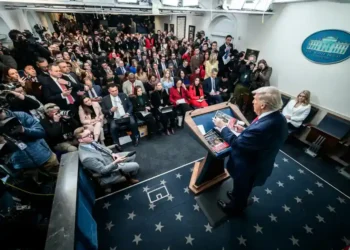
Weeks later, the tone changed. At a White House event in early March, Trump described military action as a “last, best chance” to remove intolerable threats. He concluded that negotiation was no longer viable.
The shift from conditional engagement to firm rejection narrows diplomatic flexibility. Publicly closing negotiation channels reduces room for de-escalation. It also signals to adversaries that force may take priority over dialogue.
Strategic Ambiguity Shapes the Escalation Curve
The broader issue is not rhetoric alone. In crisis settings, words guide expectations. When leaders alternate between claims of total destruction, warnings of imminent threat, and suggestions of regime change, strategic intent becomes harder to read.
Allies such as Israel and Gulf states rely on clear signals for coordination. Iran may interpret unpredictability as preparation for expanded action. Global markets, particularly energy, react to perceived instability.
The United States has long used calibrated language to manage risk in the Middle East. When messaging accelerates faster than policy clarity, escalation control becomes more difficult.
It remains unclear whether these shifts reflect new intelligence, tactical messaging, or evolving strategy. What is clear is that inconsistent framing adds friction to an already volatile standoff.
As deployments continue and diplomatic channels strain, the margin for miscalculation tightens. In a nuclear-adjacent confrontation, even incremental changes in language can reshape the trajectory of escalation.