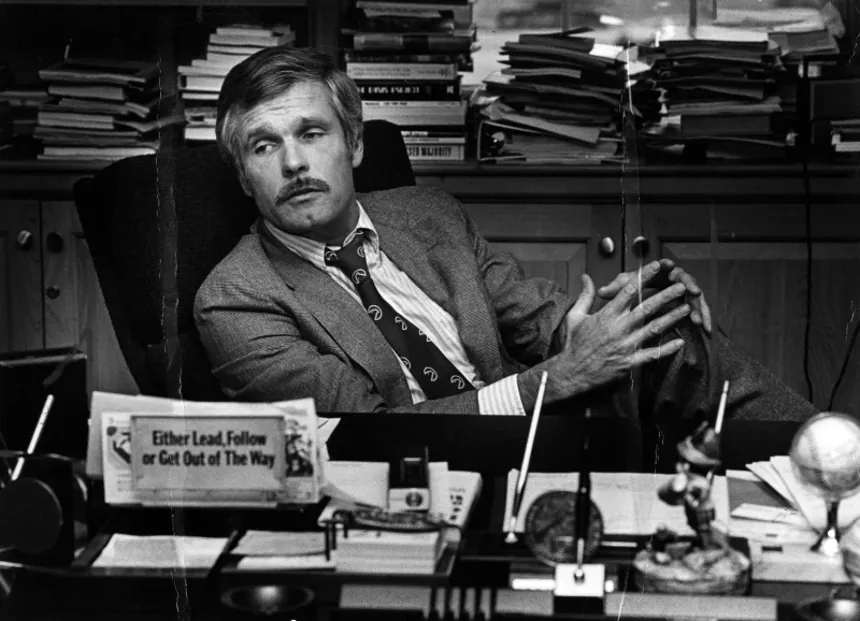
Media entrepreneur Ted Turner, the outspoken broadcasting pioneer who launched the world’s first 24-hour television news network, has died at the age of 87. Turner’s death marks the end of a defining chapter in modern television history, particularly in the evolution of global news coverage and cable broadcasting.
Best known for founding CNN in 1980, Turner fundamentally changed how audiences consumed live news by introducing round-the-clock reporting at a time when many industry observers doubted the model could succeed. His influence extended far beyond news television, shaping sports broadcasting, entertainment programming, environmental philanthropy and the economics of cable media.
According to reporting from The Associated Press, Turner died following years of declining health linked to Lewy body dementia, a diagnosis he publicly disclosed in 2018.

A Transformational Figure in Television News
Turner entered the media business through his father’s billboard company before expanding aggressively into radio and television ownership during the 1970s. His acquisition of struggling Atlanta television stations eventually laid the foundation for what became the Turner Broadcasting empire.
The launch of CNN represented one of the most consequential shifts in broadcast journalism. Before the network’s debut, television news programming largely revolved around scheduled evening broadcasts on major U.S. networks. Turner’s decision to offer continuous live coverage introduced a radically different format that would later become standard across the global media industry.
Industry analysts have frequently pointed to CNN’s real-time reporting during major geopolitical events — including the Gulf War — as the moment when continuous cable news proved its commercial and editorial viability to international audiences.
Expanding Beyond News Broadcasting
Turner’s ambitions extended well beyond journalism. Through Turner Broadcasting, he built a major entertainment portfolio that included cable channels such as TBS and TNT, while also investing heavily in sports and film libraries.
His acquisition of the Atlanta Braves and the Atlanta Hawks helped elevate Atlanta’s national media profile during the 1980s and 1990s. Turner also played a significant role in expanding nationally televised sports coverage through cable broadcasting.
■ Related News




The executive became known for his unconventional leadership style and public persona, often challenging industry competitors and political figures alike. While critics sometimes viewed his rhetoric as provocative, supporters credited Turner with taking risks that permanently altered the economics of television.
Industry Legacy and Media Consolidation
Turner’s media empire eventually became part of a larger wave of consolidation that reshaped the entertainment industry during the 1990s. In 1996, Turner Broadcasting merged with Warner Bros. Discovery predecessor Time Warner in one of the era’s most significant media deals.
Although Turner later stepped back from corporate leadership, his influence remained visible across both television journalism and entertainment strategy. The 24-hour news format he pioneered became a template replicated worldwide, while cable channels built around niche audiences evolved into a central pillar of modern media distribution.
Executives, journalists and broadcasters across the industry paid tribute following news of his death, highlighting his role in creating a more immediate and globally connected news environment.
Philanthropy and Cultural Influence
Outside broadcasting, Turner became widely recognized for his environmental and humanitarian initiatives. He donated substantial portions of his wealth to causes linked to climate advocacy, nuclear threat reduction and public health programs.
In 1997, Turner pledged $1 billion to support the United Nations, one of the largest charitable commitments made by a private individual at the time. His philanthropic work later became a major part of his public legacy alongside his media achievements.
Turner’s influence on television culture remains substantial decades after CNN’s launch. Media historians frequently credit him with accelerating the shift toward live global news coverage, personality-driven cable programming and the rapid expansion of modern broadcast competition.
His death closes a career that reshaped both journalism and entertainment, leaving a lasting imprint on how audiences worldwide consume news and televised media.