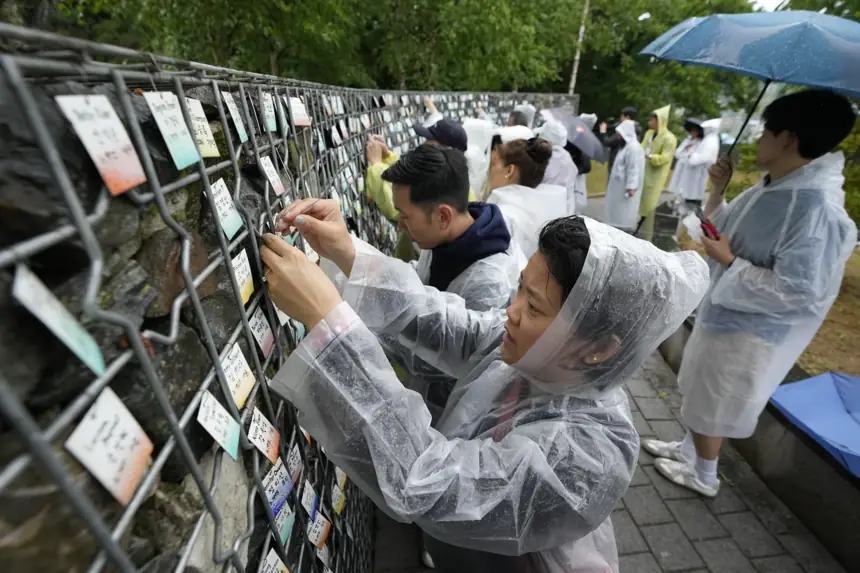
PAJU, South Korea — Hundreds of ceramic name plaques displayed at a memorial park near the North Korean border have become a powerful symbol of the enduring search by Korean adoptees for their birth mothers, highlighting the lasting impact of South Korea’s decades-long international adoption program. The site has emerged as a focal point in a broader national reckoning over overseas adoptions and family separations that affected generations of children.
The memorial, known as Omma Poom Park, or “Mother’s Embrace,” is located on a former U.S. military base in Paju. According to reporting by The Associated Press, adoptees from North America and Europe recently gathered there to attach personalized ceramic name tags to a wall dedicated to those seeking connections with their birth families. More than 900 tags now cover the structure, each bearing an adoptee’s name, birth year and birthplace.
The gathering underscored the emotional consequences of a system that sent large numbers of South Korean children abroad over several decades. International adoptions expanded significantly during the 1970s and 1980s, when thousands of children were placed with families overseas each year. Many adoptees continue searching for information about their origins, often facing incomplete records or unsuccessful attempts to locate biological relatives.

Personal Searches Continue Across Generations
Among those participating was Nicole Rieth, who was adopted to the United States as an infant. She told The Associated Press that her search is driven less by a desire for detailed information than by a wish to understand her identity and family origins.
Another adoptee, Angela Lee-Pack, who was adopted to Canada as a child, has spent years searching for her birth mother. Her efforts included multiple trips to South Korea and public appeals in several cities. Despite receiving potential leads, she has not achieved a confirmed reunion. Her experience reflects challenges reported by many adoptees attempting to trace relatives decades after their adoptions.
The park also contains messages left by adoptees and birth families. In some cases, parents searching for children have posted notes expressing regret and hope for future reunions.
Adoption Legacy Faces Renewed Scrutiny
The memorial’s creation comes amid growing attention to South Korea’s overseas adoption system. Omma Poom Park opened in 2025 following efforts by photographer Lee Yong-nam and the adoptee support organization Me & Korea. Organizers describe the site as a place where adoptees can share experiences and preserve memories connected to their search for family.
Recent investigations have intensified scrutiny of historical adoption practices. South Korea’s Truth and Reconciliation Commission previously found evidence of widespread irregularities in parts of the overseas adoption system, including cases involving inaccurate or falsified records. Those findings have fueled calls from adoptees and birth mothers for further investigations and greater accountability.
■ Related News



Government efforts to address those concerns have continued through renewed investigations and reforms aimed at strengthening oversight of adoption records and procedures. Authorities have also expanded efforts to examine unresolved adoption-related cases.
A Symbol of Hope and Unanswered Questions
Beyond its role as a memorial, the park serves as a reminder of unresolved personal histories. A museum overlooking the site houses roughly 1,000 profiles and letters written by adoptees hoping their birth mothers may one day learn of their search.
For many visitors, the wall represents both remembrance and possibility. While some adoptees have successfully reunited with biological relatives, many continue to face uncertainty. Details surrounding numerous adoptions remain unclear, and many searches have yet to produce answers.
As South Korea continues examining one of the largest international adoption programs in modern history, the growing collection of names at Omma Poom Park stands as a visible record of families separated across continents and of ongoing efforts to reconnect them.