BEIRUT, Lebanon – A U.S.-brokered framework agreement between Lebanon and Israel aimed at ending hostilities has instead deepened political divisions in Lebanon, fueling concerns over renewed instability and the possibility of another civil conflict.
The agreement outlines a path toward an eventual peace accord between the two countries, which have technically remained at war since Israel’s establishment in 1948. Under the framework, Israeli forces would withdraw from Lebanese territory only after Hezbollah is disarmed, a condition that has been firmly rejected by the Iran-backed militant group.
The proposal has sharpened tensions between Lebanon’s Western-backed government and Hezbollah, with supporters of the group staging demonstrations and blocking major roads. Senior Hezbollah figures have warned that any attempt to enforce the group’s disarmament could trigger internal conflict, reviving memories of Lebanon’s 1975-1990 civil war and the armed confrontations that erupted in 2008.

The issue is expected to dominate discussions when Lebanese President Joseph Aoun visits the White House on July 21, while uncertainty surrounding broader U.S.-Iran relations continues to cloud prospects for implementing the agreement.
Regional conflict shapes Lebanon’s political divide
Lebanon has long been divided between political factions aligned with Western countries and those backed by Iran, led by Hezbollah. Both sides view the outcome of the current negotiations as critical to Lebanon’s political future.
The latest round of fighting between Israel and Hezbollah began in March after the joint U.S.-Israel military campaign against Iran. Hezbollah entered the conflict without authorization from Lebanon’s government and later sought to tie an end to hostilities with Israel to wider negotiations between Washington and Tehran.
Lebanese authorities instead pursued a separate ceasefire directly with Israel, seeking to limit Iran’s influence over decisions affecting Lebanon’s security.
Agreement shifts political momentum
Supporters of Hezbollah initially welcomed the ceasefire reached between the United States and Iran because it explicitly called for an end to the fighting in Lebanon. The truce significantly reduced hostilities between Israel and Hezbollah.
■ Related News


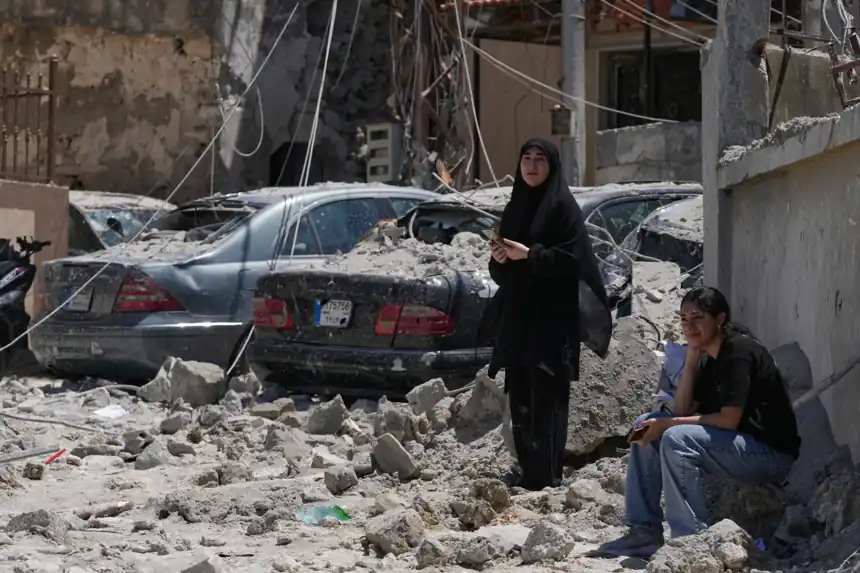
However, Israeli troops continue to occupy parts of southern Lebanon, while hundreds of thousands of displaced residents remain unable to return to villages and urban neighborhoods that were heavily damaged during the fighting.
Momentum shifted after Israel and Lebanon announced a framework agreement in Washington on June 26. The deal made the withdrawal of Israeli forces conditional on Hezbollah’s disarmament throughout Lebanon, a provision that fundamentally altered the political landscape.
Government officials have presented the agreement as a path toward restoring Lebanese sovereignty and enabling displaced civilians to return home. Hezbollah, however, argues that the absence of a timetable for Israel’s withdrawal effectively allows an indefinite military presence.
The group’s supporters have protested in Beirut, blocking roads and burning banners bearing the slogan “Lebanon First,” which many view as directed at Hezbollah. Secretary-General Naim Kassem described the agreement as a “humiliation” and declared that Hezbollah would not comply with its terms.
Hezbollah lawmaker Hassan Fadlallah warned that the government could not implement the agreement without provoking civil war if it attempted to disarm the organization with U.S. backing.
His remarks echoed the events of May 2008, when Hezbollah fighters seized parts of Beirut after the government attempted to dismantle the group’s private telecommunications network. The government ultimately reversed its decision following days of armed clashes.
Hezbollah is now demanding that Lebanon’s government rescind a March 2 decision declaring the group’s military and security activities illegal.
Prime Minister Nawaf Salam has rejected Hezbollah’s warnings, saying the agreement with Israel would restore state authority across Lebanese territory.
“I am not looking for a confrontation with Hezbollah but neither myself nor anyone in the government will accept to be blackmailed by Hezbollah,” Salam told Lebanon’s LBC television.
Implementation remains stalled
Despite political statements from both sides, implementation of the agreement has yet to begin.
The framework calls for two pilot zones where Israeli forces would transfer control to the Lebanese army after confirming the absence of Hezbollah fighters.
Although Salam has indicated implementation could begin soon, Lebanese military officials say they have received no timetable or operational details regarding any Israeli withdrawal.
The initial pilot areas include Froun, Ghandouriyeh and Zawtar. Much of that territory was not under direct Israeli military control, prompting questions about how the proposed withdrawal would proceed. A Lebanese military official, speaking anonymously because he was not authorized to discuss the matter publicly, said the army had requested larger pilot zones covering more occupied territory.
An Israeli military official, also speaking anonymously under briefing rules, said the military is awaiting instructions from Israel’s political leadership before moving forward.
Political deadlock remains a risk
Lebanon’s sectarian political system has historically struggled with prolonged institutional deadlock alongside episodes of political violence.
Parliament Speaker Nabih Berri, a close Hezbollah ally, has warned that the agreement “will not pass” in its current form.
Wissam Lahham, a constitutional law professor at St. Joseph University in Beirut, said Lebanon’s constitution requires international treaties to receive approval from two-thirds of the Cabinet before becoming legally binding. No Cabinet vote has been scheduled, and Lahham said it remains unclear whether parliamentary approval would also be required.
In a speech on Wednesday, Kassem reiterated Hezbollah’s opposition to the framework, telling the government that “not a single clause of the framework agreement will be approved.”
Michael Young, senior editor at the Malcolm H. Kerr Carnegie Middle East Center in Beirut, said the Lebanese government’s effort to separate the country’s future from broader U.S.-Iran negotiations was understandable in principle but difficult to achieve.
“You cannot reach any kind of solution with regard to Hezbollah unless Iran is on board,” Young said. “The Iranians will not give up on Hezbollah, and at the same time the Lebanese are not willing to enter into an armed conflict with Hezbollah.”
With implementation stalled, political opposition mounting and Hezbollah refusing to accept the disarmament requirement, the future of the agreement remains uncertain as Lebanon confronts another period of heightened political strain.
This report is based on reporting by The Associated Press.
Topics: Hezbollah | Lebanon | Israel | Middle East | U.S. Diplomacy | Regional Security | Ceasefire | Joseph Aoun