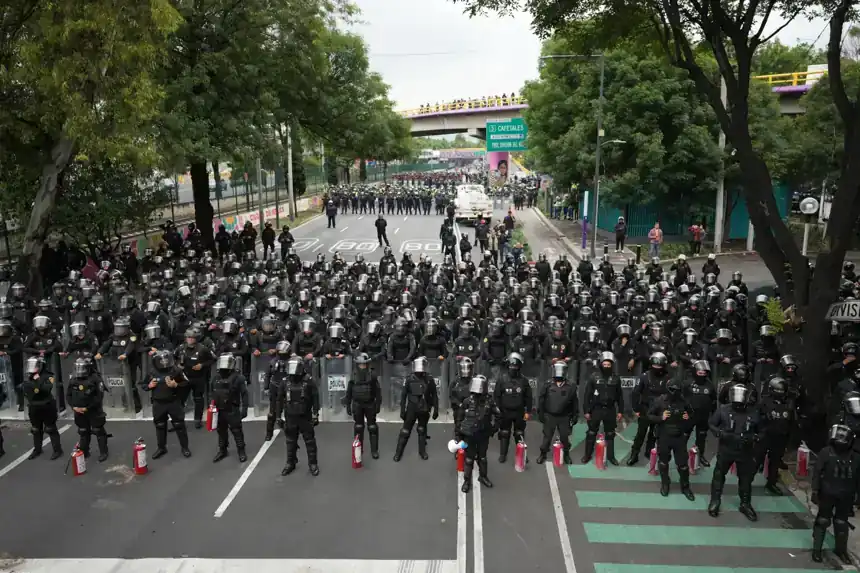
CIUDAD DE MÉXICO – Mexico has launched a large-scale security operation ahead of the opening of the FIFA World Cup, deploying thousands of security personnel across key host cities as authorities seek to ensure the tournament begins without major disruptions.
According to reporting by the Associated Press, Mexican officials have focused not only on preventing criminal activity but also on managing growing protests that threaten to disrupt transportation and public gatherings ahead of the tournament’s opening match in Mexico City.
The World Cup, jointly hosted by Mexico, the United States and Canada, represents one of the largest international sporting events ever organized. Mexican authorities have announced that more than 100,000 soldiers, sailors, National Guard members and police officers will be deployed across Mexico City, Guadalajara, Monterrey and major tourist destinations during the competition.

Despite the extensive preparations, public attention in the capital has increasingly centered on demonstrations that have occupied major public spaces and affected mobility in parts of the city. Protest camps and security barricades have become visible across central Mexico City, while teachers’ unions and other activist groups have staged demonstrations near key venues.
Mexico City police intensified inspections at major entry points into the capital and reported the seizure of small homemade explosive devices found aboard buses carrying protesters. Authorities have warned that additional demonstrations could affect transportation routes during the opening days of the tournament.
President Claudia Sheinbaum sought to reassure the public, stating that preparations for the opening ceremony remain on schedule and that visitors will be able to enjoy the event despite the ongoing protests.
Security Challenges Beyond the Stadiums
The tournament presents a significant security test for FIFA and the three host nations. For Mexico, the challenge extends beyond crowd management, as officials seek to demonstrate that major international events can be held safely despite the country’s long-standing security concerns.
Recent incidents, including violence linked to organized crime and a rare shooting near the archaeological site of Teotihuacán earlier this year, have intensified scrutiny of security arrangements surrounding the tournament.
■ Related News




Rogelio Barba of the University of Guadalajara said authorities must balance World Cup security operations with ongoing efforts to address criminal activity in regions affected by organized crime.
Federal and state governments have pointed to extensive personnel deployments and advanced surveillance technologies as key elements of their strategy. However, some residents remain skeptical, arguing that security resources are being concentrated around tourist areas and tournament venues.
Organized Crime Concerns Remain in Focus
Security analysts have suggested that criminal organizations may have limited incentive to target international visitors during the tournament because any high-profile incident involving foreign tourists could trigger stronger government and international responses.
In recent days, messages circulating on social media have purportedly urged criminal groups to avoid actions that could affect the World Cup. The authenticity of those messages has not been independently verified.
Francisco Rivas, director of Mexico’s National Citizen Observatory, warned that portraying security conditions as fully under control could encourage visitors to take unnecessary risks. He urged tourists to remain cautious, particularly when traveling to unfamiliar neighborhoods or engaging in activities that could expose them to criminal networks.
Mexican federal prosecutors have launched an online information platform outlining legal restrictions, reporting procedures and guidance for visitors. Rivas argued that additional information about risks such as virtual kidnappings and police corruption would further strengthen public awareness.
Technology and International Cooperation
Security measures during the 39-day tournament include anti-drone systems, surveillance camera networks, specialized crowd-management units and coordinated military and police patrols around stadiums, airports, fan zones and team facilities.
FIFA President Gianni Infantino expressed confidence in Mexico’s preparations earlier this year, while local authorities have highlighted extensive cooperation with international security partners.
Officials in Monterrey reported receiving training support from U.S. security agencies, Israeli specialists and British police. Authorities in Nuevo León and Jalisco also showcased armored tactical vehicles, robotic security systems and explosive-disposal technologies as part of their preparations.
In Tijuana, where Iran’s national team has been based amid uncertainty surrounding its participation, National Guard personnel have maintained visible security around team activities.
Mobility Concerns Ahead of Opening Day
Beyond security, city officials are attempting to prevent transportation disruptions caused by demonstrations, road closures and seasonal rainfall.
Mexico City Mayor Clara Brugada has encouraged residents and visitors to use public transportation and bicycles where possible. The federal government has also suspended non-essential public and private administrative activities on opening day to ease congestion.
Despite concerns, many football supporters continued gathering around the iconic Azteca Stadium in the days before kickoff, taking photographs and celebrating the tournament’s arrival.
Local residents living near the venue reported significant pressure on transportation systems but acknowledged the increased security presence surrounding the event.
While officials insist the opening ceremony will proceed without major issues, authorities continue monitoring demonstrations and crowd movements as Mexico prepares to welcome supporters from around the world.
Tag: Mexico, FIFA, World Cup, Claudia Sheinbaum, Security