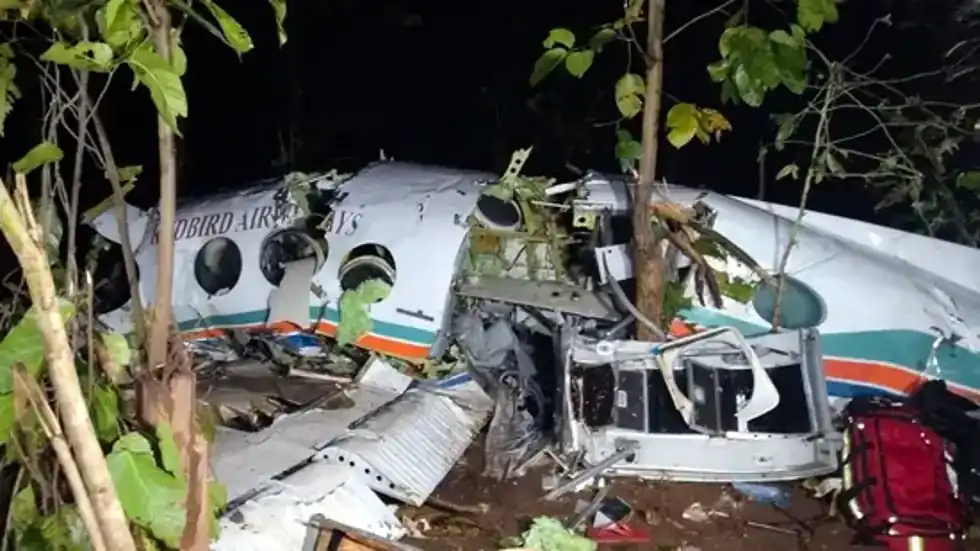
The recovery operation following the Jharkhand plane crash has underscored the logistical challenges posed by remote terrain in eastern India. All seven people on board an air ambulance travelling from Ranchi to Delhi were killed when the aircraft went down in Chatra district late Monday night, according to local authorities.
Rescue personnel said reaching the site required hours of trekking through forested land without road access, slowing efforts to retrieve the bodies. The difficult approach highlighted longstanding infrastructure gaps in parts of rural Jharkhand.
Officials said the aircraft had departed from Ranchi and was en route to the national capital when it crashed in a remote stretch of Chatra district. The cause of the crash has not yet been officially confirmed, and an investigation is expected to determine what led to the accident.

Difficult terrain slowed overnight rescue
Ramesh Kumar, Second-in-Command of the Sashastra Seema Bal (SSB), said his team received information about the crash during the night and immediately moved toward the site. However, the absence of road connectivity significantly complicated access.
“This area is quite inland,” Kumar said from the crash site. “There’s no road at all for two kilometres, and beyond that there is a trek of around five kilometres that one has to cross.”
By the time the team arrived, no survivors were found. Kumar said the recovery process was “very difficult,” given both the terrain and limited equipment available at the time. He noted that the team had only one stretcher with them, which had to be used to carry the bodies back across the uneven ground.
The operation took place in darkness and through forested terrain, further increasing the risks for responders. Such conditions are not uncommon in parts of Jharkhand, a mineral-rich state where forest cover and hilly landscapes often limit accessibility.
Seven confirmed dead
Authorities confirmed that all seven people on board the air ambulance died in the crash. Air ambulances in India are typically used to transport critically ill patients between cities for advanced medical treatment, particularly to major centres such as Delhi.
■ Related News



While officials have not publicly detailed the identities of the victims in full, local media reported that medical personnel were among those on board. The aircraft had reportedly been carrying a patient for treatment in Delhi, a route commonly used due to the capital’s concentration of tertiary care hospitals.
Civil aviation authorities are expected to conduct a formal inquiry into the incident, as is standard procedure following aircraft accidents. India’s Directorate General of Civil Aviation (DGCA) typically oversees such investigations, examining flight data, weather conditions and mechanical factors.
Infrastructure challenges in remote districts
The crash has drawn attention to the difficulties emergency responders face in remote districts such as Chatra. Large parts of Jharkhand remain heavily forested, with limited paved road networks connecting interior villages to district headquarters.
In emergencies, this lack of connectivity can delay response times and complicate rescue and recovery operations. Officials involved in Monday night’s operation described the approach as physically demanding, requiring teams to navigate rough terrain for several kilometres before reaching the wreckage.
Emergency management experts note that while India has expanded aviation infrastructure in recent years, accident response capacity in remote areas can vary widely depending on terrain and local resources. In forested or hilly districts, helicopters or specialised equipment may be required to expedite recovery efforts.
Investigation expected
The focus is now shifting to determining the cause of the crash. Aviation authorities typically secure the site, recover flight recorders if available, and collect debris for analysis. Weather conditions, aircraft maintenance history and pilot communication records are among the factors examined in such probes.
Until official findings are released, authorities have refrained from commenting on possible causes. In previous aviation incidents in India, final investigation reports have taken months to complete.
For families of those on board, the immediate concern has been the recovery and identification of the victims. The overnight trek and limited equipment added to the strain on rescue teams tasked with bringing the bodies out of the remote crash site.
The incident has once again highlighted the dual challenge faced by authorities: ensuring aviation safety while strengthening emergency response infrastructure in hard-to-reach regions.
Source: Hindustantimes – ‘Trekked 2 km, only 1 stretcher’: How terrain made retrieving bodies difficult after Jharkhand plane crash