Journos News - Breaking News, World News, Top Stories, Todays Headlines and Flash Reports
Wednesday, September 2, 2026
  • Login
  • Home
  • World
    • Africa
    • Americas
    • Asia
    • Europe
    • Middle East
    • Oceania
  • Politics
  • Business
  • Technology
  • Health
  • Science
  • Sports
  • Entertainment
  • Culture
No Result
View All Result
  • Home
  • World
    • Africa
    • Americas
    • Asia
    • Europe
    • Middle East
    • Oceania
  • Politics
  • Business
  • Technology
  • Health
  • Science
  • Sports
  • Entertainment
  • Culture
No Result
View All Result
Journos News - Breaking News, World News, Top Stories, Todays Headlines and Flash Reports
No Result
View All Result
Home World News Asia

How Australian Dolphins Use Sea Sponges as Tools to Hunt Fish Underwater

Inside the Rare Sponge-Hunting Technique of Dolphins in Shark Bay, Australia

The Daily Desk by The Daily Desk
May 12, 2026
in Asia, World News
0
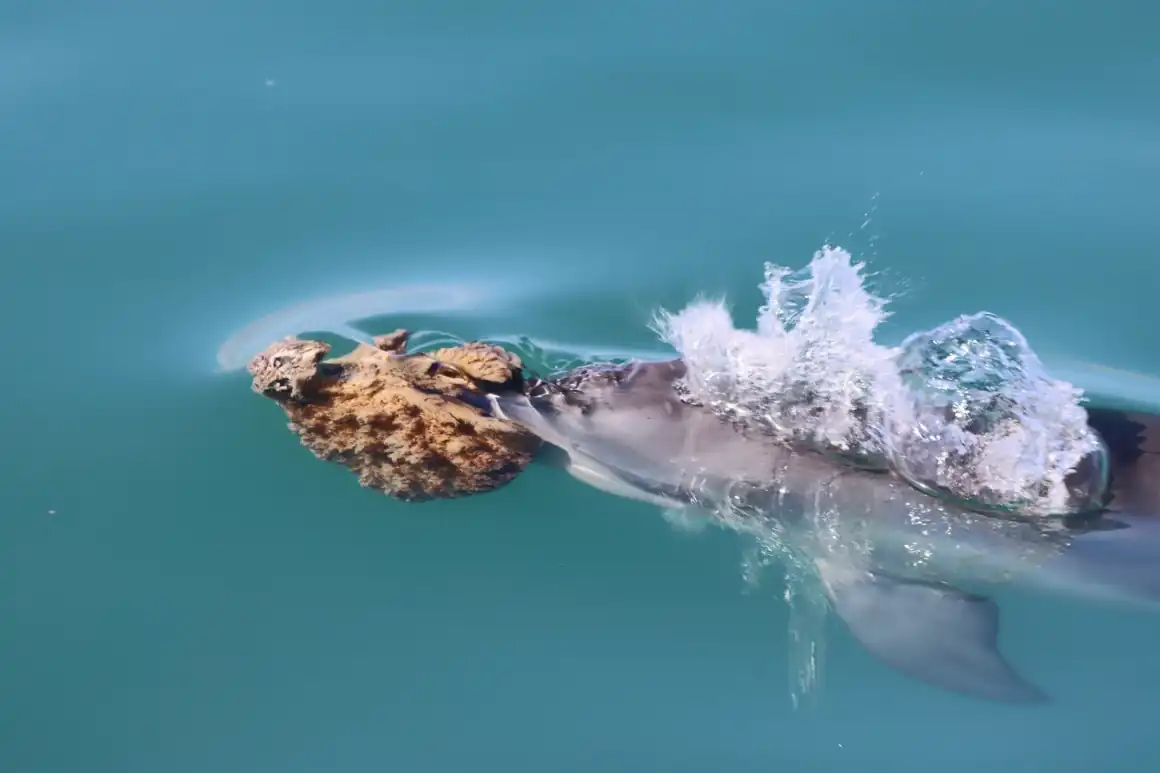
Australian Dolphins Use Natural Tools—But It Disrupts Their Echolocation - Meredith MacQueeney/Shark Bay Dolphin Research Project via AP

Not All Dolphins Can Do This: The Complex Art of Sponge Foraging - Meredith MacQueeney/Shark Bay Dolphin Research Project via AP

This rare behavior is passed down from mother to calf and takes years to master. But as scientists found, using a sponge to hunt isn’t easy. It affects the dolphin’s natural ability to “see” with sound, making the technique even more impressive.

Here’s what researchers discovered about these clever marine mammals — and why only a few are able to learn the trick.

What Is “Sponging” and Why Do Dolphins Do It?

In Shark Bay, Australia, a small group of bottlenose dolphins has been observed using marine sponges as hunting tools. These dolphins place cone-shaped sponges on their beaks, like a nose cover, before diving to the seafloor.

The sponge protects their sensitive skin from sharp rocks and rough sand while they dig into the seabed. As they stir up the bottom, small fish — especially a type called barred sandperch — get flushed out and become easy targets.

The sponges they use vary in size, from about as big as a softball to the size of a cantaloupe.

A Skill That’s Harder Than It Looks

Although the sponge acts like armor for the dolphins’ beaks, it also creates a challenge. Bottlenose dolphins rely heavily on echolocation to hunt — sending out clicking sounds and listening for the echoes that bounce back. This allows them to “see” their surroundings with sound, especially in murky waters.

But the sponge muffles those sound waves.

“It has a muffling effect in the way that a mask might,” said Ellen Rose Jacobs, a marine biologist at the University of Aarhus in Denmark and one of the study’s authors. “Everything looks a little bit weird, but you can still learn how to compensate.”

■ Related News

No Content Available

Jacobs used underwater microphones to confirm that the dolphins were still using echolocation while sponging. She then modeled how much the sponge distorted their sound waves.

Why Only a Few Dolphins Learn It

Sponge-hunting is not common among dolphins — and now scientists better understand why.

“It’s like hunting while blindfolded,” said Mauricio Cantor, a marine biologist at Oregon State University who wasn’t part of the study. “You’ve got to be very good, very well-trained to pull it off.”

Only about 5% of the Shark Bay dolphin population — roughly 30 individuals — use this technique, according to the study. That small number may be due to how long it takes to learn the skill and how tricky it is to perform.

“It takes them many years to learn this special hunting skill — not everybody sticks with it,” said marine ecologist Boris Worm of Dalhousie University in Canada, who was also not involved in the research.

A Learned Behavior Passed From Mother to Calf

Dolphin calves stay with their mothers for three to four years — a time when they watch, follow, and learn how to survive in the wild. Sponge hunting is one of the rare examples of tool use in marine animals, and researchers say it’s passed down only from mother to offspring.

“This kind of behavior is only ever passed down from mother to offspring,” said Janet Mann, a Georgetown University marine biologist and co-author of the study.

That long learning period may help explain why the skill doesn’t spread quickly among dolphins. If a dolphin doesn’t learn it early, it likely never will.

A Glimpse Into Dolphin Intelligence

Scientists have long known that dolphins are intelligent and social creatures. But this study highlights just how advanced some of their behaviors can be — including the use of tools and the ability to adapt when their natural senses are challenged.

For the few dolphins that master sponge hunting, it’s a clever and effective way to catch a meal in the wild. And it gives researchers one more fascinating example of how animals pass on knowledge across generations.

Source: AP News – Some Australian dolphins use sponges to hunt fish, but it’s harder than it looks

Tags: #AustralianMarineWildlife#MarineAnimalBehavior#MotherCalfLearning
The Daily Desk

The Daily Desk

The Daily Desk is a contributor at JournosNews.com covering politics, media, governance, and the evolving dynamics of public discourse. Stories published under this byline are produced in accordance with JournosNews' editorial standards, with an emphasis on verified reporting, accuracy, context, and impartiality.

Related Posts

No Content Available
Load More
Next Post
Opendoor Surges on Wall Street, But Can Its Home-Flipping Model Survive? - image: Data by YCharts

Opendoor Stock Soars 400% — But the Business Model Still Isn’t Profitable

Dog the Bounty Hunter’s Family Faces Heartbreak After Accidental Shooting - Getty Composite

Dog the Bounty Hunter’s Grandson Killed in Accidental Shooting by Stepson

JournosNews logo

Journos News delivers globally neutral, fact-based journalism that meets international media standards — clear, credible, and made for a connected world.

  • Categories
  • World News
  • Politics
  • Business & Markets
  • Technology
  • Health
  • Science
  • Sports
  • Arts & Culture
  • Resources
  • Editorial Standards
  • Submit a Story
  • Advertise with Us
  • Syndication & Partnerships
  • Site Map
  • Press & Media Kit
  • Editorial Team
  • Careers

Join thousands of readers receiving the latest updates, tips, and exclusive insights straight to their inbox. Never miss an important story again.

  • About Us
  • Editorial & Trust Center
  • Contact Us
  • Privacy Policy
  • Terms of Use & Copyright Notice

© JournosNews.com All rights reserved.

Welcome Back!

Login to your account below

Forgotten Password?

Retrieve your password

Please enter your username or email address to reset your password.

Log In
JournosNews

Independent Journalism.
Verified Facts.

You're about to read a professionally edited article from JournosNews.com.

Every article is produced in accordance with our editorial standards, emphasizing factual accuracy, transparent attribution, fairness, editorial independence, and meaningful context.

Editorial Standards
No Result
View All Result
  • Home
  • World
    • Africa
    • Americas
    • Asia
    • Europe
    • Middle East
    • Oceania
  • Politics
  • Business
  • Technology
  • Health
  • Science
  • Sports
  • Entertainment
  • Culture

© JournosNews.com All rights reserved.

This website uses cookies. By continuing to use this website you are giving consent to cookies being used. Visit our Privacy and Cookie Policy.