General Motors said it will record a further $6 billion charge tied to its decision to pull back from earlier electric vehicle expansion plans, adding to losses already disclosed last year. The move highlights the financial impact on legacy automakers as U.S. federal policy shifts away from aggressive support for zero-emissions vehicles.
A second major write-down linked to EV plans
GM disclosed on Thursday that the latest $6 billion hit to earnings follows a $1.6 billion charge announced in October, both stemming from revisions to its electric vehicle strategy. The company said much of the new charge will be used to settle canceled contracts with parts suppliers that had been tied to now-scaled-back EV production plans.
The charges reflect decisions taken as market conditions and policy assumptions changed more rapidly than the company initially expected. GM, like other major automakers, had invested heavily in electric vehicles in anticipation of tighter emissions rules and sustained financial incentives for buyers.

Policy reversals reshape industry assumptions
The latest adjustment comes after President Donald Trump rolled back federal policies introduced under the Biden administration that were designed to accelerate the adoption of electric vehicles. Those measures included stricter emissions standards and consumer incentives aimed at shifting buyers away from gasoline-powered cars.
The administration has also moved to challenge the authority of individual U.S. states to impose tougher vehicle emissions rules than those set at the federal level. Several states, led by California, had planned to phase out sales of new gasoline-powered vehicles within the next decade, an expectation that heavily influenced long-term investment decisions across the auto industry.
GM had previously stated that it aimed to sell only electric vehicles by 2035, aligning its strategy with those anticipated regulatory trends. The company has not formally abandoned that long-term goal, but its near- and medium-term planning has clearly shifted.
EV demand proves uneven across markets
While electric vehicles continue to attract strong interest in some global markets, demand in the United States has shown signs of volatility. U.S. EV sales surged through the summer and into September as buyers rushed to take advantage of a $7,500 federal tax credit that was scheduled to expire.
However, industry-wide sales of electric models fell sharply in the fourth quarter, both compared with the same period a year earlier and relative to the record levels reached in the third quarter. That slowdown has forced automakers to reassess production volumes and investment timelines.
GM has emphasized that electric vehicles remain part of its future, even as it acknowledges that internal combustion engine vehicles will play a larger role for longer than previously projected.
Workforce and plant impacts remain limited for now
Despite the scale of the latest charge, GM said it is not discontinuing any specific electric models at this time. The company also did not announce new factory closures or additional job cuts alongside Thursday’s disclosure.
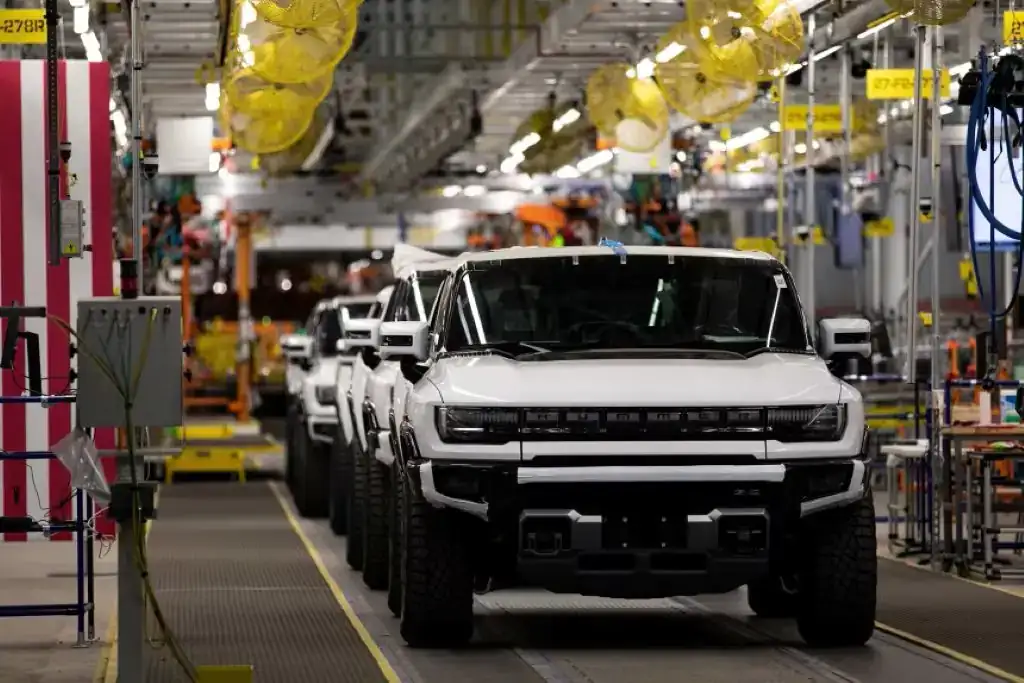
In October, however, GM confirmed it would eliminate one shift at its Factory Zero electric vehicle plant in Detroit, placing about 1,200 hourly workers on indefinite layoff. The company also put roughly 550 workers at an EV battery plant in Ohio on indefinite layoff as part of its earlier restructuring.
Those moves underscored the difficulty of aligning EV production capacity with fluctuating demand in a market still adjusting to new technologies and pricing realities.
Industry-wide recalibration underway
GM is not alone in absorbing large financial losses as it reworks its electric vehicle ambitions. Ford Motor said in December that it would take a $19.5 billion charge against earnings related to changes in its own EV strategy, reflecting similar pressures across the sector.
Traditional automakers have spent billions developing new platforms, securing battery supply chains, and retooling factories. As policy support softens and consumer demand proves less predictable, companies are increasingly balancing those investments against the continued profitability of gasoline-powered trucks and SUVs.
Long-term vision tempered by near-term realities
GM Chief Executive Mary Barra told investors in October that electric vehicles “remain our North Star,” signaling that the company has not abandoned its broader transition goals. At the same time, she acknowledged that sales of vehicles powered by traditional internal combustion engines “will remain higher for longer” than previously anticipated.
That recalibration reflects a growing consensus among global automakers that the transition to electric vehicles will be slower and more uneven than early forecasts suggested, particularly in the U.S. market.
For GM, the $6 billion charge represents both a financial setback and a strategic reset, as the company seeks to navigate changing policies, shifting consumer behavior, and the long-term challenge of transforming one of the world’s largest automotive businesses.
This article was rewritten by JournosNews.com based on verified reporting from trusted sources. The content has been independently reviewed, fact-checked, and edited for accuracy, neutrality, tone, and global readability in accordance with Google News and AdSense standards.
All opinions, quotes, or statements from contributors, experts, or sourced organizations do not necessarily reflect the views of JournosNews.com. JournosNews.com maintains full editorial independence from any external funders, sponsors, or organizations.
Stay informed with JournosNews.com — your trusted source for verified global reporting and in-depth analysis. Follow us on Google News, BlueSky, and X for real-time updates.