BUNIA, Democratic Republic of Congo — A deadly Ebola outbreak in eastern Congo is transforming one of the country’s most cherished social traditions, forcing couples to scale back wedding celebrations as authorities impose measures aimed at containing the spread of the virus.
For newlyweds Jean Claude Érable and Solange Hahati, their wedding day was marked by joy but also by the realities of a public health emergency that has altered daily life across parts of Ituri province.
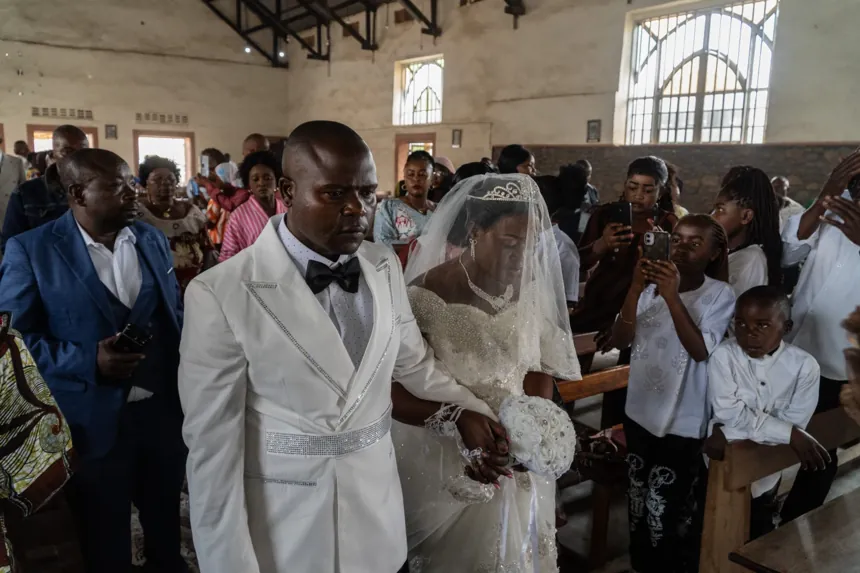
Instead of celebrating with hundreds of guests as originally planned, the couple exchanged vows before a sharply reduced gathering after local restrictions limited attendance at public events.

“We had planned 300 guests, but only 50 people were allowed to enter,” Hahati told The Associated Press. “It was really difficult because we wanted to celebrate with our friends.”
Health Measures Affect Community Gatherings
The outbreak, linked to the rare Bundibugyo strain of the Ebola virus, has become one of the most serious public health challenges facing the region.
According to Congolese health authorities, 515 confirmed infections and 91 deaths have been recorded so far. Officials believe the actual number of cases may be higher because the outbreak was identified weeks after transmission had already begun.
Health experts have also faced additional challenges because there is currently no approved vaccine or treatment specifically available for the Bundibugyo variant.
In response, authorities have encouraged residents to reduce physical contact, maintain social distancing, wash their hands frequently and promptly report suspected infections.
■ Related News



Weddings Adapt to New Reality
At a Catholic church in Bunia, the capital of Ituri province, wedding ceremonies continued under modified conditions as couples sought to balance celebration with public health precautions.
Relatives and friends attending Érable and Hahati’s ceremony remained physically distanced while taking photographs and offering congratulations. Traditional displays of affection, including close embraces and crowded festivities, were largely absent.
Outside the church, supporters gathered separately, singing and celebrating from a distance.
Érable said his family was committed to following government guidelines despite the challenges posed by the restrictions.
“We are adhering to the preventive measures and respecting social distancing,” he told The Associated Press. “We are doing our best to respect all the measures dictated by the state.”
After the ceremony, part of the wedding reception was moved outdoors, allowing guests more space while reducing the risks associated with crowded indoor gatherings.
Religious Institutions Adjust Activities
Church leaders in the region say adaptation has become necessary as the outbreak continues.
Rev. Aimé Lokanabego, who officiated the wedding ceremony, said some families have already chosen to postpone planned celebrations because of the restrictions and health concerns.
He also noted that certain religious activities considered to carry a higher risk of virus transmission have been suspended.
According to Lokanabego, the church has temporarily halted baptisms and other events that could increase exposure among participants.
“This is, in a way, how we are dealing with this Ebola epidemic at our level,” he said. “The situation is critical.”
Social Traditions Tested by Public Health Crisis
The restrictions have had a noticeable impact on social life in a region where weddings traditionally draw large crowds and often involve daylong festivities attended by extended families, neighbors and community members.
For many residents, adapting these longstanding customs has become part of the broader effort to contain the outbreak and protect vulnerable communities.
As health authorities continue monitoring the spread of the virus, families across Ituri face difficult decisions about how to preserve important cultural and religious traditions while complying with measures designed to slow transmission.
The experience of couples like Érable and Hahati illustrates how the Ebola outbreak is extending beyond hospitals and treatment centers, affecting everyday life and reshaping significant milestones throughout eastern Congo.
Tags: Democratic Republic of Congo, Ebola, Ituri Province, Public Health, Weddings