LA PAZ, Bolivia (Journos News) – Union-organized protests broke out across Bolivia on Monday as miners and allied groups launched a strike against President Rodrigo Paz’s decision to end fuel subsidies that had kept gasoline prices low for more than two decades. The demonstrations underscored growing tensions over how to address the country’s deepening economic crisis, even as parts of the labor movement and business sector back the reforms.
Protests mark first day of strike
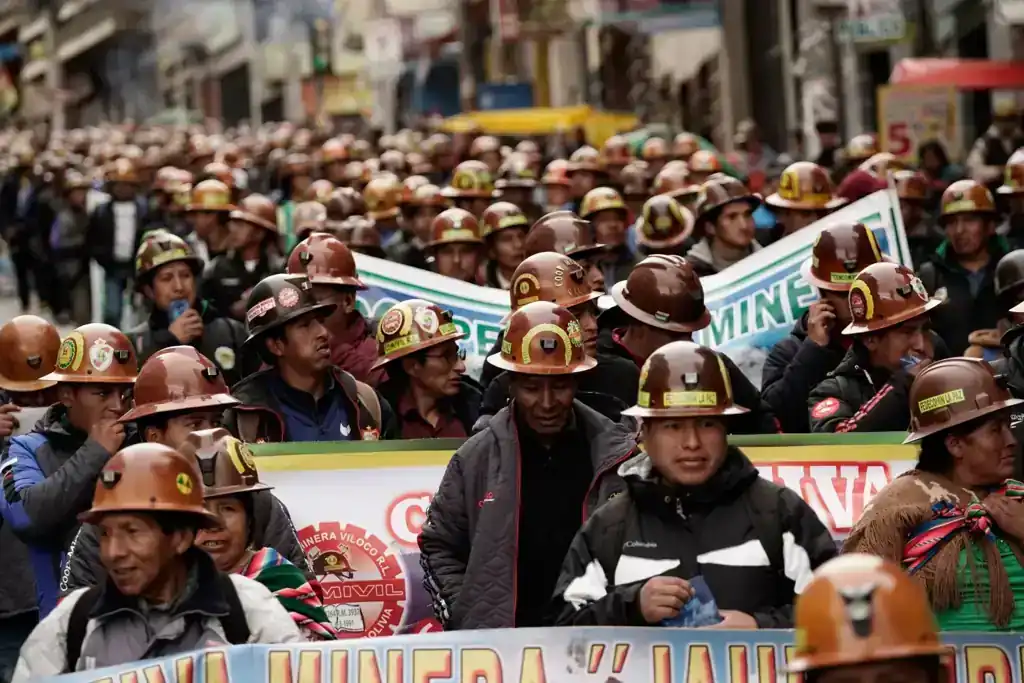
Miners marched through central La Paz while smaller rallies and roadblocks were reported in several other regions on Monday, the first day of a strike called by Bolivia’s Central Union of Workers. Police sealed off access to the main square in the capital, home to the presidential palace, to prevent demonstrators from approaching government buildings.
In the neighboring city of El Alto, local councils blocked key avenues, and Bolivia’s highway authority reported roadblocks on major highways in six of the country’s nine regions. The actions disrupted transport and commerce but fell short of a nationwide shutdown.
Despite the strike call, participation was uneven. Several powerful trade groups, including bus drivers’ unions, declined to join the protests after reaching separate agreements with the government.
Subsidies end after two decades
President Paz, a centrist who took office on Nov. 8, formally ended fuel subsidies last week through an emergency decree. The policy had kept gasoline prices at about $0.53 per liter since the early 2000s. Under the new measure, prices rose to roughly $1 per liter.
Speaking at a town hall meeting broadcast on state television on Sunday, Paz defended the decision as unavoidable. He said the government was spending about $10 million a day on subsidies that, in his view, benefited smugglers who resold cheap fuel domestically and across borders.
“The country is sick and must be healed,” Paz said, framing the move as part of a broader effort to stabilize public finances and restore confidence in the economy.
Economic pressures drive reform push
Bolivia’s fuel subsidies have long been politically sensitive, particularly among unions aligned with left-wing movements. However, the government argues that the policy has become unsustainable as imports of gasoline and diesel—costing up to $3 billion a year—have drained foreign currency reserves.
The pressure has intensified following a sharp decline in natural gas exports, historically one of Bolivia’s main sources of hard currency. Economists say the loss of export revenue has contributed to dollar shortages, import bottlenecks, and what officials describe as the country’s most severe economic strain in four decades.
Business groups have largely welcomed Paz’s measures, saying they could ease access to dollars and make it easier for companies to import goods and capital equipment.
Divisions within the labor movement
The protests revealed fractures within Bolivia’s traditionally influential labor sector. Some union leaders acknowledged that the end of subsidies had been expected, even if the speed of the decision angered workers.
“We knew that at some point the subsidies would end,” said Luis Paco, a merchants’ union leader in El Alto. “There were no negotiations over the new adjustments, but we knew this was inevitable.”
Bus drivers’ unions stayed away from Monday’s strike after the government agreed to allow duty-free imports of auto parts. Paz has also announced a 20% increase in the minimum wage, a move aimed at cushioning the impact of higher fuel costs on workers.
“We will continue to work, to serve the people,” said Lucio Gomez, a transport union leader, explaining why drivers kept operating.
Hardline unions demand reversal
Other unions, particularly those representing miners and coca growers and traditionally aligned with former president Evo Morales, rejected the government’s arguments and pushed ahead with strikes and marches.
Mining leader Andrés Paye said protesters would remain in the streets until the decree eliminating the subsidy was repealed. He accused the government of favoring business interests at the expense of poorer Bolivians, arguing that higher fuel prices would ripple through food and transport costs.
Morales-aligned unions also led a large march in Cochabamba, Bolivia’s third-largest city, and blocked two major highways in the eastern part of the country, signaling their intent to escalate pressure if the government does not reverse course.
Political calculations ahead of elections
Analysts say the standoff is taking place against a backdrop of upcoming regional elections next year, adding a political dimension to the labor unrest.
Carlos Cordero, a political science professor in La Paz, said the union behind the strike was attempting to demonstrate its mobilizing power ahead of contests for governors and mayors. However, he noted that turnout on the first day of protests appeared limited.
“In many sectors of the country, there is a conviction that the adjustment was necessary,” Cordero said, suggesting that years of economic strain have shifted public attitudes toward painful reforms.
For now, Paz’s government appears determined to press ahead, betting that partial union support and business backing will help it weather the backlash. Whether protests widen or fade may depend on how quickly the promised economic relief materializes for ordinary Bolivians.
This article was rewritten by JournosNews.com based on verified reporting from trusted sources. The content has been independently reviewed, fact-checked, and edited for accuracy, neutrality, tone, and global readability in accordance with Google News and AdSense standards.
All opinions, quotes, or statements from contributors, experts, or sourced organizations do not necessarily reflect the views of JournosNews.com. JournosNews.com maintains full editorial independence from any external funders, sponsors, or organizations.
Stay informed with JournosNews.com — your trusted source for verified global reporting and in-depth analysis. Follow us on Google News, BlueSky, and X for real-time updates.