Palestinian Gaza (Journos News) – Armed Palestinian factions backed by Israel are attempting to entrench themselves in parts of eastern Gaza left largely depopulated and under Israeli military control, as Hamas moves to reassert authority elsewhere in the enclave. The emergence of these groups has added a new layer of instability to Gaza’s post-war landscape, raising fears among residents of internal conflict and deepening uncertainty over who might govern the territory in the future.
When Sheikh Mohammed Abu Mustafa left his mosque in southern Gaza after afternoon prayers in early November, a gunman on a motorcycle shot him dead. Islamist militants later described the killing as a targeted assassination, alleging it was carried out by a local militia operating with Israeli backing.
A Hamas-linked group claimed the slain imam had been involved in hiding Israeli hostages during the war, an accusation not independently verified. It also accused the gunman of belonging to a newly formed militia led by Hussam al-Astal, a former detainee under Hamas rule who has since emerged as an outspoken opponent of the group that has governed Gaza for nearly two decades.
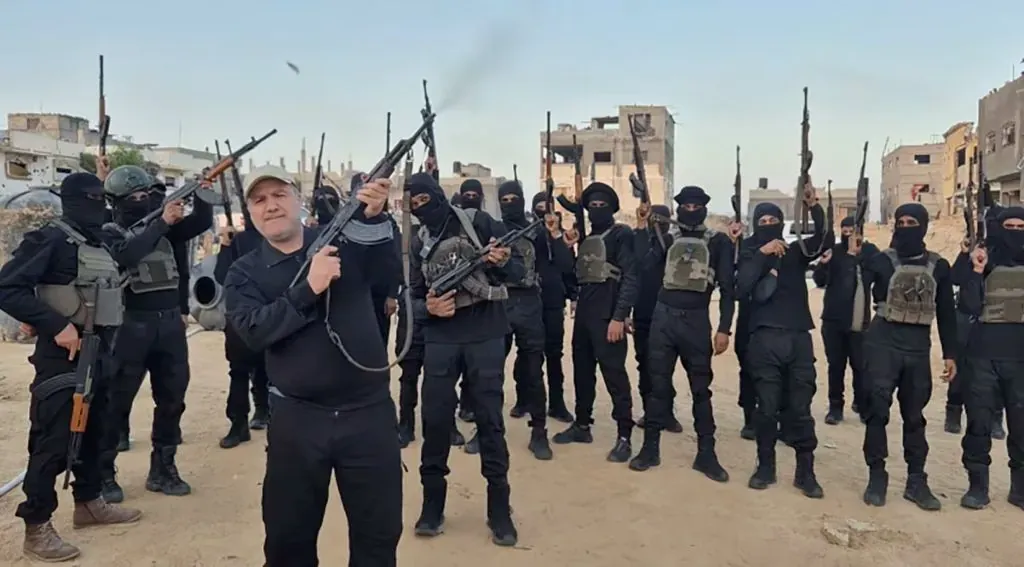
Speaking by phone to CNN, al-Astal denied responsibility for the killing but said he welcomed the death of Hamas members. He now leads a small armed faction calling itself the Counter-Terrorism Strike Force, which has taken control of a village inside Israeli-occupied territory east of Khan Younis. From there, the group conducts raids against Hamas positions and seeks to expand its local influence.
Gaza split along a new fault line
Following the ceasefire that ended nearly two years of fighting, Gaza has effectively been divided. Hamas has been re-establishing control in the western half of the strip, from which Israeli forces withdrew and where most of Gaza’s population remains. East of what Israeli forces refer to as the “yellow line” — a military boundary cutting through the enclave — civilian presence is sparse, and Israeli troops maintain control.
It is in this eastern zone that several armed factions have emerged. Under close Israeli oversight, at least five such groups are now operating, according to CNN reporting. What began as loosely organised gangs exploiting wartime chaos has evolved into a network of militias positioning themselves as potential alternatives to Hamas in any post-war arrangement.
“There is coordination between our groups. We have the same goals and the same ideology,” al-Astal told CNN, referring to their shared aim of defeating Hamas.
The factions are lightly armed, numbering only a few dozen fighters each, and operate from separate bases within Israeli-controlled areas. Their leaders post frequent videos online showing masked men in improvised uniforms brandishing rifles and declaring their intention to “liberate” Gaza from Hamas.
Despite their limited capacity, these groups have contributed to further instability. Through hit-and-run attacks, they have sought to undermine Hamas as it rebuilds administrative control in areas no longer occupied by Israel. The result has been what some analysts describe as an insurgency within an insurgency, at a moment when governance in Gaza remains fragile.
Hamas responds with force
Hamas has moved aggressively to counter the militias, pursuing suspected collaborators and rivals. The campaign has heightened fears among Palestinians that Gaza could slide into internal violence.
Videos circulating on social media in October, shared by Hamas-affiliated channels, showed masked fighters executing blindfolded detainees in a public square in Gaza City. Hamas-linked groups said those killed were collaborators or involved in criminal activity but provided no evidence to support the claims.
For many residents, the images reinforced concerns that the struggle for control could bring a new cycle of violence, even after the war with Israel has subsided.
Competing claims to govern
Among the most prominent anti-Hamas factions was the Popular Forces, previously led by Yasser Abu Shabab, an Israel-aligned militia leader who was killed this month following a family dispute, according to his group. Hamas supporters openly celebrated his death, distributing sweets in parts of Gaza.
A Hamas-affiliated Telegram channel described Abu Shabab’s group as responsible for significant suffering, accusing it of guiding Israeli forces to Hamas fighters hiding in Rafah tunnels — claims that could not be independently confirmed.
Yet the ambitions of these militias extend beyond challenging Hamas militarily. Groups operating across Gaza’s east, north, and centre — including the Popular Army, the Counter-Terrorism Strike Force, and the Popular Defense Army — have presented themselves as capable of local governance.
Some have sought to recruit civilians, appealing to professionals such as doctors, lawyers, and teachers. Abu Shabab had publicly offered monthly salaries to fighters, promising higher pay for officers. Israel has acknowledged backing his group, though details of funding and long-term support remain unclear.
Rami Hallas, who leads the Popular Defense Army, told CNN that many of his fighters were previously imprisoned by Hamas. He said the group was formed in May, initially to help secure humanitarian aid routes in eastern Gaza, and that it later took on a broader role in coordination with the Palestinian Authority based in the West Bank.
Uncertain future in Gaza’s “day after”
The idea of establishing Hamas-free zones as a first step toward reconstruction has been discussed by some international figures. In October, Jared Kushner, a former senior adviser to US President Donald Trump, suggested rebuilding could begin in areas such as Rafah, where some of the militias operate.
Militia leaders insist they will play a role in Gaza’s future, though there is little evidence of widespread public support. Israeli sources told CNN that Israel intends to continue backing these groups, even after Abu Shabab’s death, and that some were expected to help secure planned reconstruction sites.
Analysts remain sceptical. Muhammad Shehada of the European Council on Foreign Relations described the arrangement as sustaining a “pretend population” in eastern Gaza, noting that most Palestinians are neither allowed nor willing to live there.
Residents interviewed by CNN echoed that view. Several said approaching the Israeli-controlled boundary risks death, and those who do are often viewed as collaborators. Many stressed that relocation would only be considered after a full Israeli withdrawal and under a recognised Palestinian authority.
For now, Gaza remains in diplomatic and political limbo. As Hamas tightens its grip in the west and armed factions consolidate positions in the east, the absence of a credible, unified governance plan continues to cloud prospects for stability — and leaves civilians caught between competing powers in a territory still reeling from war.
This article was rewritten by JournosNews.com based on verified reporting from trusted sources. The content has been independently reviewed, fact-checked, and edited for accuracy, neutrality, tone, and global readability in accordance with Google News and AdSense standards.
All opinions, quotes, or statements from contributors, experts, or sourced organizations do not necessarily reflect the views of JournosNews.com. JournosNews.com maintains full editorial independence from any external funders, sponsors, or organizations.
Stay informed with JournosNews.com — your trusted source for verified global reporting and in-depth analysis. Follow us on Google News, BlueSky, and X for real-time updates.