CAIRO, Egypt – Saudi Arabia has accused Iran of encouraging the latest escalation of Houthi attacks against the kingdom, but the public evidence reviewed for this report does not independently establish that Tehran directed specific operations.
Rayed Krimly, Saudi Arabia’s deputy minister for public diplomacy, made the accusation during a briefing with journalists on October 15, 2026. He said Riyadh believed Iran was encouraging the Houthis’ latest campaign and accused Tehran of continuing to arm, train and support the movement in violation of relevant United Nations Security Council resolutions and commitments under the agreement that restored Saudi-Iranian diplomatic relations in 2023.
The statements outline Saudi Arabia’s assessment of Iran’s role in the conflict. They do not, on their own, demonstrate that Iranian officials ordered or controlled particular attacks.

Saudi Arabia alleges Iranian encouragement
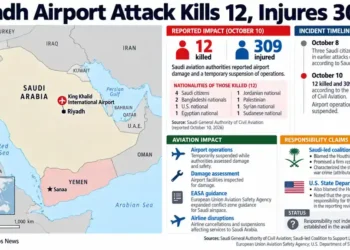
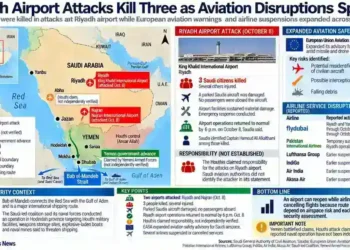
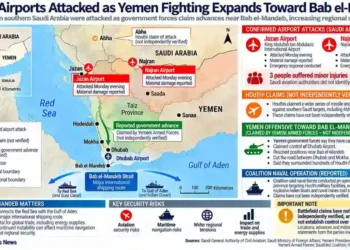
Krimly’s accusation came after a wave of Houthi attacks against Saudi infrastructure, including Riyadh’s King Khalid International Airport and facilities associated with Saudi oil company Aramco. Saudi authorities have described the campaign as a serious threat to national security.
The Saudi official also said Iran continued to provide weapons, training and other support to the Houthis. These are government allegations that require assessment against the relevant evidence. General evidence of Iranian support for the movement does not automatically establish Iranian involvement in planning or directing each attack.
The distinction is important because encouragement, material support and operational command are different claims. Evidence supporting one does not necessarily establish the others.
The Houthis dispute claims of Iranian direction
Houthi spokesperson Mohammed Abdulsalam disputed the assertion that the movement was acting at Iran’s behest. In a statement reported on October 15, he said the group’s demands concerned issues including restrictions on Yemeni ports and airports, economic conditions and the payment of public-sector salaries.
The response contests the characterization of the Houthi campaign as an Iranian-directed effort, but it does not independently establish the extent of Tehran’s involvement in weapons supply, training or other support.



Iran’s Foreign Ministry had not immediately responded to a request for comment reported by Reuters on October 15. The Saudi government media office also had not immediately responded to that outlet’s request. No direct response to a Journos News inquiry was obtained for this report.
The available record therefore contains a Saudi accusation and a Houthi denial of acting at Iran’s direction, but no independently examined evidence resolving the specific question of Iranian encouragement or command.
What United Nations records establish
The UN Security Council has imposed sanctions and arms-embargo measures relating to Yemen. Resolution 2216, adopted in 2015, established an arms embargo targeting designated individuals and entities, including Houthi leadership. Subsequent resolutions and expert monitoring have addressed efforts to prevent prohibited arms transfers and other forms of support that threaten Yemen’s peace and security.
UN documentation provides a framework for assessing allegations about weapons transfers and assistance. It must be read carefully, however: a sanctions regime is not proof that a particular state violated it in connection with a specific attack.
The public material reviewed for this report does not establish that a UN body has independently determined Iran encouraged or directed the latest attacks on Saudi Arabia. Nor does the existence of earlier findings or allegations about weapons transfers resolve who made operational decisions during the current escalation.
A stronger conclusion would require evidence tied to the specific claims, such as relevant expert-panel findings, documented transfers, authenticated operational communications or other independently verifiable records. No such evidence specifically establishing Iranian direction of the latest attacks was independently obtained for this report.
Saudi-Houthi contacts and the proposed Oman meeting
Krimly said Saudi Arabia had sought a meeting with the Houthis in Oman to address outstanding differences and reduce the escalation, but that the group declined the invitation. He also said Riyadh maintained direct communication with both Iran and the Houthis, with Oman facilitating Saudi-Houthi contacts rather than mediating them.
The account offers a view of Saudi Arabia’s diplomatic position during the conflict. However, the proposed meeting and the reported refusal remain based on the Saudi official’s account in the material reviewed. The original invitation, a contemporaneous Omani statement and an independent Houthi account of the proposed meeting were not obtained.
The existence of communication channels also does not establish that negotiations are producing progress or that either side has accepted the other’s terms. Further official documentation would be needed to establish the meeting’s precise timing, agenda and reasons it did not take place.
Strategic motives remain contested
The latest attacks have prompted assessments that the Houthis may be seeking to pressure Saudi Arabia and indirectly influence the wider confrontation involving Iran and the United States. Such assessments draw attention to the strategic importance of Saudi infrastructure and the economic consequences of continued disruption.
But a broader strategic interpretation should not be confused with a proven account of the decision-making behind each operation. The Houthis have publicly framed their demands around restrictions on Yemen and economic issues, while Saudi Arabia argues that Iran is encouraging the escalation.
The available reporting does not independently establish that every Houthi attack was undertaken to advance Iranian objectives. The movement’s own political and military calculations, the nature of Iranian support and the degree of coordination between them remain separate questions.
What remains unverified
The public evidence reviewed does not establish what specific intelligence or documentary evidence Saudi Arabia is relying on to support its accusation that Iran encouraged the latest escalation. The original briefing transcript and any supporting intelligence materials were not independently obtained.
Nor was a direct response from Iran’s Foreign Ministry or a relevant Houthi representative obtained by Journos News. The Houthi spokesperson’s reported denial is therefore presented as a statement made to another news organization, not as the result of a direct interview conducted for this report.
The next stage of reporting should examine the complete Saudi briefing, relevant UN expert-panel findings, official records concerning the reported attacks and any documented evidence of weapons transfers or operational coordination. Saudi, Iranian, Houthi and Omani authorities should be asked to clarify the accusation, the proposed meeting and the status of diplomatic contacts.
For now, the defensible conclusion is that Saudi Arabia has publicly accused Iran of encouraging the latest Houthi escalation, while the Houthis dispute acting at Tehran’s direction. The available evidence reviewed here does not independently establish that Iran directed particular attacks.
Reporting Credit: United Nations Security Council sanctions documentation concerning Yemen; statements by Saudi Deputy Minister for Public Diplomacy Rayed Krimly and Houthi spokesperson Mohammed Abdulsalam as reported in contemporaneous coverage. The original Saudi briefing transcript and supporting intelligence materials were not independently obtained.