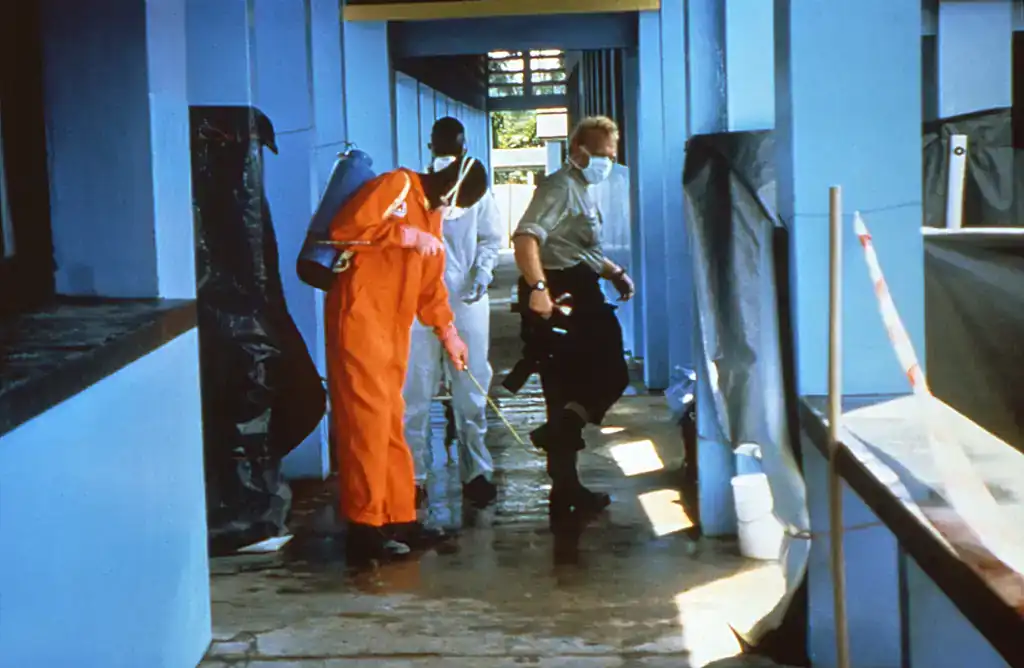
KINSHASA, Democratic Republic of the Congo – The Democratic Republic of the Congo (DRC) reported 9,066 confirmed cases of Ebola disease and 4,381 deaths as of October 13, as health workers continued efforts to control an outbreak spreading across multiple provinces.
The outbreak is caused by Bundibugyo virus, a species for which no vaccine or specific treatment has been approved. The World Health Organization (WHO) says insecurity, population movement, gaps in contact tracing and delays in accessing medical care are complicating efforts to stop transmission.
The latest national figures make this the largest and deadliest Ebola outbreak recorded in the DRC. The 4,381 reported deaths represent a crude case-fatality ratio of about 48.3% when compared with the confirmed-case total. That figure is not a prediction of an individual patient’s outcome, and it may change as authorities identify more cases and reconcile records.

The outbreak has also crossed national borders. Kenya reported an imported case involving a traveller who had journeyed from the DRC through Uganda and died in Nairobi on October 5. Kenyan authorities reported on October 11 that 293 tests had found no additional cases.
The scale of the outbreak is putting sustained pressure on surveillance, treatment and contact-tracing operations. However, the available evidence does not show that all containment measures have stopped working. Health authorities and international partners continue to support case detection, clinical care, community engagement and vaccine research.
Cases Continue Across Multiple Provinces
The DRC’s national public-health institute reported 9,066 confirmed cases and 4,381 deaths as of October 13, according to contemporaneous reporting. The figures carry a later cutoff than the WHO’s most recent detailed situation report available for this article.
The WHO recorded 8,728 confirmed cases and 4,205 deaths as of October 6. At that point, the outbreak had reached 64 health zones across seven provinces.
The WHO identified Ituri as the main centre of transmission, with North Kivu also reporting substantial numbers of cases. Other affected provinces included Haut-Uélé, Tshopo, Bas-Uélé, South Kivu and Sud-Ubangi.
■ Related News



Subsequent reporting published on October 13 said the outbreak had reached 65 health zones. That figure reflects a later update and should not be confused with the WHO’s October 6 count.
The geographic spread makes the response more difficult. Authorities must identify infections in different communities, monitor people who have had contact with confirmed cases and ensure that patients can reach appropriate care.
The number of affected health zones does not mean that every area faces the same level of transmission. The intensity of the outbreak varies between locations, and some areas have reported no recent cases even as others continue to experience new infections.
Delayed Detection Contributes to Deaths
The WHO’s October 6 report highlighted the number of deaths occurring outside treatment centres. Such deaths can indicate that people become seriously ill before health workers identify their infection or that patients face barriers to reaching medical facilities.
Early detection is important because patients need timely supportive care. Health workers also need to identify and monitor people who may have been exposed before they develop symptoms.
The WHO reported that contact follow-up remained below its target during the period covered by its latest detailed situation report. As of October 4, response teams had reached 23,741 of 29,535 contacts, or about 80.4%. The target was 85%.
Contact tracing helps teams identify people who may have been exposed and monitor them during the period when symptoms could develop. When teams cannot locate contacts or maintain follow-up, they may miss opportunities to detect new infections early.
The WHO has also emphasized that delays in recognizing cases can allow transmission to continue in households, communities and health facilities.
The figures do not establish that every death outside a treatment centre resulted from a lack of care. They do, however, underline the importance of making testing, clinical support and early referral accessible to affected communities.
Conflict and Mistrust Complicate the Response
The outbreak is unfolding amid a humanitarian crisis and insecurity in parts of eastern DRC. Armed conflict, population displacement and movement between communities can make it harder for health teams to reach patients and maintain contact with exposed people.
The WHO has identified insecurity, dense populations in some affected areas and high population and trade movements as important challenges. The organization says it is supporting surveillance, laboratory testing, clinical preparedness, supplies and community engagement.
Community cooperation also matters. People may delay seeking care when they distrust authorities, fear isolation or worry about how health workers will handle a family member’s illness or death.
However, those concerns should not be generalized to entire communities. The available institutional reports describe operational challenges but do not establish that all residents in affected areas reject health guidance.
Health responders need to explain infection-control measures clearly, work with trusted local leaders and address practical barriers to care. Safe burial practices and early reporting of symptoms can also help reduce opportunities for transmission.
The response therefore depends on more than medical supplies. Teams need reliable access to affected areas, timely information about possible cases and cooperation from the people they are trying to protect.
Kenya Case Raises Cross-Border Concerns
The outbreak’s regional reach became more apparent after Kenya confirmed an imported case in a traveller who had travelled from the DRC through Uganda.
The patient was hospitalized in Kenya and died on October 5, according to the WHO’s October 8 disease outbreak report. Kenyan authorities subsequently said 293 tests had produced no additional confirmed cases as of October 11.
The result was an encouraging update, but it did not remove the need for surveillance. Health authorities in Kenya and Uganda began contact tracing and other public-health measures following the case.
Uganda had reported 20 confirmed cases and two deaths earlier in the outbreak. The country was declared Ebola-free in August after meeting the required monitoring period without new cases.
The imported case in Kenya demonstrates the possibility of cross-border transmission, not proof that widespread transmission has begun there. Authorities must continue monitoring contacts and investigating potential exposures to determine whether further infections occur.
The WHO has warned that movement through informal border routes can complicate screening at official crossings. It recommends continued coordination between neighbouring countries, surveillance and preparedness.
The current evidence therefore supports concern about regional spread, while distinguishing the ongoing outbreak in the DRC from the status of countries that have not reported continuing transmission.
No Approved Bundibugyo Vaccine, but Research Continues
The Bundibugyo virus is distinct from the Ebola virus species responsible for the 2014–2016 West African epidemic. Vaccines and specific treatments developed for other Ebola species cannot automatically be assumed to protect against it.
There is currently no vaccine licensed specifically for Bundibugyo virus disease. However, researchers are testing candidate interventions and evaluating whether an existing Ebola vaccine may provide protection.
In August, the international vaccine-allocation mechanism released 70,000 doses of Ervebo for the DRC. The allocation included 20,000 doses for a Phase 3 clinical trial and 50,000 doses for frontline and health workers under the applicable recommendations.
Ervebo is licensed for Ebola disease caused by the Zaire species. Its effectiveness against Bundibugyo virus in humans remains unknown. The WHO has therefore recommended using it against this outbreak only within a research protocol.
A separate vaccine candidate developed by the University of Oxford has entered an early-stage clinical study in Uganda, according to the university’s research team. That study assesses safety and the immune response; it has not established that the vaccine prevents illness.
These efforts are important steps in developing tools against a virus for which approved vaccine protection is unavailable. But a vaccine allocation, a clinical trial and an approved intervention are different things. None should be described as proof that an effective Bundibugyo vaccine is already available.
The WHO has also supported clinical research into potential treatments. For now, prompt diagnosis, infection prevention, careful clinical management and supportive care remain central to the response.
A Larger Historical Context
The current outbreak is the largest and deadliest Ebola outbreak recorded in the DRC, surpassing the country’s 2018–2020 epidemic.
It remains smaller than the 2014–2016 West African epidemic, which caused approximately 28,600 reported cases and more than 11,000 deaths across Guinea, Liberia and Sierra Leone, according to WHO historical figures.
Those comparisons involve different outbreaks, periods and surveillance conditions. They do not establish how large the current epidemic will ultimately become.
The high death toll in the DRC reflects both the severity of the disease and continuing challenges in detecting infections early and ensuring access to care. It also reinforces the need to interpret cumulative figures according to their reporting dates.
Containment Depends on Access, Trust and Early Care
The latest totals show that Bundibugyo virus disease continues to cause substantial loss of life in the DRC. The spread across multiple provinces and the imported case in Kenya underline the importance of sustained surveillance and regional coordination.
The response is not without tools. Health authorities and international partners continue to trace contacts, strengthen clinical preparedness, provide supplies, engage communities and support research. However, the effectiveness of those measures depends on whether teams can reach affected populations and identify infections quickly enough to interrupt transmission.
The available evidence does not support declaring that containment has completely failed, nor does it show that the outbreak is under control. The number of confirmed cases and deaths continues to rise, while conditions vary across affected areas.
For now, the DRC’s reported total stands at 9,066 confirmed cases and 4,381 deaths as of October 13. The next phase of the response will depend on faster detection, access to care, stronger contact follow-up and sustained cooperation between communities and health workers, alongside research into vaccines and treatments.
Reporting Credit: World Health Organization; Africa Centres for Disease Control and Prevention.