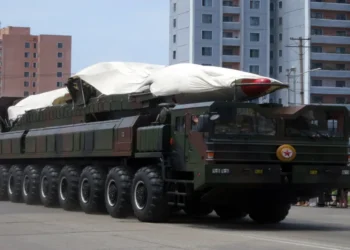
SEOUL, South Korea – North Korea fired at least one ballistic missile toward the East Sea on Saturday morning, South Korea’s military said, as tensions remain elevated over explosions that injured three South Korean soldiers near the inter-Korean border.
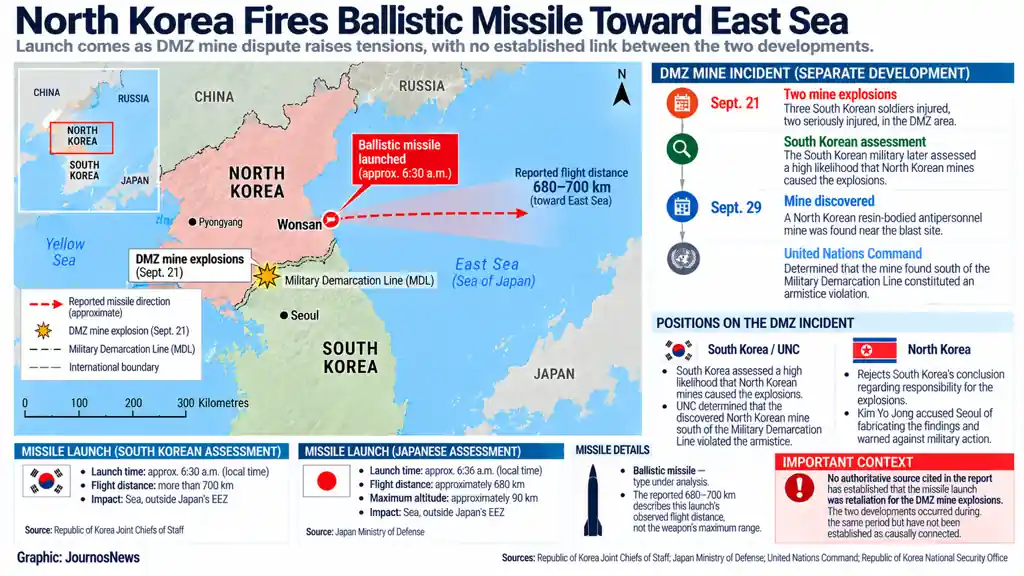
South Korea’s Joint Chiefs of Staff said it detected the launch from the Wonsan area at about 6:30 a.m. local time. The missile traveled more than 700 kilometers before landing at sea, while South Korean and U.S. authorities continued analyzing its precise specifications.
Japan’s Defense Ministry separately reported that at least one ballistic missile was launched from near North Korea’s east coast at about 6:36 a.m. It estimated a flight distance of about 680 kilometers and a maximum altitude of approximately 90 kilometers, with the missile falling outside Japan’s exclusive economic zone.

The different distance estimates reflect the separate preliminary assessments by the South Korean and Japanese authorities. Both governments confirmed the launch and said further analysis was underway.
South Korea increases surveillance
The South Korean military said it had strengthened surveillance and readiness for possible additional launches.
The Joint Chiefs of Staff also said South Korea, the United States and Japan were closely sharing information about the launch. South Korean and U.S. intelligence authorities had tracked the missile from the early stages of the launch, according to the JCS.
South Korea’s presidential National Security Office held an emergency security meeting after the launch. Seoul said the ballistic-missile firing violates relevant U.N. Security Council resolutions and called on Pyongyang to stop such launches.
Japan also said the launch violated applicable U.N. Security Council resolutions and instructed its defense authorities to maintain surveillance and prepare for possible further developments.



The missile did not enter Japan’s EEZ, and Japan’s Defense Ministry said there were no reports of damage to aircraft or vessels in the area.
Missile type remains under analysis
South Korea has not publicly assigned a definitive missile class to Saturday’s launch.
The JCS said it was analyzing the exact specifications with the United States. South Korean reporting has described medium-range and intermediate-range possibilities as being examined, but those classifications have not been officially confirmed.
JournosNews is therefore not identifying the weapon as a particular missile model, an intermediate-range ballistic missile or an intercontinental ballistic missile.
The reported flight distance also should not be treated as the missile’s maximum range. It describes the trajectory observed during this launch.
Saturday’s firing came 13 days after North Korea launched two short-range ballistic missiles from the Wonsan area toward the East Sea on Sept. 20, according to the South Korean military.
Missile launch follows DMZ mine dispute
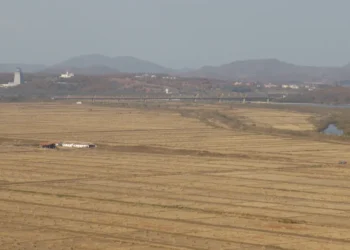
The launch occurred amid a separate and unresolved confrontation over land mines inside the Demilitarized Zone.
On Sept. 21, three South Korean soldiers were injured in two mine explosions while troops were clearing a route near the Military Demarcation Line. Two soldiers suffered serious injuries and another was less severely injured.
South Korea’s military later assessed that there was a high likelihood that North Korean mines caused the explosions. Investigators cited evidence from the site and forensic material recovered from the soldiers’ equipment.
A subsequent inspection by South Korean forces and the United Nations Command found a North Korean resin-bodied antipersonnel mine near the blast site on Sept. 29. The South Korean military and the UNC said additional examination was continuing.
The discovery led the United Nations Command to determine that a North Korean mine found south of the Military Demarcation Line constituted an armistice violation. The broader investigation into the Sept. 21 explosions has remained separate from that specific finding.
Pyongyang rejects responsibility
North Korea has rejected South Korea’s conclusion that its mines caused the Sept. 21 explosions.
Kim Yo Jong, the sister of North Korean leader Kim Jong Un, accused Seoul of fabricating the findings and warned of retaliation if South Korean forces take military action against North Korean troops working on border fortifications.
She repeated the denial in a statement issued Friday, while also rejecting South Korean efforts to reduce military tensions and proposals for dialogue concerning the Military Demarcation Line.
The statements do not establish a link between the mine dispute and Saturday’s missile launch.
North Korea has not publicly said that the missile launch was carried out in response to the Sept. 21 explosions or South Korea’s subsequent accusations.
A broader period of military tension
The missile launch adds another military development to an already tense period on the Korean Peninsula.
South Korea has accused North Korea of continuing border fortification work, including mine-laying and construction activity near the Military Demarcation Line. Pyongyang has rejected Seoul’s accusations concerning the recent mine explosions while continuing to issue warnings against South Korean military action.
The latest missile launch therefore occurred alongside, rather than necessarily because of, the unresolved border dispute.
For now, the confirmed facts are that North Korea launched at least one ballistic missile from the Wonsan area, South Korea and Japan detected the launch, the missile traveled roughly 680–700 kilometers according to their preliminary assessments, and authorities are continuing to determine its precise specifications.
No authoritative source cited in this report has established that the launch was retaliation for the DMZ mine explosions.
Reporting Credit: Republic of Korea Joint Chiefs of Staff; Republic of Korea National Security Office; Japan Ministry of Defense; United Nations Command; North Korean/KCNA statements as reported and attributed by South Korean authorities and official reporting.