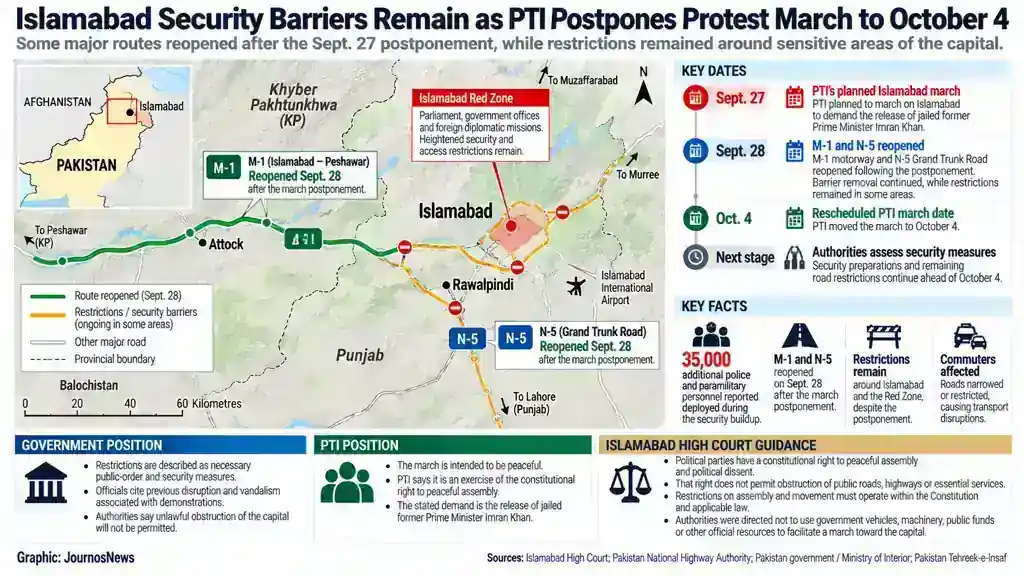
ISLAMABAD, Pakistan – Shipping containers and other barriers remain deployed along key roads in and around Pakistan’s capital as authorities prepare for a protest march by supporters of jailed former Prime Minister Imran Khan, despite the opposition Pakistan Tehreek-e-Insaf having postponed the demonstration by a week.
The PTI originally planned to march on Islamabad on September 27 to demand Khan’s release. The party later moved the date to October 4, while authorities began removing some of the barriers from major highways connecting Islamabad with the northwest. Several restrictions inside and around the capital, however, have remained.
The measures have affected daily travel between Islamabad and neighboring Rawalpindi and have disrupted commercial activity along some routes.

Containers have been positioned near major approaches to the capital and around the Red Zone, which contains Parliament, government offices and foreign diplomatic missions. Some roads have been narrowed rather than completely closed, creating additional congestion and forcing commuters to seek alternative routes.
Authorities maintain security measures
The government has defended the restrictions as necessary preparations for a protest that could disrupt public order.
Information Minister Attaullah Tarar said PTI had a record of disruption and vandalism during previous demonstrations and that supporters would not be allowed to enter the capital in circumstances that authorities consider unlawful.
The government has also pointed to previous confrontations involving PTI supporters and security forces.
Reuters reported last week that authorities had deployed about 35,000 additional police and paramilitary personnel in and around Islamabad and closed two major highways linking the capital with Khyber Pakhtunkhwa, the province governed by PTI.
■ Related News

The security operation followed arrests of PTI activists and several of Khan’s sisters ahead of the originally scheduled march. Authorities cited public-order concerns for the measures.
PTI says the march is intended to be peaceful
PTI leaders have said the demonstration is intended to demand Khan’s release and to exercise what the party describes as its constitutional right to peaceful assembly.
The party postponed the march from September 27 to October 4 after authorities blocked major approaches to Islamabad, according to the Associated Press.
Khan has been imprisoned since 2023 and is serving sentences following convictions on corruption and other charges. He and PTI have described the cases as politically motivated, while Pakistani authorities have rejected that characterization.
Khan was removed as prime minister in a parliamentary no-confidence vote in April 2022. His political movement has remained a major force in Pakistan despite his imprisonment and restrictions affecting the party.
Courts set limits on road blockades
The dispute over the march is also being shaped by a recent Islamabad High Court ruling.
The court said political parties have a constitutional right to peaceful assembly and political dissent but cannot use that right to obstruct public roads, highways or access to essential services. It said restrictions on assembly and movement must operate within the Constitution and applicable law.
The ruling also directed provincial authorities not to use government vehicles, machinery, public funds or other official resources to facilitate a march toward the capital.
The court’s decision therefore places obligations on both the organizers of political demonstrations and authorities responsible for maintaining public order.
Road restrictions have carried an economic cost
The barriers have affected more than the movement of protesters.
Major routes between Islamabad, Rawalpindi and Khyber Pakhtunkhwa were restricted during the security buildup. The M-1 motorway between Islamabad and Peshawar and the N-5 Grand Trunk Road were reopened on September 28 after the PTI postponement, although work to remove barriers from other routes continued.
Transport operators reported reduced activity during the closures, while businesses dependent on movement between the capital and surrounding areas also experienced disruption.
The restrictions have been particularly visible around Attock and other crossings connecting Khyber Pakhtunkhwa with Punjab and Islamabad. Authorities had deployed thousands of containers at key points before the planned march.
For residents, the containers have become an early signal of anticipated political disruption. The Associated Press reported that some residents changed commuting routes and stocked up on supplies after the barriers appeared.
October 4 becomes the next test
With the PTI march now scheduled for October 4, authorities face another decision over how long the current restrictions should remain and whether additional security measures will be introduced as the new date approaches.
The government has said it will enforce the court’s directions and prevent unlawful obstruction of the capital. PTI has maintained that its demonstration is intended to be peaceful and focused on Khan’s release.
The immediate effect is already visible across the capital region.
Containers placed to prevent demonstrators from reaching sensitive government areas have also narrowed routes used by ordinary residents, commercial vehicles and public transport.
For Islamabad, the political confrontation is therefore being felt before the march itself arrives. Whether the remaining barriers are removed or reinforced will depend on how authorities assess the security situation as October 4 approaches.
Reporting Credit: Islamabad High Court — September 2026 ruling concerning political marches, public roads, citizens’ rights and government resources; Pakistan National Highway Authority — reopening and restrictions affecting major Islamabad–Khyber Pakhtunkhwa routes; Pakistan government / Ministry of Interior — security measures and public-order position; Pakistan Tehreek-e-Insaf — statements concerning the planned march and demand for Imran Khan’s release.