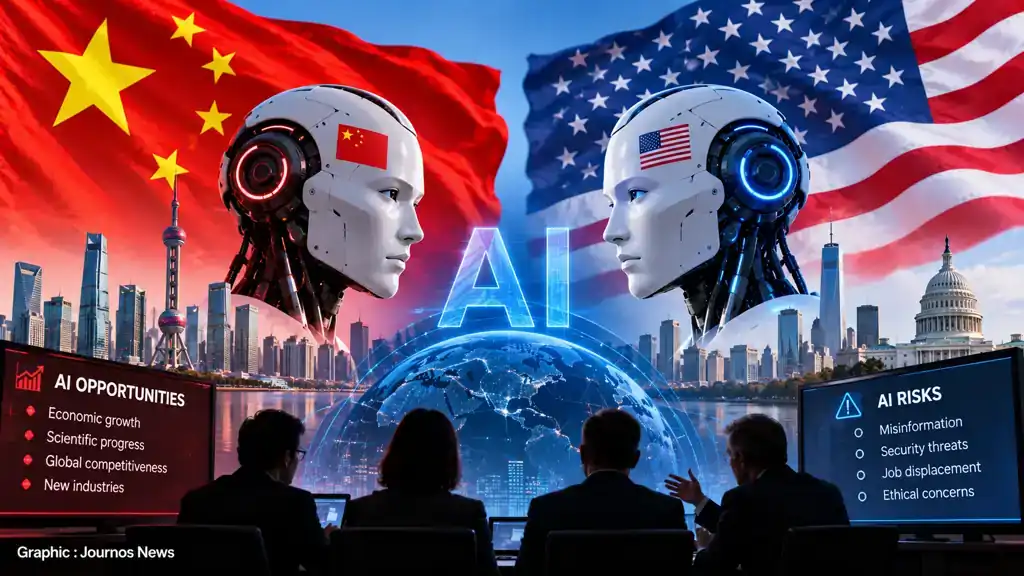
BEIJING, China – China is narrowing the artificial-intelligence gap with the United States, according to recent assessments of the two countries’ AI capabilities, as policymakers and technology companies face growing questions over the risks accompanying increasingly powerful systems.
The competition extends across model performance, computing infrastructure, research, investment and the ability to deploy AI at scale. While the United States continues to hold significant advantages in several parts of the AI ecosystem, Chinese companies have made rapid progress in developing and deploying advanced models.
The changing balance has added urgency to an already contentious debate over how governments should regulate AI without restricting technological development.

Chinese AI companies accelerate development
Chinese technology companies including DeepSeek, Alibaba, ByteDance and Tencent have invested heavily in large AI models and related infrastructure.
DeepSeek drew international attention after releasing models that demonstrated competitive performance while emphasizing relatively efficient use of computing resources. Its progress challenged assumptions that access to the most advanced AI chips would necessarily prevent Chinese developers from producing highly capable systems.
U.S. restrictions on advanced semiconductor exports remain an important constraint on China’s access to leading-edge computing hardware. Chinese companies have nevertheless pursued domestic chip development, alternative computing systems and techniques designed to reduce the amount of computing required to train and operate AI models.
The result is a more competitive landscape than earlier expectations that American restrictions would create a persistent and widening technological gap.
The U.S. retains major advantages
Narrowing the AI gap does not mean that China and the United States have reached technological parity.
■ Related News



The United States retains major advantages in advanced semiconductor design, access to cutting-edge AI accelerators, private-sector investment and the concentration of leading AI developers.
Companies such as Nvidia and major U.S. AI laboratories remain central to the global AI ecosystem. American technology companies also have extensive access to the computing infrastructure needed to train increasingly large models.
China’s progress has instead raised a different question: how much can Chinese developers compensate for hardware restrictions through software efficiency, domestic infrastructure and rapid commercialization?
That question is becoming increasingly important as both countries seek to translate AI research into economic and strategic capabilities.
AI safety debate grows
The technology race is taking place alongside a separate argument over AI safety.
Researchers, technology executives and policymakers have warned that increasingly capable AI systems could create risks involving cybersecurity, misinformation, autonomous systems and biological research. At the same time, industry leaders have argued that excessive regulation could slow innovation and weaken national competitiveness.
The debate has become particularly prominent in Washington, where policymakers are weighing how to regulate powerful AI systems while maintaining U.S. technological leadership.
The question is not simply whether AI development should be regulated. It also concerns which systems should face restrictions, what risks can be demonstrated, and whether rules should apply equally to domestic and foreign developers.
China and U.S. pursue different policy approaches
Beijing has pursued a more state-directed approach to AI development, combining support for domestic technology companies with regulations governing areas such as generative AI and algorithmic systems.
Washington’s approach has been more fragmented, with regulation divided among federal agencies, Congress, state governments and voluntary industry initiatives.
That difference creates competing pressures.
Chinese developers face stronger government oversight in some areas, while U.S. companies operate within a comparatively decentralized regulatory environment. But American companies also benefit from a large private investment ecosystem and strong links between technology firms, universities and research institutions.
Both governments are therefore trying to balance innovation with concerns about safety and national security, although their regulatory mechanisms differ substantially.
AI competition has wider strategic implications
The competition increasingly reaches beyond consumer chatbots.
AI is being incorporated into scientific research, manufacturing, logistics, military planning, intelligence analysis and other areas with potential economic and national-security consequences.
For the United States, maintaining access to advanced chips and computing infrastructure remains central to its strategy. For China, expanding domestic semiconductor production and improving AI efficiency are important ways to reduce dependence on foreign technology.
The result is a technological competition in which progress cannot be measured only by which country produces the most capable individual AI model.
The ability to manufacture chips, operate large data centers, attract researchers, finance development and deploy AI across the economy can all influence the eventual balance.
For now, assessments that China is narrowing the gap point to a more competitive AI landscape rather than the disappearance of the U.S. lead in key areas.
The continuing debate over AI safety adds another layer to that competition, as governments face the challenge of determining how to manage emerging risks while preserving the research and investment needed to remain technologically competitive.
Reporting Credit: U.S. Department of Commerce and Bureau of Industry and Security — semiconductor export controls and technology restrictions; Chinese government and relevant regulatory authorities — AI development and regulatory policy; International organizations and published technical assessments — comparative AI capability and development indicators.