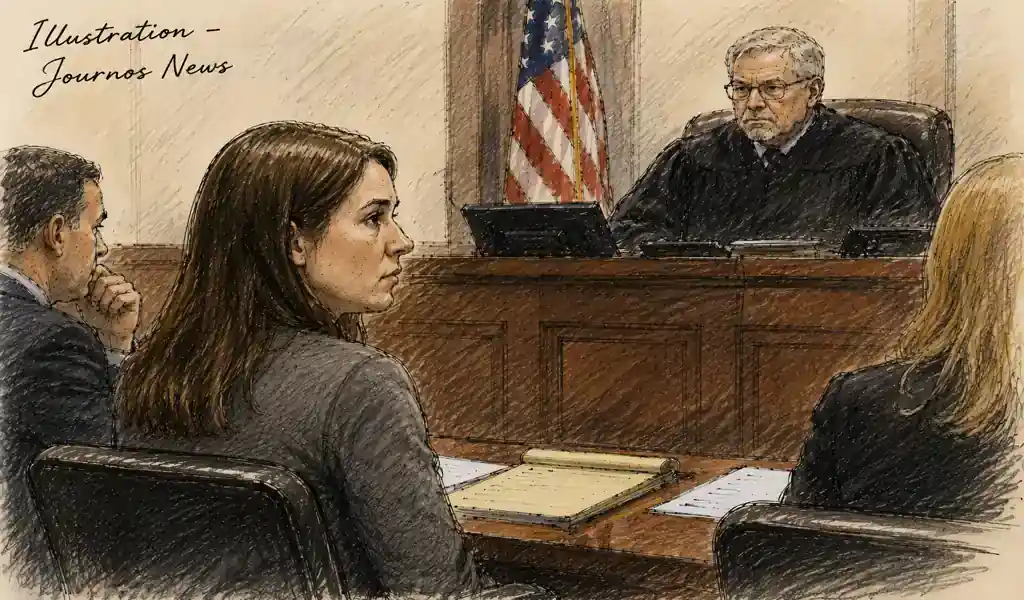
PLYMOUTH, Massachusetts – The jury in Lindsay Clancy’s murder trial returned Thursday for a sixth day of deliberations after twice telling the judge it could not reach a unanimous verdict on whether the Massachusetts mother was criminally responsible for the deaths of her three children.
The 12 jurors resumed deliberations after Superior Court Judge William Sullivan gave them a special instruction urging them to reconsider their positions and make another effort to reach a unanimous decision. The instruction followed a second consecutive day in which jurors reported that they were unable to agree.
Clancy, 36, does not dispute that she strangled her children — Cora, 5, Dawson, 3, and Callan, 8 months — at the family’s home in Duxbury on Jan. 24, 2023. The central question for jurors is whether she was criminally responsible for their deaths.

Jury remains unable to reach unanimous decision
Jurors first reported a deadlock Tuesday after more than 17 hours of deliberations over three days. They returned to court Wednesday but again told Sullivan they could not reach agreement.
Sullivan instructed jurors to continue their discussions while maintaining their individual judgments and not surrendering sincerely held conclusions merely to produce a verdict. He also urged them to consider opposing views and reassess their own positions where appropriate.
The continuing disagreement has increased the possibility that the case could end in a mistrial if the jury ultimately cannot reach a unanimous decision.
Mental condition is at the center of the trial
Clancy’s defense has argued that she was suffering from severe postpartum psychosis when she killed her children and therefore lacked criminal responsibility for her actions.
Prosecutors acknowledged evidence concerning her mental health but argued that she understood what she was doing and should be held criminally responsible.




The competing arguments placed Clancy’s psychiatric condition and its effect on her ability to understand her actions at the center of the trial.
The jury must therefore decide not simply whether Clancy caused the deaths, but whether the evidence establishes the level of criminal responsibility required under Massachusetts law.
Several verdicts remain possible
Jurors have several possible verdicts available to them, including first-degree murder, second-degree murder, manslaughter, not guilty, or not guilty by reason of lack of criminal responsibility.
A first-degree murder conviction could result in life imprisonment without parole. A finding of lack of criminal responsibility would instead lead to psychiatric evaluation and potential confinement in a state mental health facility.
The range of possible outcomes has added significance to the jury’s continued inability to reach agreement.
Mistrial remains possible
If jurors remain unable to reach a unanimous decision after further deliberations, Sullivan could declare a mistrial.
A mistrial would leave the criminal case unresolved. Prosecutors would then have to determine whether to retry Clancy or pursue another course available under Massachusetts law.
The possibility has become increasingly significant after the jury twice reported that it could not agree.
Trial included extensive mental health testimony
The trial lasted several weeks and included extensive testimony concerning Clancy’s mental health before the killings.
More than 80 witnesses testified, and the court considered hundreds of exhibits, including evidence concerning her treatment and psychiatric condition. Medical experts presented competing assessments of her mental state around the time of the children’s deaths.
The case has drawn widespread attention because of the questions it raises about postpartum psychosis and criminal responsibility.
Deliberations remain unresolved
The jury’s sixth day of deliberations leaves the case unresolved, with the next step dependent largely on whether jurors can bridge their differences and reach a unanimous verdict.
Sullivan has urged them to continue examining the evidence without abandoning their individual judgments simply to reach an outcome.
For now, the case remains suspended between two broad possibilities: a unanimous verdict resolving Clancy’s criminal responsibility or a continued deadlock that could lead to a mistrial.
Reporting Credit: Massachusetts Superior Court / Plymouth County Superior Court; Plymouth County District Attorney’s Office.