BOGOTÁ, Columbia – Colombia’s landmark tribunal investigating atrocities committed during the country’s decades-long armed conflict faces an uncertain future after President-elect Abelardo de la Espriella pledged to dismantle the court that was created under the 2016 peace agreement with the Revolutionary Armed Forces of Colombia (FARC).
The Special Jurisdiction for Peace (SJP), established as part of the historic accord that ended Latin America’s longest-running guerrilla insurgency, has remained one of the country’s most politically divisive institutions.
De la Espriella, who has received the endorsement of U.S. President Donald Trump, has described the tribunal as a “failed” court. However, constitutional scholars and legal analysts say dismantling it would be legally difficult because of protections embedded in Colombia’s Constitution and international commitments.

Court protected by constitutional and international safeguards
The tribunal is backed by Colombia’s Constitution and supported by the International Criminal Court (ICC), which ended its nearly 20-year preliminary examination of Colombia in 2021 after determining the country was fulfilling its international justice obligations through the SJP.
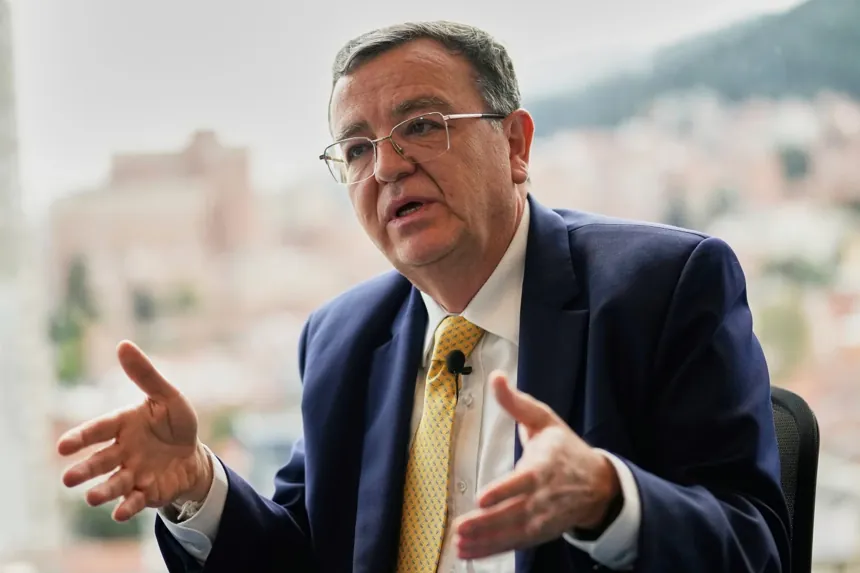
Alejandro Ramelli, president of the tribunal, told The Associated Press that the ICC’s decision depended on the court continuing its work.
If the tribunal were dismantled prematurely, Colombia could violate its obligations under international law, he said.
The SJP is mandated to investigate war crimes and crimes against humanity through 2028, followed by a five-year trial period. After that, Colombia’s Congress will determine whether to extend its mandate for another five years.
Tribunal continues work amid ongoing violence
Although the peace agreement formally ended the conflict with the FARC, Colombia continues to experience violence involving dissident FARC factions that rejected the accord, the National Liberation Army (ELN), the Clan del Golfo cartel and other armed groups fighting over drug trafficking and illegal mining revenues.
Supporters of the tribunal view it as a cornerstone of Colombia’s transitional justice system that has promoted accountability while helping to consolidate peace.
Critics, however, argue the court disproportionately targets former members of Colombia’s armed forces.
Since beginning operations in 2018, the tribunal has processed cases involving more than 14,000 suspects accused of crimes committed during the armed conflict.
Approximately 70% of those investigated are former FARC members, 29% are former military and security personnel, and the remainder are civilians.
Incoming government signals review rather than immediate closure
Iván Cancino, the president-elect’s designated justice minister, said Wednesday that the incoming administration does not currently plan to eliminate the tribunal outright.
Instead, he said the government intends to demand stronger results while reviewing the court’s budget and spending.
Outgoing President Gustavo Petro, despite previously criticizing the tribunal, this week argued its budget should be increased, saying that uncovering the judicial truth about the conflict remains essential to national reconciliation.
Tribunal warns closure would create legal uncertainty
Ramelli said significant budget reductions would undermine victims’ access to justice and warned that abruptly shutting down the tribunal would create legal uncertainty for thousands of ongoing cases.
Among its most significant rulings, the SJP has held former FARC leaders responsible for more than 21,000 kidnappings and convicted former military personnel over more than 100 extrajudicial killings.
In both landmark cases, former FARC commanders and military officials admitted responsibility and received alternative, non-prison sentences that require them to complete projects benefiting victims.
The tribunal has also imposed a 20-year prison sentence on a former soldier who denied involvement in extrajudicial killings.
Ramelli defended the court’s work, saying it has established facts about the conflict that were previously unknown.
He cited findings documenting more than 21,000 kidnappings by the FARC, the recruitment of more than 18,677 children, widespread sexual violence committed by the rebel group and extrajudicial killings carried out by state security forces.
“The country simply did not know the full extent of these crimes,” Ramelli said.
This report is based on reporting by The Associated Press.
Article Topics: Colombia | Special Jurisdiction for Peace | FARC | Abelardo de la Espriella | Transitional Justice | Peace Agreement | International Criminal Court | Latin America