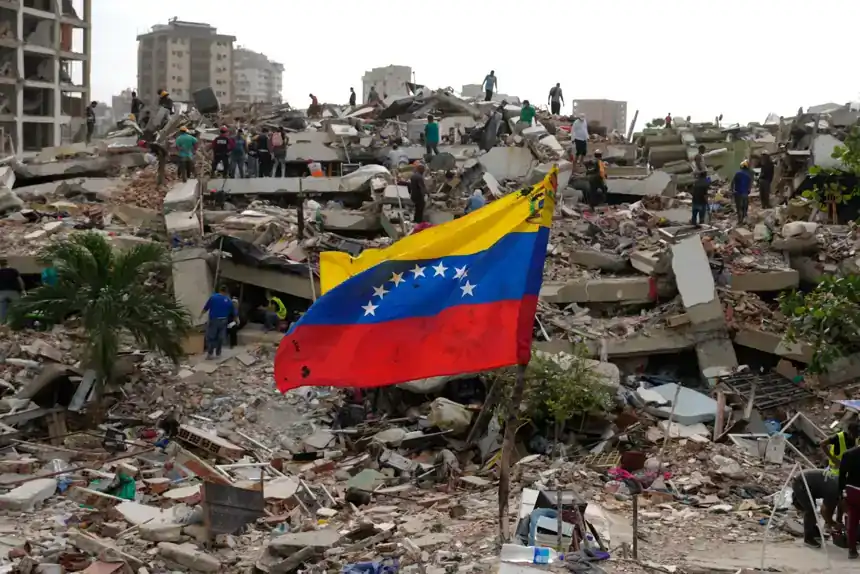
CARABALLEDA, Venezuela – On Venezuela’s Caribbean coast, wealthy yacht owners and working-class families once lived side by side in Caraballeda, reflecting decades of government efforts to integrate different socioeconomic groups. Today, many share a different reality after devastating earthquakes destroyed homes across the coastal community, leaving thousands homeless.
The destruction has displaced an estimated 17,000 survivors as the official death toll has risen above 3,500. Many now face an uncertain future as they depend on authorities for temporary shelter and eventual housing assistance amid criticism of the government’s response to the disaster.
Earthquakes erase homes across social divides
Caraballeda’s waterfront combined private apartments overlooking marinas with public housing towers that housed lower-income residents, placing families of different economic backgrounds along the same coastline.

When powerful earthquakes struck on June 24, both luxury residences and government-built apartment blocks collapsed within seconds.
Among those searching for loved ones is Carlos Ortega, whose relatives had received 12 apartments in the area’s public housing program after losing their homes in an earlier mudslide more than a decade ago.
“It was their home, their house. It was an immense joy when they were assigned these houses here,” Ortega said.
“Imagine, they were given a home after losing everything, but now they’ve lost everything, even their lives.”
Only one of Ortega’s siblings survived the collapse of the apartment buildings. His son, who had been working at a convenience store when the earthquakes struck, remains missing more than a week after the disaster.
Nearby, rescue crews continued searching through rubble surrounding homes adjacent to a yacht club, where families still hoped missing relatives might be found.
Housing remains central to recovery
Home ownership has long been a defining aspiration for Venezuelans, supported for decades by oil revenues that financed large public housing developments while enabling wealthier families to acquire vacation properties along the coast.
Even after Venezuela’s prolonged economic collapse began in 2013, many citizens continued to secure housing through government programs, discounted private sales, self-built neighborhoods or occupation of abandoned properties.
Many residents living in housing constructed under the late President Hugo Chávez’s Grand Housing Mission received homes without legal property deeds.
Political analyst Ronal Rodríguez of the Venezuela Observatory at Colombia’s Universidad del Rosario said successive governments sought to reduce socioeconomic segregation by building subsidized housing in affluent neighborhoods, while also broadening political support.
He argued that the absence of formal property ownership left beneficiaries dependent on the government.
“What Chavismo tries to do is maintain political dependence,” Rodríguez said. “That is, if at any point you turn against me and stop supporting me, then I’ll take away the roof I’ve given you.”
The uncertainty surrounding property rights has become increasingly significant as survivors await information about permanent housing following the disaster.
Survivors await rebuilding plans
Acting President Delcy Rodríguez’s government has not announced a timetable for long-term housing reconstruction despite growing criticism from residents over search-and-rescue operations and disaster response.
The full scale of the destruction is still being assessed. Satellite imagery analyzed by Microsoft’s AI for Good Lab found that at least 10,000 structures—roughly one-third of all buildings—in the nearby city of Catia La Mar sustained damage.
Analysts said older buildings, construction quality and local geography contributed to the extensive destruction.
Many survivors continue living in temporary shelters while deciding whether to remain in the affected region.
Benito Mantilla, 68, now lives in a tent erected in a pharmacy parking lot after his privately owned home was damaged. His wife has relocated to the Dominican Republic, but Mantilla remains in Venezuela hoping to find work in nearby Caracas after the earthquakes also damaged his family’s auto repair business.
Other displaced residents remain hopeful that government assistance will eventually provide replacement housing.
Caryudedi González, whose home partially collapsed into a ravine, said she still hopes it can be repaired.
“In many countries, it’s very difficult to own a home, and here, we work so hard to have what’s ours,” González said.
This report is based on reporting by The Associated Press.
Topics: Venezuela | Earthquake Recovery | Housing Crisis | Humanitarian Crisis | La Guaira | Disaster Relief | Homelessness | Caribbean