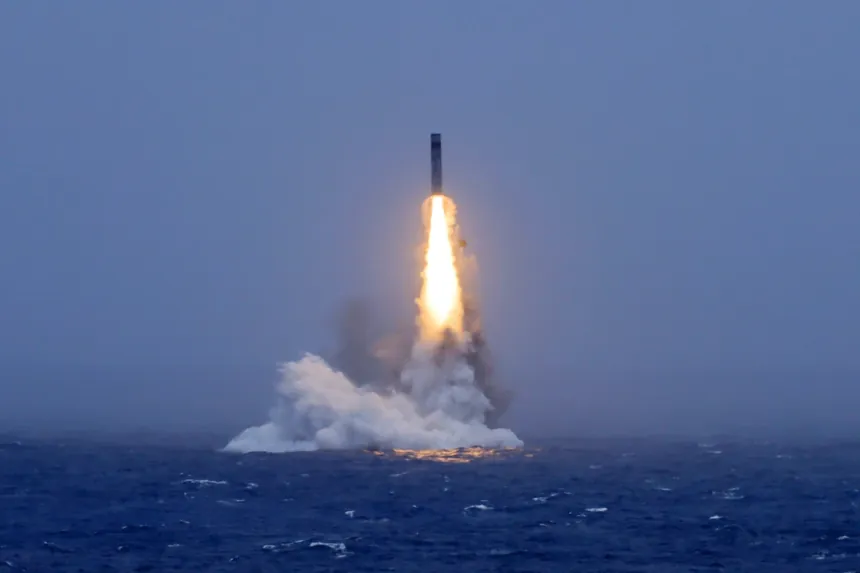
BANGKOK, Thailand – China launched a long-range ballistic missile from a nuclear-powered submarine into the Pacific Ocean on Monday, a rare demonstration of its growing strategic capabilities that prompted protests from the United States and several Asia-Pacific countries concerned about regional security and military transparency.
Beijing described the launch as part of routine annual military training and said it complied with international law and was not directed at any country. The test, however, marked only the second known occasion in recent years that China has fired a ballistic missile into international waters, intensifying concerns about the country’s expanding military capabilities.
The missile carried a dummy rather than a nuclear warhead, but defense analysts said the launch underscored China’s advancing sea-based nuclear deterrent as regional tensions continue to grow.

Experts assess missile type
China publicly acknowledged the launch only after it had taken place. In a brief statement, the state-run Xinhua News Agency said the missile was fired into the Pacific Ocean but did not identify the model.
A photograph released by Xinhua the following day provided no additional technical details.
Military analysts said the missile was likely either a JL-2 or the newer JL-3 submarine-launched ballistic missile, although they cautioned that the available imagery was insufficient to make a definitive identification.
China’s state-owned Global Times reported that the missile was “most likely” a JL-3, which has a reported range exceeding 10,000 kilometers (6,200 miles). The older JL-2 has a shorter operational range.
Pacific nations voice concern
The launch prompted criticism from governments across the region despite China’s insistence that other countries should “avoid overinterpretation.”
■ Related News

New Zealand said the missile landed within the South Pacific Nuclear Free Zone established under the 1986 Treaty of Rarotonga. Wellington argued the launch violated the spirit of the agreement, under which China pledged not to test nuclear weapons in the region or threaten treaty members with nuclear force.
Australian Prime Minister Anthony Albanese said Beijing failed to provide adequate advance notice before conducting the launch.
“There is no doubt that this is a provocative act by China which does destabilize the region,” Albanese told reporters during a visit to the Solomon Islands.
He added that the launch of a nuclear-capable ballistic missile from a nuclear-powered submarine was particularly concerning and said the region needed fewer nuclear weapons rather than more.
New Zealand Foreign Minister Winston Peters also described the test as “unwelcome and concerning.”
Solomon Islands Prime Minister Matthew Wale urged all major powers to refrain from conducting ballistic missile tests in the Pacific, saying the region did not want such military demonstrations regardless of which country carried them out.
Transparency remains a central concern
Security specialists said the limited information surrounding the launch contributed significantly to regional unease.
Drew Thompson, a senior fellow at the S. Rajaratnam School of International Studies in Singapore, said China’s military modernization has advanced without corresponding improvements in transparency, creating uncertainty over Beijing’s long-term strategic intentions.
The missile test comes as Chinese President Xi Jinping continues an extensive modernization of the People’s Liberation Army.
China already possesses the world’s largest standing military and largest navy. Although its nuclear arsenal remains smaller than those of the United States and Russia, Beijing has steadily expanded its stockpile of nuclear warheads while developing longer-range missiles and more advanced military technologies.
China’s official defense budget is projected to reach $270 billion in 2026 after annual increases of roughly 7% over the past four years. Independent estimates suggest actual military spending may be substantially higher. The Stockholm International Peace Research Institute estimated China’s defense expenditure at $313.7 billion in 2024.
Regional military competition intensifies
China’s growing military capabilities continue to influence defense planning across the Indo-Pacific, particularly as tensions persist over Taiwan, the self-governed island claimed by Beijing.
China has increased military activity around Taiwan through regular deployments of warships and military aircraft, describing the operations as exercises.
Neighboring countries have responded by strengthening their own defense capabilities. Japan is increasing military spending to 2% of gross domestic product, doubling its long-standing spending benchmark, while the Philippines has expanded U.S. military access by granting American forces access to four additional bases.
Emma Chanlett-Avery, director of Political-Security Affairs at the Asia Society Policy Institute, said the missile launch adds to already strained relations between China and Japan, particularly amid disagreements over Taiwan and broader regional security.
This report is based on reporting by The Associated Press.
Topics: China | Ballistic Missile | Indo-Pacific Security | Nuclear Deterrence | South Pacific | Taiwan | Military Modernization | Regional Tensions