TAIPEI, Taiwan – China has imposed new export controls on 40 Japanese entities, escalating economic pressure on Tokyo as diplomatic and security tensions between the two countries continue to intensify.
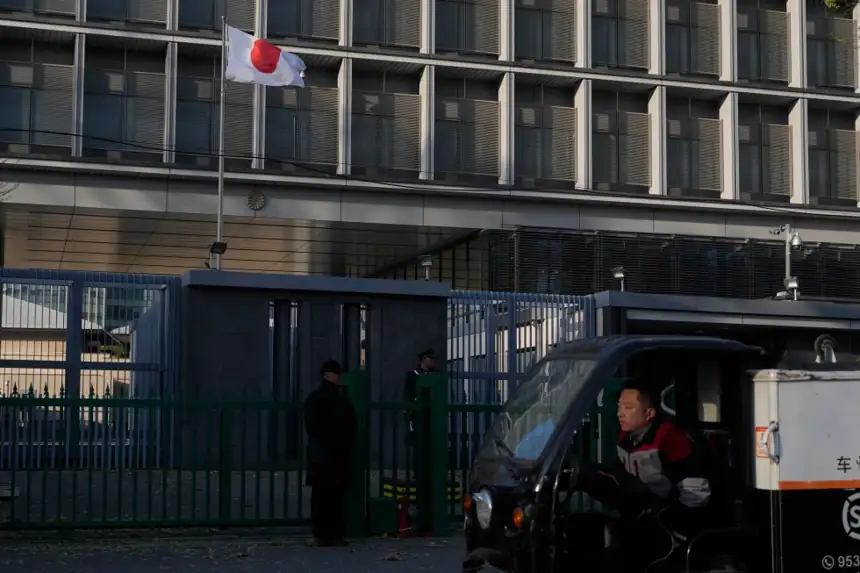
According to The Associated Press, China’s Ministry of Commerce announced Monday that the measures target Japanese companies it says are contributing to the country’s “remilitarization.” The restrictions come amid growing disagreements over regional security, Taiwan, and Japan’s expanding defense capabilities.
China Targets 40 Japanese Entities
Under the new measures, 20 Japanese entities have been placed on China’s export control list, preventing Chinese and foreign exporters from supplying them with dual-use goods manufactured in China. Dual-use items are products that can serve both civilian and military purposes.

The list includes several divisions of Mitsubishi Corporation.
An additional 20 entities have been added to a watch list for dual-use exports. Among them are divisions of Fujitsu and Komatsu, as well as Mitsui E&S.
Chinese exporters seeking to supply those companies must now obtain special government licenses, submit risk assessments, and provide written assurances that exported items will not be used for military purposes.
Beijing Links Restrictions to Japan’s Defense Policies
China’s Commerce Ministry defended the restrictions as lawful and necessary, describing them as a response to what it called Japan’s pursuit of “new militarism.”
The ministry urged Tokyo to reverse what it characterized as its current policy direction and said the export controls were intended to deter further military expansion.


Officials also emphasized that the restrictions affect only a limited number of Japanese companies involved with dual-use technology and stated that ordinary trade between the two countries would continue unaffected for businesses complying with Chinese regulations.
Earlier this year, Beijing imposed similar restrictions on another 40 Japanese companies, placing 20 on an export control list and 20 on a watch list.
According to the ministry, Japan has continued strengthening its military capabilities since those earlier measures were introduced.
Japan Rejects the Measures
Japan’s government strongly criticized the latest restrictions.
Chief Cabinet Secretary Minoru Kihara described China’s actions as “unacceptable and extremely regrettable” and called on Beijing to withdraw the measures.
He said the Japanese government would carefully evaluate the impact of the export controls before deciding on appropriate countermeasures.
The dispute comes as Japan continues expanding its defense posture under Prime Minister Sanae Takaichi.
The country has introduced policies allowing exports of lethal military equipment and has deployed longer-range missile systems to remote islands as part of broader efforts to strengthen national defense.
On Monday, Japan’s Ground Self-Defense Force announced the deployment of a Type-12 missile launcher to Minamitorishima, Japan’s easternmost island in the Pacific, a move widely viewed as part of Tokyo’s response to China’s expanding military activities.
Taiwan Remains a Central Source of Tension
Relations between Beijing and Tokyo have deteriorated steadily since Prime Minister Takaichi indicated last year that Japan could intervene if China attempted to use military force against Taiwan.
China considers Taiwan part of its territory and has repeatedly stated that it reserves the option of using force to bring the self-governed island under its control.
Earlier this month, China’s coast guard conducted patrols east of Taiwan in an operation that state media described as a warning to Japan and the Philippines following plans by the two countries to discuss maritime boundaries in waters also claimed by Beijing.
Last week, the governments of the United Kingdom, Germany, and France issued a joint statement criticizing Chinese activities in waters east of Taiwan and reaffirmed their opposition to any unilateral attempt to change the status quo across the Taiwan Strait.
Analysts View Curbs as Political Signal
George Chen, a partner for Greater China at advisory firm The Asia Group, said the export restrictions appear intended primarily as a diplomatic signal rather than a broad economic measure.
According to Chen, Beijing believes Japan has failed to take meaningful steps to stabilize bilateral relations and remains concerned about expanding defense cooperation between Japan, the United States, and other regional partners.
He said relations between China and Japan are likely to remain fragile in the near term unless both governments take steps to ease rising tensions.
Tags: China, Japan, Export Controls, Dual-Use Goods, Taiwan, Sanae Takaichi, Minoru Kihara, Mitsubishi Corporation, Fujitsu, Komatsu, Mitsui E&S, China-Japan Relations