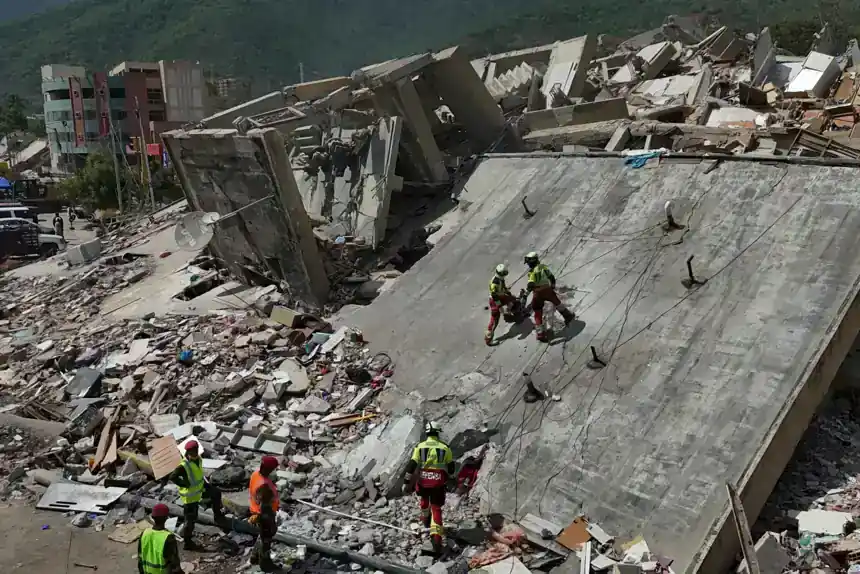
LA GUAIRA, Venezuela — Venezuelan and international rescue teams continued searching for survivors on Sunday, four days after two powerful earthquakes devastated the northern state of La Guaira, as authorities reported a rising death toll and pledged to continue rescue operations despite diminishing chances of finding people alive.
The Venezuelan government said 1,450 people had died in the earthquakes as of Sunday afternoon, while thousands more remained missing. The disaster has also drawn criticism from residents who say civilian volunteers initially played a larger role in rescue efforts than government responders.
Even as emergency experts acknowledge that the first 48 to 72 hours after a major disaster offer the highest likelihood of finding survivors, rescue workers continued to recover people alive from collapsed buildings, providing hope for families still awaiting news of missing relatives.

International Rescue Operations Expand
Acting President Delcy Rodríguez said Sunday evening that search operations would continue despite the passing of the critical rescue window.
Government officials said more than 2,600 rescue personnel from multiple countries had arrived in Venezuela, bringing specialized search equipment, heavy machinery, and trained rescue dogs to assist operations in the country’s hardest-hit areas.
“It’s been incredibly hard work, but we’re going strong,” civilian volunteer Jason Mercano said as he described working alongside rescue teams after maintaining communication with relatives trapped beneath the rubble.
“We’ve never given up hope,” he added.
Scale of Destruction Becomes Clearer
Authorities said more than 770 buildings were either partially or completely destroyed, roughly double the number reported damaged or collapsed two days earlier.
■ Related News
The United Nations estimated that up to 6.8 million people could be affected by the earthquakes, which measured magnitudes 7.2 and 7.5 when they struck last Wednesday.
Aftershocks continued on Sunday, including earthquakes measuring magnitudes 4.2 and 4.5, raising concerns about additional structural damage and complicating rescue efforts.
Government officials also reported that more than 14,000 military and police personnel had been deployed across La Guaira state, where access remained restricted through a permit system.
Families Continue Search for Missing Loved Ones
Communication difficulties caused by damaged infrastructure have prompted many Venezuelans to rely on independent online databases to report missing relatives.
One such platform had received reports involving more than 50,000 missing people, although it remained unclear how many individuals had since been located.
Scenes across La Guaira reflected both hope and grief as rescue operations continued.
Rescue teams from Venezuela, the United States, and France successfully pulled a man and his son alive from beneath collapsed concrete, drawing applause from nearby crowds before both survivors were transferred to an ambulance for emergency medical treatment.
Elsewhere in the city, Helen Guedez said her family continued trying to rescue her father, Jesús, who remained trapped beneath their collapsed apartment building.
Guedez said rescue personnel from the United States confirmed that her father was still alive but determined the structure was too unstable to enter safely. She said civilian volunteers and local miners had continued attempting to reach him.
“We’re not going to give up,” Guedez said. “The rest of the team is willing to continue. They know there’s another way to get him out and they said they’re going to keep working until the very end.”
Hospitals Face Heavy Demand
Health facilities also continued treating large numbers of injured residents.
At Domingo Luciani Hospital in Caracas, anesthesiologist Leomery Pérez said donations from the public had helped the hospital manage an influx of patients despite longstanding shortages within Venezuela’s public health system.
Authorities said more than 3,100 injured people had received treatment, including many suffering crush injuries.
Disaster Presents Political and Humanitarian Challenge
The earthquake response has become a major test for acting President Rodríguez, who assumed office in January following the removal of former President Nicolás Maduro by the United States, according to the supplied source material.
Researcher Ronal Rodríguez of the Venezuelan Observatory at the University of Rosario said the disaster has compounded existing political and humanitarian challenges facing the country.
Amy Pope, director general of the International Organization for Migration, warned that the disaster could accelerate displacement from Venezuela, where millions of people have already left the country over the past decade.
Rodríguez announced the creation of a special government commission to assess damage to homes and infrastructure while determining whether displaced residents could safely return.
She said authorities would continue searching for survivors as rescue operations moved into a fifth day.
“Today we recovered people who are still alive,” Rodríguez said. “We always maintain hope.”
Tags: Venezuela, La Guaira, Earthquake, Natural Disaster, Search and Rescue, Delcy Rodríguez, United Nations, International Organization for Migration, Humanitarian Crisis, Emergency Response, Caracas, Aftershocks