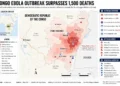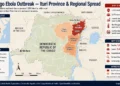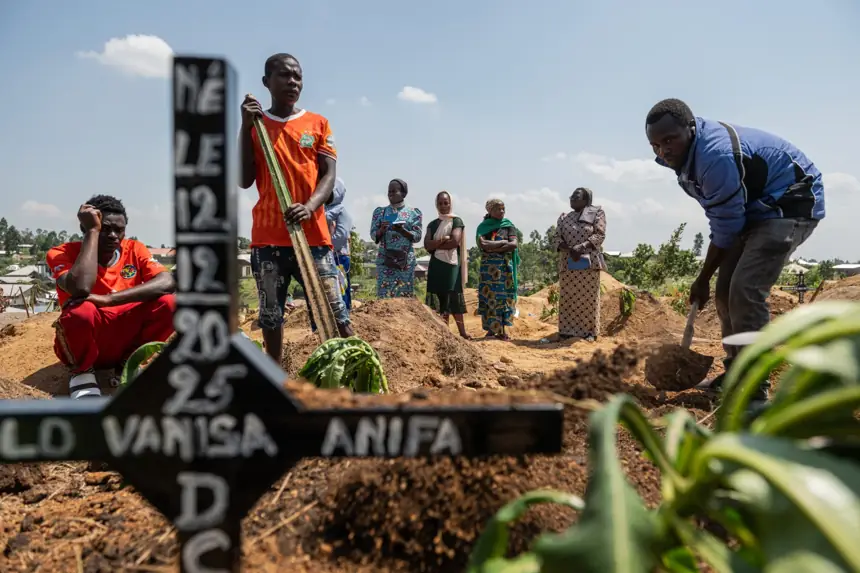
BUNIA, Congo – Confirmed Ebola infections in eastern Democratic Republic of Congo have exceeded 1,000 cases, with authorities reporting 254 deaths as health officials struggle to contain an outbreak that continues to spread across conflict-affected communities.
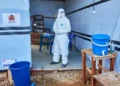
The Congolese Ministry of Health said Sunday that the outbreak, concentrated in Ituri province, had reached 1,003 confirmed cases since it was declared on May 15. The ministry reported that 100 people have recovered, while at least 365 patients remain hospitalized or in isolation.
The outbreak is caused by the Bundibugyo strain of the Ebola virus, a rare variant for which officials say there are currently no approved vaccines or specific treatments. Health authorities have warned that the true scale of the outbreak may be significantly larger than current figures indicate.

Contact Tracing Remains a Critical Obstacle
Efforts to identify and monitor people exposed to the virus continue to lag behind the pace of transmission.
According to the Ministry of Health, contact tracing coverage has reached only 55%, limiting authorities’ ability to quickly isolate new infections and interrupt chains of transmission.
Dr. Jean Kaseya, Director-General of the Africa Centers for Disease Control and Prevention, told The Associated Press last week that uncertainty surrounding the outbreak’s origin remains a major concern.
“If you want to control an outbreak, especially Ebola outbreak, you must know the index case. We don’t have confidence on when this outbreak started,” Kaseya said.
Authorities have not yet identified the outbreak’s first known patient and were still attempting to trace more than 35,000 individuals who had contact with infected people as of last week.
■ Related News



Conflict Complicates Health Operations
The outbreak is unfolding in a region already affected by armed violence and displacement.
Officials said attacks by the Allied Democratic Force, an armed group linked to the Islamic State organization, have restricted access to numerous communities across Ituri province. The insecurity has forced many residents to flee their homes, making surveillance and medical response efforts more difficult.
Health authorities acknowledged that the disease may still be spreading faster than containment measures can address, and officials say the outbreak may not yet have reached its peak.
Concerns Grow in Displacement Camps
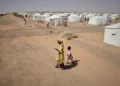
Fears of wider transmission have intensified following reports of unexplained deaths at a major displacement site near Bunia, the provincial capital.
Officials at the Kigonze displacement camp reported Friday that 10 people had died during the previous week under unusual circumstances. While no Ebola cases had been confirmed at the camp, local administrators said the number of deaths was unprecedented and warranted investigation.
The camp houses more than 20,000 displaced people living in crowded conditions, raising concerns about the potential consequences of an infectious disease outbreak.
The U.N. refugee agency said at least 2 million internally displaced people and more than 320,000 refugees are currently living in areas considered at risk from Ebola transmission in Congo.
In a statement issued Friday, the agency said it was “deeply concerned by the accelerating spread” of the virus and warned of increasing risks facing displaced populations across the region.
Humanitarian Risks Continue to Increase
Humanitarian organizations and local leaders have warned that overcrowded living conditions could accelerate transmission if the virus reaches displacement camps.
Charité Banza, a civil society leader in Ituri, said the vulnerability of camp residents remains a major concern as health authorities work to determine the cause of recent deaths.
“If a disease or epidemic were to spread among the thousands of people living at this site, it would be a real catastrophe given our already very precarious living conditions,” Banza said.
Authorities continue to investigate the outbreak while expanding surveillance, treatment, and tracing operations. However, officials acknowledge that significant uncertainty remains regarding the outbreak’s full extent and future trajectory.