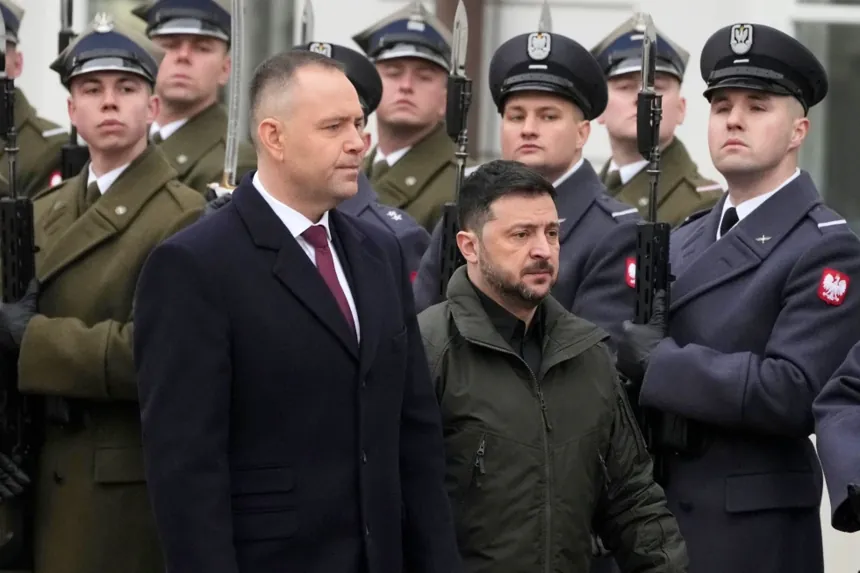
WARSAW, Poland — Ukrainian President Volodymyr Zelenskyy has returned Poland’s highest state distinction after Polish President Karol Nawrocki revoked the honor, escalating a dispute rooted in differing interpretations of World War II history.
In a message published on social media Saturday, Zelenskyy said he had sent back the Order of the White Eagle, stating that Ukrainians viewed the decoration as recognition of the Ukrainian people and the country’s armed forces rather than a personal award.
The Ukrainian leader shared photographs of the medal alongside documentation showing it was being returned to Poland’s presidential office. He added that future generations would ultimately judge the respect earned by Ukrainians through their sacrifices and defense of their country.

The diplomatic disagreement emerged after Nawrocki withdrew the award in response to Zelenskyy’s decision to name a Ukrainian military unit after the Ukrainian Insurgent Army, known as the UPA.
Wartime Legacy Reignites Political Tensions
The Order of the White Eagle had been presented to Zelenskyy in 2023 by former Polish President Andrzej Duda in recognition of Ukraine’s resilience, security efforts, and defense of human rights during Russia’s ongoing invasion.
Controversy erupted after Zelenskyy signed a decree on May 26 granting honorary designation to a unit within Ukraine’s Special Operations Forces linked symbolically to the UPA, a nationalist movement active during the 1940s and 1950s.
In a video statement posted online, Nawrocki argued that the organization remains associated in Poland with atrocities committed against Polish civilians during World War II.
For many Poles, the UPA is primarily remembered for killings that occurred in the regions of Volhynia and Eastern Galicia during the war. In 2016, Poland’s parliament formally recognized those crimes as genocide.
■ Related News
Ukraine, meanwhile, views the UPA as part of the country’s historical struggle for independence against both Nazi Germany and Soviet rule.
Dispute Tests Relations Between Allies
The controversy has resurfaced at a sensitive moment in relations between the neighboring countries.
Poland has been one of Ukraine’s strongest supporters since Russia launched its full-scale invasion, providing military assistance and hosting millions of Ukrainian refugees. Despite that support, historical disagreements between the two nations have periodically strained bilateral relations.
Nawrocki emphasized that Poland’s backing for Ukraine’s defense against Russia would continue despite the decision to revoke the award.
Zelenskyy acknowledged Poland’s support in his statement and said Ukraine remains willing to pursue dialogue on unresolved historical issues while maintaining appreciation for Polish assistance during the war.
The Ukrainian president also praised Ukrainian soldiers and citizens, describing them as a source of national pride.
Ukrainian Officials React
The decision prompted criticism from several senior Ukrainian officials.
Kyrylo Budanov, head of Ukraine’s Presidential Office, described the move as unfriendly toward the Ukrainian people and argued it could benefit Russia by creating divisions between two countries that have cooperated closely throughout the conflict.
Budanov and three other Ukrainian officials announced plans to return Polish honors they had previously received.
Not all reactions within Ukraine supported that response. Former Prime Minister Arseniy Yatsenyuk urged restraint, arguing that one controversial decision should not be answered with another.
Leaders Urged to Ease Tensions
The disagreement comes shortly before Poland hosts a major conference focused on Ukraine’s future reconstruction, an event Zelenskyy is expected to attend.
Polish Prime Minister Donald Tusk, a political rival of Nawrocki, called for both sides to lower tensions and avoid deepening the dispute.
Writing on social media, Tusk warned that public disagreements between Warsaw and Kyiv risk benefiting Russian President Vladimir Putin while troubling Ukraine’s international partners.
Recent diplomatic efforts had appeared to improve relations on historical issues. Poland and Ukraine had made progress regarding the exhumation of Polish victims from wartime massacres, while a meeting between the two presidents in Warsaw last December had been viewed as a positive step toward reconciliation.
The latest dispute, however, highlights how unresolved interpretations of wartime history continue to influence contemporary relations between two nations whose strategic partnership remains crucial amid ongoing regional security challenges.
Tags: Ukraine, Poland, Volodymyr Zelenskyy, Karol Nawrocki, World War II, UPA, Historical Dispute, Diplomacy