
NEW YORK – U.S. stocks fell sharply Wednesday after Federal Reserve projections suggested policymakers may still consider raising interest rates later this year, underscoring ongoing concerns about inflation despite months of steady monetary policy.
The sell-off accelerated after the central bank released updated forecasts showing that nine of its 18 policymakers expect at least one increase in the federal funds rate before the end of the year. The projections overshadowed the Fed’s decision to leave rates unchanged at its latest meeting and prompted investors to reassess expectations for future monetary policy.
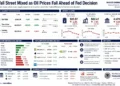
The benchmark S&P 500 declined 1.2%, reversing an earlier gain. The Dow Jones Industrial Average dropped 507.12 points, or 1%, while the Nasdaq Composite fell 1.3%.

Fed Projections Drive Market Reaction
The Federal Reserve maintained its benchmark interest rate at current levels, continuing a pause that has remained in place throughout the year. However, the latest economic projections signaled that inflation remains a concern for a significant number of policymakers.
Federal Reserve Chairman Kevin Warsh, speaking during his first press conference as head of the U.S. central bank, emphasized a broader review of how the institution communicates with financial markets and the public.
One of his initial changes was ending the use of forward guidance in policy statements, removing language that previously offered clues about the likely direction of future interest rates.
Warsh said the central bank wants investors to focus more on incoming economic data—including inflation, employment, and growth figures—rather than attempting to anticipate policy responses from the Fed.
He also indicated that the central bank could reconsider the format and role of its quarterly economic projections, which include forecasts for inflation, economic growth, and interest rates.
■ Related News


Bond Yields Move Higher
Financial markets reacted swiftly to the projections.
Treasury yields climbed as traders increased expectations that borrowing costs could rise before year-end. According to CME Group data cited in the report, traders raised the probability of at least one rate increase this year to 84%, up from 59.5% a day earlier.
The yield on the 10-year U.S. Treasury note rose to 4.49% from 4.43% on Tuesday. The two-year Treasury yield, which is particularly sensitive to expectations for Federal Reserve policy, increased to 4.21% from 4.05%.
Higher bond yields can increase borrowing costs for consumers and businesses while also putting pressure on stock valuations.
Technology Shares Lead Market Declines
Large technology companies weighed heavily on major indexes.
Microsoft fell 3.8%, Amazon declined 3.5%, and Nvidia lost 1.3%, contributing significantly to the broader market downturn.
SpaceX also reversed earlier gains and closed down 4.9%, marking its first decline since its recent stock market debut.
Not all companies moved lower. Furniture manufacturer La-Z-Boy surged 14.8% after reporting quarterly profit and revenue that exceeded analyst expectations. The company said recently opened stores contributed to revenue growth, though executives maintained a cautious outlook on broader consumer demand.
Economic Data Offers Mixed Signals
Separate economic data released Wednesday showed stronger-than-expected growth in retail revenue during May, suggesting consumer spending continues to support economic activity.
At the same time, elevated inflation has continued to weigh on household sentiment, creating uncertainty about the sustainability of consumer-driven growth.
The combination of resilient spending and persistent inflation presents a challenge for policymakers attempting to balance economic growth with price stability.
Oil Market Stabilizes
Energy markets were comparatively calm following declines earlier in the week.
Oil prices had eased on optimism surrounding a tentative agreement between the United States and Iran that could support the resumption of oil shipments through the Strait of Hormuz, a critical route for global energy supplies.
Brent crude oil rose 0.7% to $79.55 per barrel. Although prices remain above levels seen before recent regional tensions escalated, they are substantially below the peaks recorded several weeks ago.
Lower energy prices could help ease inflationary pressures, a key consideration for central banks monitoring price trends.
Global Markets Mixed
International markets delivered a mixed performance.
South Korea’s Kospi index rose 1.6%, while Hong Kong’s Hang Seng Index declined 0.7%. European markets also posted varied results as investors assessed the implications of global inflation trends and interest-rate expectations.
The latest market reaction highlights the continued sensitivity of investors to Federal Reserve policy signals, particularly as inflation remains above levels policymakers consider consistent with long-term price stability.