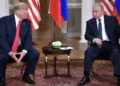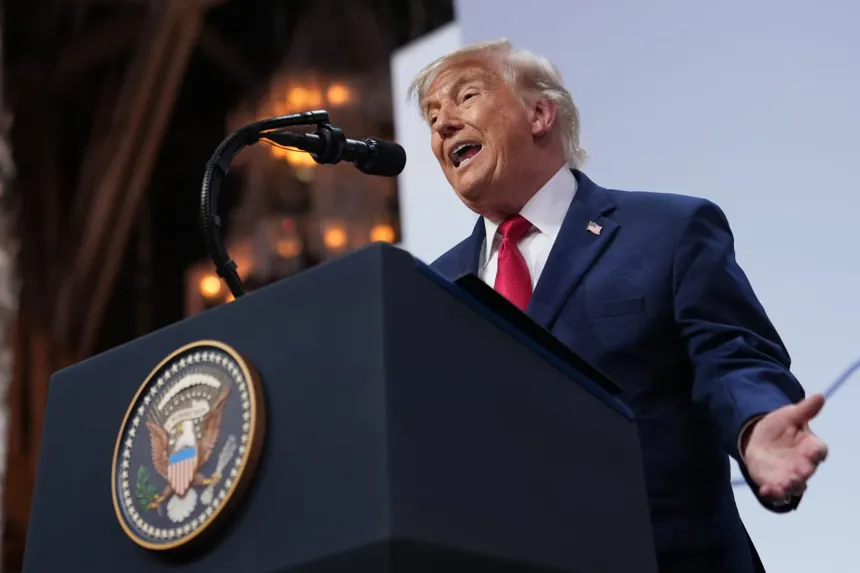
EVIAN-LES-BAINS, France – Leaders of the Group of Seven nations expressed support Wednesday for a tentative agreement championed by U.S. President Donald Trump that seeks to extend a fragile ceasefire with Iran and restore maritime traffic through the strategically important Strait of Hormuz.
The backing came as the three-day G7 summit concluded in Évian-les-Bains, France, where heads of government discussed global security, economic challenges and regional conflicts. According to statements made at the summit, the proposed accord is expected to be formally signed in Switzerland on Friday.
French President Emmanuel Macron described the arrangement as a positive step toward reducing instability, arguing that prolonged tensions in the Middle East had carried significant economic consequences for countries around the world.

Trump also praised the agreement during a separate news conference, calling it historic and saying other G7 leaders strongly supported efforts to bring the conflict to an end.
Sanctions Relief Linked to Nuclear Agreement
Details of the proposed framework emerged after the summit concluded when U.S. officials outlined elements of the accord to journalists.
Under the terms described by U.S. officials, Washington would work toward ending U.S. and United Nations sanctions on Iran if a final agreement addressing Tehran’s nuclear program is successfully negotiated.
Trump indicated confidence that a broader settlement could be reached, saying Iran appeared interested in returning to normal economic and political conditions.
Reopening the Strait of Hormuz Remains Central Goal
A key component of the proposed agreement involves restoring commercial shipping through the Strait of Hormuz, one of the world’s most important energy transit routes.



In a joint declaration, G7 leaders said a maritime mission led by France and the United Kingdom could help facilitate the safe return of merchant shipping by protecting vessels, reassuring operators and supporting efforts to verify the removal of mines.
According to the summit discussions, concerns about disruptions to maritime traffic remain a major issue for global energy markets and international trade.
Lebanon Ceasefire Presents Additional Challenge
The proposed agreement also includes provisions aimed at ending hostilities between Israel and Hezbollah in Lebanon.
That element could prove particularly sensitive given ongoing security concerns and Israel’s stated position that it will continue acting against threats from the Iranian-backed group.
G7 leaders voiced support for Lebanese efforts to disarm Hezbollah through an immediate and robust ceasefire while emphasizing the need to protect Lebanon’s sovereignty and territorial integrity.
Trump said the conflict had continued for too long and noted the growing humanitarian toll from the fighting.
Ukraine and Global Security Remain on Agenda
Beyond the Middle East, G7 leaders reaffirmed support for Ukraine in its war against Russia.
Joint declarations issued during the summit pledged additional air defense assistance and signaled support for stronger sanctions targeting Russia’s energy sector.
Trump described discussions on Ukraine as productive and said both Russian President Vladimir Putin and Ukrainian President Volodymyr Zelenskyy appeared interested in finding a path forward, though significant obstacles remain.
The leaders also agreed to intensify efforts against international drug trafficking networks and reaffirmed commitments to combat migrant smuggling and human trafficking, describing both as serious transnational crimes.
Trade and Diplomacy Discussions Continue
The summit additionally focused on economic growth, artificial intelligence and concerns over global trade competition.
Leaders from India, South Korea, Kenya and Brazil participated as guests during portions of the discussions.
Trump also met Indian Prime Minister Narendra Modi on the sidelines of the summit and said negotiations on a broader U.S.-India trade agreement were progressing. The meeting took place amid ongoing discussions over trade, regional security and the recent deaths of three Indian sailors in a U.S. military strike in the Gulf of Oman.
Modi raised concerns about the safety of Indian seafarers and expressed hope that maritime security would remain a priority as the proposed U.S.-Iran agreement moves forward.
While significant diplomatic and political hurdles remain, G7 leaders used the summit’s closing day to signal support for efforts aimed at reducing tensions in the Middle East and stabilizing global trade routes.
Tags: G7, Donald Trump, Iran, Strait of Hormuz, France, Middle East, Ukraine, Global Security